Tuesday, March 12, 2013

KANSAS WILDLIFE FEDERATION RECOGNIZES 13 CONSERVATIONISTS AT ANNUAL BANQUET


Local group acknowledges individual achievements in conservation
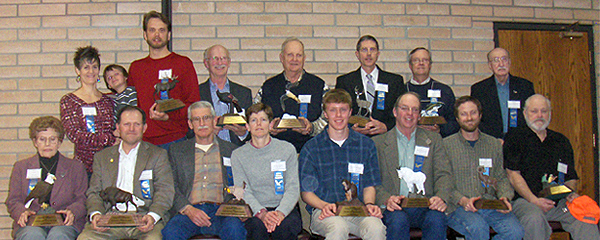
PRATT ­– The Kansas Wildlife Federation (KWF) honored 13 individuals and organizations for their conservation efforts in 2012 at the Conservation Achievement Program (CAP) Awards banquet on Feb. 23. The banquet, held in Emporia, was part of KWF’s annual meeting. Activities prior to the banquet included a social hour and silent auction. The evening concluded with a presentation by guest speaker Bob Gress, wildlife photographer and former Director of the Great Plains Nature Center.

Out of the 13 awards given, five of the recipients have been or are currently employed by the Kansas Department of Wildlife, Parks and Tourism (KDWPT):
Matt Smith, Wildlife Conservationist Award
Smith began his career with KDWPT as a district wildlife biologist in the southwest part of the state. He later moved to a similar position at Wilson where he took on the additional responsibility of serving as a Natural Resources and Conservation Service (NRCS) area biologist. Recently, Smith has been focusing on Farm Bill issues important to the welfare of Kansas wildlife and their habitat. He currently resides in Wilson.
Randy Rodgers and Helen Hands, Land and Soil Wildlife Conservationist Award
Rodgers provided years of valuable service to KDWPT as an upland bird research biologist. He researched and developed options to improve habitat on private land in conjunction with crop production. Now retired, Rodgers and Hands, his wife – also a former KDWPT biologist – are developing wildlife habitat on their private land. They currently reside in Hays.
Thayne Smith, Conservation Communicator Award
Smith served as the chief of Information and Education for the Kansas Fish and Game Commission from 1966-1970. In that capacity, he edited the Kansas Fish & Game magazine. Smith was a founding member of the Outdoor Writers of Kansas organization, which is still active today. He was also the first recipient of the Conservation Communication award in 1967. Smith currently resides in Claremore, OK.
Other 2012 award recipients include:
  • Mike Knotts, Peck, KS: Outdoor Skills Instructor Award
  • Robert Robel, Manhattan, KS: Conservationist of the Year Award
  • Stephen DeHart, Olathe, KS: Youth Conservationist Award
  • Stephen Pletcher, Emporia, KS: Conservation Educator Award
  • Kansas Grazing Lands Coalition, Hutchinson, KS: Conservation Organization Award
  • Tom Meek, Clay Center, KS: Water Conservationist Award
  • Paul and Kristan Dean, Madison, KS: Forest Conservationist Award
  • Mike Calwell, Shawnee Mission, KS: Stream Monitor Award
  • Caleb Stotts, Fredonia, KS: Farmer/Rancher Wildlife Conservationist Award
  • Ted Beringer, Lenexa, KS: President's Award
KWF, an affiliate of the National Wildlife Federation, has been dedicated to the sustainable use, conservation, appreciation, and restoration of Kansas wildlife and natural resources since 1950.

For more information on how you can support KWF, visit: www.kswildlife.org/donate.php or call (316) 214-3001.

PADDLEFISH SPAWNING SEASON OFFERS BIG ANGLING OPPORTUNITIES


Warmer temperatures give way to a special snagging season
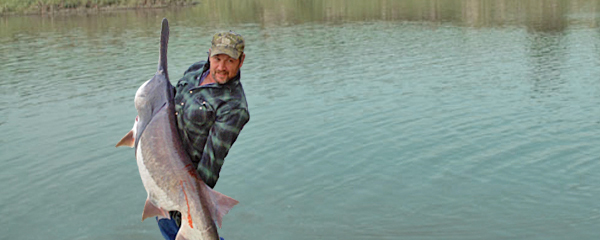
PRATT ­– A much-anticipated season for Kansas anglers draws near as paddlefish begin their annual spring spawning run. From Mar. 15-May 15, paddlefish permit-holders can snag up to six of these gentle giants from designated areas on the Neosho and Marais des Cygnes Rivers.

Paddlefish permits, which include six carcass tags, are $12.50 for anglers 16 and older, and $7.50 for youth 15 and younger.

Paddlefish may be taken inside Chetopa and Burlington city parks on the Neosho River, on the Neosho River at Iola downstream from the dam to the city limits, on the Marais des Cygnes River below Osawatomie Dam downstream to a posted boundary, and on the Marais des Cygnes River on the upstream boundary of Marais des Cygnes Wildlife Area downstream to the Kansas-Missouri border.

Paddlefish may be snagged using pole and line with not more than two single or treble hooks. Barbless hooks must be used in Chetopa City Park.

Catch and release is allowed in Burlington, Chetopa, and Iola except that once attached to a stringer, a fish becomes part of the daily creel limit. The daily creel limit for paddlefish is two, and the season limit is six. On the Missouri River (season: March 15-April 30), there is a 24-inch minimum length limit. On the Marias des Cygnes River there is a 34-inch minimum length limit.

Immediately upon harvest, anglers must sign a carcass tag, record the county, date and time of harvest, and attach the tag to the lower jaw of the paddlefish.

Paddlefish caught out of season or in non-snagging areas may be kept only if they are hooked in the mouth.

During this special season, nonsport fish (carp, drum, grass carp, threadfin and gizzard shad, goldfish, gar, suckers including carpsucker and buffalo, goldeye, and bowfin) may also be snagged in waters posted open to paddlefish snagging. There are no limits on nonsport fish.
For information, consult your 2013 Kansas Fishing Regulation Summary, or visit www.ksoutdoors.comand click “Fishing/Fishing-Regulations/Paddlefish-Snagging.”

Monday, March 11, 2013

PRACTICE MAKES PERFECT FOR HOUNDS DURING RUNNING SEASON

English: American Red Fox (Vulpes vulpes fulvu...
 (Photo credit: Wikipedia)

No-kill season allows runners and their dogs to sharpen hunting abilities

PRATT – Mar. 1, opening day of running season, marks the start of an eight-month-long race as hound enthusiasts and their dogs perfect their furbearer-chasing skills. Through Nov. 1, hunters and their dogs can chase – but not take – bobcats, opossums, raccoons, red fox and gray fox.
Hunters can run furbearers 24 hours daily during running season. A furharvester license is required for all runners.

Because no furbearer may be legally killed or taken during running season, it is illegal for runners to possess any firearms or weapons while pursuing furbearers, however certain exceptions apply.
For additional information on furbearer regulations, visit www.ksoutdoors.com and click “Hunting/Hunting-Regulations/Furbearers.”

Sunday, March 10, 2013

KDWPT ANNOUNCES FIVE-YEAR REVIEW OF STATE LISTED SPECIES


The Kansas Department of Wildlife, Parks and Tourism (KDWPT) is currently conducting the five-year review of the list of Kansas species that are threatened, endangered, or species-in-need-of-conservation (SINC). The five-year review is required by the Kansas Nongame and Endangered Species Conservation Act of 1975. Any individual or group can petition KDWPT to propose an addition, deletion, or modification to the current lists by providing pertinent scientific information required within the petition.

KDWPT relies on the Threatened and Endangered Species Task Force to assist with the review process. The task force consists of members representing various disciplines, including state and federal agencies and state universities. To determine if a full review is warranted, the task force examines updated scientific information and research for currently listed species and those proposed for listing by petition. Species experts are consulted and all available data is evaluated during the full review. After a full review is completed, the task force makes recommendations to the KDWPT Secretary and the Kansas Wildlife, Parks and Tourism Commission at a public commission meeting. These recommendations and any amendments to them are published in the Kansas Register for public comment for at least 90 days. The secretary then submits to the commission the recommended changes, if any, that should be made to the list of threatened and endangered species or SINC.

At the last five-year review in 2008, three species were added to the state threatened list (shoal chub, plains minnow, and delta hydrobe snail) and two species were removed from the list (bald eagle and peregrine falcon). The current state threatened list includes six invertebrates, 13 fish, seven amphibians, seven reptiles, two birds and one mammal. The state endangered list includes 10 invertebrates, five fish, three amphibians, four birds and two mammals. The state species-in-need-of-conservation (SINC) list includes 17 invertebrates, 31 fish, two amphibians, seven reptiles, 15 birds, and six mammals. Species on the SINC list are deemed to require conservation measures to prevent them from becoming threatened or endangered. Complete lists can be viewed on the KDWPT website,www.ksoutdoors.com. Go to Services, then click on Threatened and Endangered Wildlife.

A recent survey conducted by Responsive Management, an internationally recognized research firm specializing in natural resource and outdoor recreation issues, found that conservation of threatened and endangered wildlife remains important among Kansans. Some interesting findings include:
  • A majority of Kansas residents (91 percent) agreed that the department should continue to identify and protect habitat critical to threatened and endangered species.
  • A majority (73 percent) of residents agree with the statement, “Wildlife that is threatened and endangered in Kansas yet abundant in other states should still be protected in Kansas.”
Petitions must be received by July 31, 2013 to be considered for the current five-year review. Petition forms can be downloaded at http://www.ksoutdoors.com/news/Services/Threatened-and-Endangered-Wildlife and must be submitted to the Office of the Secretary, 1020 S. Kansas Ave., Suite 200, Topeka, KS 66612-1327.

Monday, February 25, 2013

PUBLIC INPUT SOUGHT ON DRAFT LESSER PRAIRIE CHICKEN MANAGEMENT PLAN


Anyone interested in lesser prairie chicken management encouraged to attend

PRATT – The Kansas Department of Wildlife, Parks and Tourism (KDWPT) has been working with the Lesser Prairie Chicken Interstate Working Group to produce a draft Range-wide Conservation Plan for the Lesser Prairie Chicken. The plan addresses the decline of the lesser prairie chicken in Kansas, Oklahoma, New Mexico, Texas and Colorado and is intended to benefit the wildlife resources, people, and economies of these states by providing a framework for effective lesser prairie chicken management and habitat improvement. The ultimate goal is to increase the range-wide population of lesser prairie chickens. The draft plan emphasizes incentives and tools that encourage landowners to partner with agencies in conservation efforts while achieving their land use needs.

In December, the U.S. Fish and Wildlife Service announced a proposal to list the lesser prairie chicken as a threatened species under the Endangered Species act. A final decision will be made next fall. The Interstate Working Group’s management plan could influence the USFWS’s decision if it can show that lesser prairie chicken populations can be managed at sustainable levels.

Public meetings were held in southwest Kansas in November to gain input from landowners, producers and other stakeholders as the plan was being developed. Now that a draft plan has been assembled, three additional public meetings are scheduled to continue the dialog.

March 5: WaKeeney, 7 p.m.-9 p.m., WaKeeney City Library, 610 Russell Ave.
March 6: Lakin, 7 p.m.-9 p.m., Kearny County Library, 101 E. Prairie.
March 7: Greensburg, 7 p.m.-9 p.m., Community Center (by fairgrounds), 720 N Bay.
More information about the planning process can be found at the project website: http://www.ksre.k-state.edu/p.aspx?tabid=275

Sunday, February 24, 2013

NEW CONTEST TO SHOWCASE BUDDING OUTDOOR PHOTOGRAPHERS


 The Kansas Department of Wildlife, Parks and Tourism (KDWPT) is proud to announce the 1st Wild About Kansas junior photo contest. Designed to showcase Kansas outdoors through the lens of photographers age 18 or younger, Wild About Kansas will feature winning entries in the 2014 January/February issue of Kansas Wildlife & Parks magazine.

“This is a great opportunity for area youth to explore the outdoors on a completely different level,” saidKansas Wildlife & Parks magazine associate editor, Nadia Marji. “We hope this contest will showcase some of the wonderful talent that our youth have to offer, and possibly even be the start of a new hobby for some.”

Divided into three categories, participants can submit photos related to wildlife, outdoor recreation or landscapes. Participants can submit up to three photos and multiple entries can be submitted in the same category. Photos will be judged on creativity, composition, subject matter, lighting and overall sharpness of the photo.

Prizes will be awarded to the 1st, 2nd, and 3rd place in each category, as well as one honorable mention per category.

Entries must be received by 5 p.m. on Oct. 25, 2013. An entry form must be submitted for each participant. Requested format for photos is JPEG, 8 inches by 10 inches, 300 dpi. File size should be a minimum of 1mb and not exceed 5mb.

For more information, or to submit an entry, e-mail Nadia Marji at nadia.marji@ksoutdoors.com. Enter “Junior Photo Contest” in the subject line.


Saturday, February 23, 2013

MITCHELL COUNTY GAME WARDEN RESCUES STRANDED FISHERMEN


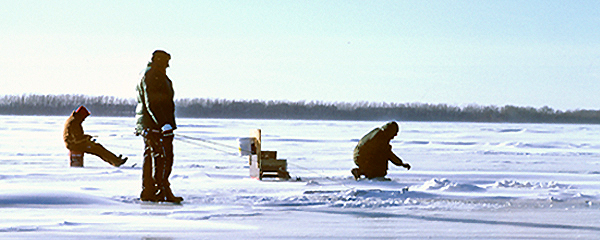
On Feb. 1, 2013, two men ice fishing for crappie and white bass in the Boller Point area on Glen Elder Reservoir found themselves in a dangerous situation when the piece of ice they were fishing on broke away from shore and headed toward the main lake. Frigid temperatures, high winds, and a lack of personal flotation devices (PFDs) put both men at risk of hypothermia and drowning. At 12:56 p.m., local goose hunter Charlie Stevens stumbled upon the two men and quickly phoned Kansas Department of Wildlife, Parks and Tourism (KDWPT) game warden Landen Cleveland for assistance.

Stevens assured Cleveland that he could launch a boat from shore, but it was going to be difficult; the only part of the lake not completely covered in ice was just northeast of the Boller Point boat ramp. Upon arrival, Cleveland was joined by Mitchell County Sheriff’s Deputy Steve Martin. Cleveland quickly provided Martin with a PFD, as well as directions on how to use rescue ropes.

“We could see these guys were in bad shape,” said Cleveland. “It’s not uncommon for us to rescue people off water, but strong winds and near-freezing temperatures made this cold-water rescue dangerous for everyone involved.”

Driving the boat upwind of where the men were stranded, Cleveland positioned the boat on top of the ice the men were on, leaving the motor in the water. Finding both men had already tied themselves together, Cleveland then threw the closest man an orange rescue disc and advised him to tie it to the rope already wrapped around his waist. As Cleveland attempted to throw the same man a PFD, the man then slipped and fell on to the ice. After several seconds of lying still, the man, seemingly uninjured, stood back up and grabbed the PFD. Cleveland then provided the second man with a PFD.

With Martin at the edge of the boat, Cleveland advised the men to walk toward the boat, staying in unison and maintaining as much distance as possible between each other for better weight distribution on the ice slab. As the first man approached the boat, Martin quickly grabbed him and pulled him aboard. The second man followed, and was also assisted on to the boat by Martin.

“I don’t think they realized the situation they were in until they were on shore,” said Cleveland. “When they looked back and saw that the piece of ice they were just on was now gone, it finally hit them that they could have died.”
Cleveland explained that wind will often send drift ice to shore. When it’s cold enough, the drift ice will refreeze, attaching itself to land. In this instance, a rise in temperature and strong winds caused waves that eventually broke the ice loose at a weak point, detaching it from shore again. Cleveland added that the men didn’t realize they were on drift ice.

Upon their arrival to shore, the two men were checked out and later discharged by Mitchell County medical personnel.

“Once the men were safely on the boat, they calmed down and realized they could breath easy,” said Cleveland. He added that one of the men even joked about not having to get wet amid the whole ordeal.

“I’m glad we got there when we did, but people can really learn a lesson from this,” said Cleveland. “It’s important that people educate themselves on their surroundings and always be cautious of the circumstances because in a split second, it can be a life or death situation.”

For information on who to call in your area in case of an emergency such as this, visit www.ksoutdoors.com and click “Services/Law Enforcement/Who do I call?”