Showing posts with label Species. Show all posts

Friday, June 14, 2013

STREAMS SURVEYS BEING CONDUCTED THROUGH AUGUST

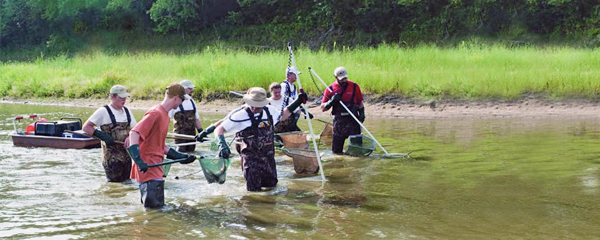
Crew members from the Kansas Department of Wildlife, Parks and Tourism
(KDWPT) Stream Survey and Assessment Program are traveling across the state this summer to collect information regarding the health of Kansas’ flowing waters. From May through August, a team of biologists, stream ecologists and numerous volunteers will visit 45 sites in nearly 20 different counties to study a vast array of aquatic life. Primary survey sites this summer include the Saline and Smoky Hill River basins.

Since 1994, KDWPT has been surveying and assessing streams to establish and maintain an inventory of the fish, mussels and other aquatic invertebrates found in Kansas’ 12 river basins. The results and samples from each site are used to help manage native aquatic communities, including threatened and endangered species and species in need of conservation.

“Native species are good indicators of the overall health and vitality of our land,” said ecologist and program coordinator Mark VanScoyoc. “The fish we catch for recreational purposes out of our reservoirs, lakes, and ponds can be raised in a hatchery and released, but this is not the case for many native stream species at this time. It’s only prudent to realize that what is good for our aquatic species is going to be good for us as well.”

For more information on this program, visit ksoutdoors.com and click “Services/Stream Assessment and Monitoring Program.”

Friday, April 5, 2013

CHICKADEE CHECKOFF SMALL GRANTS PROPOSALS BEING ACCEPTED

Department of Wildlife, Parks, and Tourism (KDWPT) is accepting proposals for the Chickadee Checkoff Small Grants Program through April 15. The program, which is funded by donations, aids individuals and organizations in carrying out projects focused on native nongame wildlife species, while addressing the issues and strategies within the Kansas Comprehensive Wildlife Conservation Plan “A Future for Kansas Wildlife”.

For the past 33 years, the Chickadee Checkoff Small Grants Program has funded education, research, habitat, and the monitoring of nongame wildlife and their habitats. From the creation of the top 20 birds of Cheyenne Bottoms identification cards, to evaluating the habitat characteristics surrounding prairie chicken leks in northwest Kansas, the small grants program funnels donations to projects that benefit species in greatest need of conservation.

The diverse projects completed have resulted in numerous publications in scientific journals, educational products, and most importantly, new information on native nongame wildlife species and their habitats.

Grant proposals must be turned in by April 15, 2013.

For more information, including eligibility requirements, how and where to submit proposals, and the priority projects list for 2013, download the grant guidance document, or visit www.ksoutdoors.com.

Sunday, March 10, 2013

KDWPT ANNOUNCES FIVE-YEAR REVIEW OF STATE LISTED SPECIES


The Kansas Department of Wildlife, Parks and Tourism (KDWPT) is currently conducting the five-year review of the list of Kansas species that are threatened, endangered, or species-in-need-of-conservation (SINC). The five-year review is required by the Kansas Nongame and Endangered Species Conservation Act of 1975. Any individual or group can petition KDWPT to propose an addition, deletion, or modification to the current lists by providing pertinent scientific information required within the petition.

KDWPT relies on the Threatened and Endangered Species Task Force to assist with the review process. The task force consists of members representing various disciplines, including state and federal agencies and state universities. To determine if a full review is warranted, the task force examines updated scientific information and research for currently listed species and those proposed for listing by petition. Species experts are consulted and all available data is evaluated during the full review. After a full review is completed, the task force makes recommendations to the KDWPT Secretary and the Kansas Wildlife, Parks and Tourism Commission at a public commission meeting. These recommendations and any amendments to them are published in the Kansas Register for public comment for at least 90 days. The secretary then submits to the commission the recommended changes, if any, that should be made to the list of threatened and endangered species or SINC.

At the last five-year review in 2008, three species were added to the state threatened list (shoal chub, plains minnow, and delta hydrobe snail) and two species were removed from the list (bald eagle and peregrine falcon). The current state threatened list includes six invertebrates, 13 fish, seven amphibians, seven reptiles, two birds and one mammal. The state endangered list includes 10 invertebrates, five fish, three amphibians, four birds and two mammals. The state species-in-need-of-conservation (SINC) list includes 17 invertebrates, 31 fish, two amphibians, seven reptiles, 15 birds, and six mammals. Species on the SINC list are deemed to require conservation measures to prevent them from becoming threatened or endangered. Complete lists can be viewed on the KDWPT website,www.ksoutdoors.com. Go to Services, then click on Threatened and Endangered Wildlife.

A recent survey conducted by Responsive Management, an internationally recognized research firm specializing in natural resource and outdoor recreation issues, found that conservation of threatened and endangered wildlife remains important among Kansans. Some interesting findings include:
  • A majority of Kansas residents (91 percent) agreed that the department should continue to identify and protect habitat critical to threatened and endangered species.
  • A majority (73 percent) of residents agree with the statement, “Wildlife that is threatened and endangered in Kansas yet abundant in other states should still be protected in Kansas.”
Petitions must be received by July 31, 2013 to be considered for the current five-year review. Petition forms can be downloaded at http://www.ksoutdoors.com/news/Services/Threatened-and-Endangered-Wildlife and must be submitted to the Office of the Secretary, 1020 S. Kansas Ave., Suite 200, Topeka, KS 66612-1327.

Saturday, February 18, 2012

ASIAN CARP CAUGHT IN AUGUSTA CITY LAKE

Asian Carp in the Wabash River
Asian Carp in the Wabash River (Photo credit: LouisvilleUSACE)

Strange-looking fish puzzles anglers
AUGUSTA — On Jan. 25, anglers were taking advantage of a fish salvage order as Augusta City Lake was being drained for renovation. During a fish salvage, anglers can take sportfish with equipment not ordinarily allowed, such as seines, snagging rigs, bow and arrow, and gigs. Most of the prizes hauled in were large flathead catfish, but one angler snagged a fish estimated to weigh about 55 pounds that no one could identify. Officials with the Kansas Department of Wildlife, Parks and Tourism (KDWPT) became involved with the catch when a picture of the fish appeared on local television. It was immediately identified as an aquatic nuisance species (ANS), an Asian carp.
“This report supports our long-standing recommendation that fish should not be moved between waters,” said Jason Goeckler, KDWPT aquatic nuisance specialist. “Here is a case of a lake with Asian carp that we didn't even know about.”
Asian carp were imported to the U.S. in the 1970s for aquaculture purposes but escaped into Midwestern rivers and streams. Previously, they had been found only in the Kansas, Missouri, Big Blue, and Wakarusa rivers and Browning Oxbow Lake in northeastern Kansas. Officials believe that the fish was released into Augusta City Lake or waters above the lake.
Two species of Asian carp have been discovered in Kansas — bighead and silver carp. Both species have scaleless heads, and silver carp may grow to more than 60 pounds and as long as 4 feet. This fish, however, was a bighead carp, which may grow to more than 100 pounds. Both species have low-set eyes and a large upturned mouth without barbels (“whiskers”).
Asian carp directly compete with other fish for food resources, grow quickly, and feed voraciously. They can consume 40 percent of their body weight each day. Silver carp pose physical danger to boaters because of their leaping ability. Anyone boating in silver carp-infested waters should be aware that these large fish may jump into their boat.
Shortly after news reports of the Augusta City Lake Asian carp, KDWPT began receiving calls and emails.
“We want to thank the public for sending in reports,” Goeckler said. “Unfortunately we did not hear about this discovery prior to press-time. But the big news is that we received countless emails, calls, and online reports from the public. They shared our concern about the discovery, and their reports help us monitor these species.”
Anyone who catches an Asian carp should not release the fish back into any body of water. Anglers who catch Asian carp somewhere other than the Kansas, Missouri, Big Blue, and Wakarusa rivers should freeze the fish in a sealed plastic bag, note the date and location, and call the KDWPT Emporia Research Office at 620-342-0658 or emailjason.goeckler@ksoutdoors.com.

Monday, September 26, 2011

STATE ASKING FOR INPUT ON SPECIES IN NEED OF CONSERVATION

The Greenish Warbler demonstrates the concept ...Image via Wikipedia
Comprehensive Wildlife Conservation Plan under review
PRATT — The Kansas Comprehensive Wildlife Conservation Plan was prepared in 2005 as a requirement for the Kansas Department of Wildlife, Parks and Tourism (KDWPT) to be eligible to continue receiving State Wildlife Grants (SWG). Scheduled to be updated before its 10-year anniversary, efforts are currently underway for this revision.

The first element of this revision was updating the native species list in July. The next step is soliciting recommended changes to the list of Species of Greatest Conservation Need (SGCN), including suggestions that any species already on that list be taken off.

Also, an important new element of this revision will be the identification of priority areas for actions. By identifying priority Conservation Opportunity Areas, SWG funds may be most effectively applied to the most pressing issues and SGCN species. After nominations have been received, they will be considered for listing as SGCN species, or taken off.

The state of Kansas has received about $9 million in SWG funds since 2000. This plan revision and update will be finalized in 2013. Anyone interested in this process is welcome to provide input. Go online to tinyurl.com/cwcprevision to see the schedule and first actions as part of this revision.

With the help of many experts, KDWPT staff have updated the native species list. Within this listing, categories for the names, as well as whether a species is recognized as a state threatened (T), endangered (E), or an extirpated or extinct (x) species may be viewed. Also, the SGCN species are identified as yes (Y) or no (N) in the last column. A nomination form may also be found at this site.

FAMILY-OUTDOORS

Thursday, June 2, 2011

STATE WILDLIFE GRANT PROCESS UNDER REVIEW

Guidelines focus on species in greatest need of conservation; public input deadline July 1
PRATT — The State Wildlife Grants (SWG) program has provided funding for wildlife conservation programs for more than 10 years. In Kansas, this has meant nearly $10 million for many kinds of projects designed to keep species off threatened and endangered lists. Notable projects funded through this program include the Prairie Window Project by Dyck Arboretum at Hesston, which helped landowners restore and maintain native prairies; the compilation of a substantial amount of new information on the status and distributions of sensitive species; and a project that assessed natural areas of northeast Kansas.

The use of these funds has been guided by the Kansas Comprehensive Wildlife Conservation Plan (CWCP), entitled "A Future for Kansas Wildlife.” Found on the Kansas Department of Wildlife and Parks (KDWP) website, www.kdwp.state.ks.us (Other Services/Kansas CWCP/Kansas CWCP), this plan was approved in 2005 as a requirement before Kansas could obtain and apply additional SWG funds. Now KDWP is in the process of revising this dynamic plan, with the revision scheduled for completion in 2013.

The first step in this process is a review of the basic native species list. This is the list of all vertebrate species as well as many invertebrate animals to be considered for potential changes on the Species of Greatest Conservation Need (SGCN) list. There are currently 316 species on this list, and this plan update will consider all needed changes — those to be added to the list, deleted from it, or name changes according to the latest information.

“A Future for Kansas Wildlife” on the KDWP website also includes Appendix II, which describes the process by which any native species will be evaluated for possible listing as a SGCN. Top ranked species on this list are given priority in projects funded through the SWG program. This an opportunity for the public to look over the native species list and recommend any needed changes. Find the list under “Kansas CWCP Updates and Revisions” under “Other Services,” as well as further instructions for this process.

July 1 is the deadline for recommending changes to the Native Species List. Then work will begin on re-evaluating the Species of Greatest Conservation Need. Use the contact portal on the website to submit any recommendations.

For more information, contact Ken Brunson at 620-672-0792 or email him atken.brunson@ksoutdoors.com .

Enhanced by Zemanta