Showing posts with label Neosho River. Show all posts

Tuesday, March 12, 2013

PADDLEFISH SPAWNING SEASON OFFERS BIG ANGLING OPPORTUNITIES


Warmer temperatures give way to a special snagging season
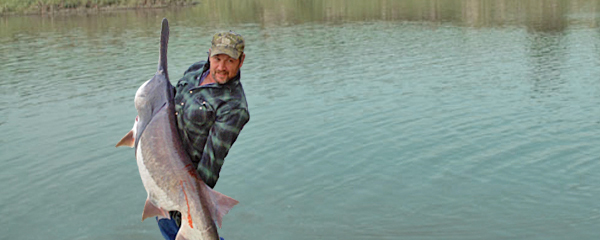
PRATT ­– A much-anticipated season for Kansas anglers draws near as paddlefish begin their annual spring spawning run. From Mar. 15-May 15, paddlefish permit-holders can snag up to six of these gentle giants from designated areas on the Neosho and Marais des Cygnes Rivers.

Paddlefish permits, which include six carcass tags, are $12.50 for anglers 16 and older, and $7.50 for youth 15 and younger.

Paddlefish may be taken inside Chetopa and Burlington city parks on the Neosho River, on the Neosho River at Iola downstream from the dam to the city limits, on the Marais des Cygnes River below Osawatomie Dam downstream to a posted boundary, and on the Marais des Cygnes River on the upstream boundary of Marais des Cygnes Wildlife Area downstream to the Kansas-Missouri border.

Paddlefish may be snagged using pole and line with not more than two single or treble hooks. Barbless hooks must be used in Chetopa City Park.

Catch and release is allowed in Burlington, Chetopa, and Iola except that once attached to a stringer, a fish becomes part of the daily creel limit. The daily creel limit for paddlefish is two, and the season limit is six. On the Missouri River (season: March 15-April 30), there is a 24-inch minimum length limit. On the Marias des Cygnes River there is a 34-inch minimum length limit.

Immediately upon harvest, anglers must sign a carcass tag, record the county, date and time of harvest, and attach the tag to the lower jaw of the paddlefish.

Paddlefish caught out of season or in non-snagging areas may be kept only if they are hooked in the mouth.

During this special season, nonsport fish (carp, drum, grass carp, threadfin and gizzard shad, goldfish, gar, suckers including carpsucker and buffalo, goldeye, and bowfin) may also be snagged in waters posted open to paddlefish snagging. There are no limits on nonsport fish.
For information, consult your 2013 Kansas Fishing Regulation Summary, or visit www.ksoutdoors.comand click “Fishing/Fishing-Regulations/Paddlefish-Snagging.”

Wednesday, July 25, 2012

ZEBRA MUSSELS CONFIRMED IN COFFEY COUNTY LAKE

Zebra Mussel From a USA government website tha...
Zebra Mussel
EMPORIA – Officials with the Kansas Department of Wildlife, Parks and Tourism and the Wolf Creek Generating Station announced Friday that zebra mussels have been found in Coffey County Lake. Officials knew it was a matter of time before zebra mussels appeared in the lake near Burlington because the aquatic nuisance species (ANS) had been detected in Marion Reservoir three years ago. The Cottonwood River flows from Marion Reservoir into the Neosho River, which then fills John Redmond Reservoir. Coffey County Lake, which is the cooling lake for Kansas’ only nuclear power plant, gets its water from John Redmond. The larval stage of zebra mussels, called veligers, are microscopic and free-floating in water. Transmission downstream from an established population is the only method of spreading zebra mussels that is inevitable.


Wolf Creek officials were prepared for this event and have implemented procedures and equipment to ensure that zebra mussels won’t interfere with the generating station’s operations.


Zebra mussels are small, bi-valve mollusks with striped shells. They are native to the Black and Caspian seas of Western Asia and Eastern Europe and have been spread across the world via shipping. They were discovered in Lake St. Clair and the Detroit River in 1988. Zebra mussels quickly spread through out the Great Lakes and to many inland rivers including the Mississippi, Illinois, Ohio, Tennessee, Arkansas and Hudson. They first appeared in Kansas in 2003 when they were discovered in El Dorado Reservoir. Public education programs were designed to inform boaters about the dangers of zebra mussels in our waters and ways to prevent spreading them. However, zebra mussels have been confirmed in more the a dozen Kansas lakes in the past nine years. Moving water in boats and bait buckets was identified as a likely vector and recently, KDWPT established stringent regulations regarding the use of wild-caught bait, as well as prohibiting the movement of live fish from lakes where zebra mussels have been found.


Although related, zebra mussels differ from our native mussels in several important categories. Perhaps the most important is their ability to produce very large populations in a short time. Unlike native mussels, zebra mussels do not require a host fish to reproduce. A large female zebra mussel is capable of producing 1 million eggs during the reproductive season. Once fertilized, eggs develop into microscopic veligers. These veligers cannot be seen by the naked eye and can be contained by the thousands in very small quantities of water. Veligers passively float within the water for up to two weeks before they settle out as young mussels. These young mussels quickly grow to adult size and reproduce during their first summer of life, thus adding to the problem of extremely dense populations.


After settling, zebra mussels develop byssal threads that allow the shells to attach to hard surfaces such as rocks, piers, and flooded timber. They also attach themselves to pipes, water intake structures, boat hulls, propellers, and lower units of out board motors. As populations continue to increase in these areas, they can clog intake pipes and prevent water treatment plants and electrical generating plants from drawing water. In 2012, two Kansas communities, Council Grove and Osage City, experienced water shortages because of zebra mussel infestations before water intake structures could be cleaned up. Removing large quantities of zebra mussels to ensure adequate water supplies can be labor-intensive and costly.


Zebra mussels are just one of the non-native aquatic species that threaten our waters and native wildlife. Boaters and anglers are reminded to follow basic precautions to stop the spread:

• Clean, drain and dry boats and equipment between uses

• Wild-caught bait may only be used in the lake or pool where it was caught

• Live fish may not be moved from waters infested with zebra mussels or other aquatic nuisance species

• Livewells and bilges must be drained and drain plugs removed from all vessels prior to transport from any Kansas water on a public highway

Monday, March 12, 2012

PADDLEFISH SNAGGING SEASON OPENS MARCH 15


PADDLEFISH SNAGGING SEASON OPENS MARCH 15
March 8, 2012
Anglers should be aware of rules, areas open; season runs through May 15
PRATT — Many anglers in eastern Kansas look forward to March 15, when the Kansas paddlefish season opens, running through May 15 at specific locations. Once water temperatures near 60 degrees, paddlefish make the annual spawning run. Some snagging areas, such as the Neosho River in Chetopa, require a rise in the river level for paddlefish to be present, so significant rainfall is essential.
Paddlefish may be taken inside Chetopa and Burlington city parks on the Neosho River, on the Neosho River at Iola downstream from the dam to the city limits, on the Marais des Cygnes River below Osawatomie Dam downstream to a posted boundary, and on the Marais des Cygnes River on the upstream boundary of Marais des Cygnes Wildlife Area downstream to the Kansas-Missouri border.
Paddlefish may be snagged using pole and line with not more than two single or treble hooks. Barbless hooks must be used in Chetopa City Park. Catch and release is allowed in Burlington, Chetopa, and Iola except that once attached to a stringer, a fish becomes part of the daily creel limit. The daily creel limit for paddlefish is two, and the season limit is six. On the Missouri River (season: March 15-April 30), there is a 24-inch minimum length limit. There is a 34-inch minimum length limit on Marias des Cygnes River.
A paddlefish permit — $12.50 for those 16 and older, $7.50 for youth 15 and younger — includes six carcass tags. Immediately upon attaching a fish to a stringer, the angler must sign a carcass tag; record the county, date, and time of harvest; and attach the carcass tag to the lower jaw of the paddlefish taken. Anglers must stop snagging once the daily creel limit of two paddlefish is reached.
Paddlefish caught outside the paddlefish season or in non-snagging areas may be kept if they are hooked in the mouth only.
Nonsport fish (carp, drum, grass carp, threadfin and gizzard shad, goldfish, gar, suckers including carpsucker and buffalo, goldeye, and bowfin) may also be snagged in waters posted open to snagging during the paddlefish season. There are no limits on nonsport fish.

Wednesday, January 5, 2011

CORPS OF ENGINEERS TO LOWER JOHN REDMOND RESERVOIR

Search for drowning victim prompts lowering of lake level
TULSA — The U.S. Army Corps of Engineers has announced that the lake level at John Redmond Reservoir is being lowered approximately 2 feet below normal conservation pool level to help facilitate recovery efforts of a drowning victim missing since Dec. 4, 2010. Current releases are 5,000 cubic feet per second, and the drawdown is expected to be completed by late Jan. 5 or early Thursday, Jan 6.
Increased flows downstream of the dam will cause Neosho River levels to rise quickly. Recreational users of the lake should also be aware because lower than normal lake elevations may expose boating hazards around the lake that may have been submerged with normal water elevations. Boaters are urged to use caution while launching boats and while on the lake.
For more information about current lake levels, visit the Water Control Data System or the daily report link under the Lakes and River Information section of the Corps of Engineers Tulsa District website, www.swt.usace.army.mil.
Enhanced by Zemanta