Showing posts with label Conservation and Endangered Species. Show all posts

Thursday, November 14, 2013

KANSAS WILDLIFE FEDERATION SEEKS AWARD NOMINATIONS

2013 Conservation Achievement Award winners will be recognized at the February banquet in Salina

PRATT – Many conservation projects around the state would never happen without the dedicated men and women who work tirelessly each day to contribute their time, skills and expertise. The Kansas Wildlife Federation (KWF) believes these contributions, however large or small, should be recognized. If you know someone who has made exceptional contributions to wildlife and natural resource conservation this past year, KWF would like to hear about them. Nominate your favorite conservationist for a Conservation Achievement Program (CAP) award.
CAP award categories include Land and Soil Conservation, Youth Conservationist, Conservation Communicator, Conservation Educator, Wildlife Conservationist, Water Conservationist, Conservation Legislator, Conservation Farmer/Rancher, Forestry Conservationist, Stream Team Conservationist, Outdoor Skills Instructor, Conservation Organization, and Conservationist of the Year.
Nominations can be made by e-mailing your contact information along with the nominee’s contact information, and a 2,000-word explanation of why this individual should be recognized to drrkidd@gmail.com. Nominations must be received by December 10. Winners of these prestigious awards will be recognized at the 2014 CAP Banquet in Salina,Feb. 22, 2014.

Tuesday, March 12, 2013

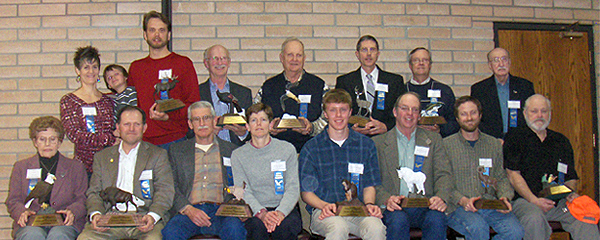
KANSAS WILDLIFE FEDERATION RECOGNIZES 13 CONSERVATIONISTS AT ANNUAL BANQUET


Local group acknowledges individual achievements in conservation
PRATT ­– The Kansas Wildlife Federation (KWF) honored 13 individuals and organizations for their conservation efforts in 2012 at the Conservation Achievement Program (CAP) Awards banquet on Feb. 23. The banquet, held in Emporia, was part of KWF’s annual meeting. Activities prior to the banquet included a social hour and silent auction. The evening concluded with a presentation by guest speaker Bob Gress, wildlife photographer and former Director of the Great Plains Nature Center.

Out of the 13 awards given, five of the recipients have been or are currently employed by the Kansas Department of Wildlife, Parks and Tourism (KDWPT):
Matt Smith, Wildlife Conservationist Award
Smith began his career with KDWPT as a district wildlife biologist in the southwest part of the state. He later moved to a similar position at Wilson where he took on the additional responsibility of serving as a Natural Resources and Conservation Service (NRCS) area biologist. Recently, Smith has been focusing on Farm Bill issues important to the welfare of Kansas wildlife and their habitat. He currently resides in Wilson.
Randy Rodgers and Helen Hands, Land and Soil Wildlife Conservationist Award
Rodgers provided years of valuable service to KDWPT as an upland bird research biologist. He researched and developed options to improve habitat on private land in conjunction with crop production. Now retired, Rodgers and Hands, his wife – also a former KDWPT biologist – are developing wildlife habitat on their private land. They currently reside in Hays.
Thayne Smith, Conservation Communicator Award
Smith served as the chief of Information and Education for the Kansas Fish and Game Commission from 1966-1970. In that capacity, he edited the Kansas Fish & Game magazine. Smith was a founding member of the Outdoor Writers of Kansas organization, which is still active today. He was also the first recipient of the Conservation Communication award in 1967. Smith currently resides in Claremore, OK.
Other 2012 award recipients include:
  • Mike Knotts, Peck, KS: Outdoor Skills Instructor Award
  • Robert Robel, Manhattan, KS: Conservationist of the Year Award
  • Stephen DeHart, Olathe, KS: Youth Conservationist Award
  • Stephen Pletcher, Emporia, KS: Conservation Educator Award
  • Kansas Grazing Lands Coalition, Hutchinson, KS: Conservation Organization Award
  • Tom Meek, Clay Center, KS: Water Conservationist Award
  • Paul and Kristan Dean, Madison, KS: Forest Conservationist Award
  • Mike Calwell, Shawnee Mission, KS: Stream Monitor Award
  • Caleb Stotts, Fredonia, KS: Farmer/Rancher Wildlife Conservationist Award
  • Ted Beringer, Lenexa, KS: President's Award
KWF, an affiliate of the National Wildlife Federation, has been dedicated to the sustainable use, conservation, appreciation, and restoration of Kansas wildlife and natural resources since 1950.

For more information on how you can support KWF, visit: www.kswildlife.org/donate.php or call (316) 214-3001.

Friday, November 11, 2011

WILDLIFE FEDERATION WANTS AWARD NOMINEES

List of invasive species in the Mid-Atlantic r...Image via Wikipedia
Conservation Achievement Award deadline Dec. 1
PRATT — The Kansas Wildlife Federation’s (KWF) Conservation Achievement Program (CAP) recognizes Kansans who have devoted themselves to conserving the state's natural resources. Whether through education, communication, or on-ground habitat work, such dedicated people are eligible for CAP awards. KWF is asking conservation-minded citizens to nominate candidates who have worked for wildlife conservation.
Each year, KWF honors people who have made special efforts in the areas of land and soil conservation, youth conservation, conservation communication, conservation education, wildlife conservation, water conservation, conservation legislator, conservation farmer/rancher, forestry conservation, stream team conservation, outdoor skills, conservation organization, and conservationist of the year.
Nominations are due by Dec. 1. For more information, phone 316-648-8827 or email info@kswildlife.org.

Monday, September 26, 2011

STATE ASKING FOR INPUT ON SPECIES IN NEED OF CONSERVATION

The Greenish Warbler demonstrates the concept ...Image via Wikipedia
Comprehensive Wildlife Conservation Plan under review
PRATT — The Kansas Comprehensive Wildlife Conservation Plan was prepared in 2005 as a requirement for the Kansas Department of Wildlife, Parks and Tourism (KDWPT) to be eligible to continue receiving State Wildlife Grants (SWG). Scheduled to be updated before its 10-year anniversary, efforts are currently underway for this revision.

The first element of this revision was updating the native species list in July. The next step is soliciting recommended changes to the list of Species of Greatest Conservation Need (SGCN), including suggestions that any species already on that list be taken off.

Also, an important new element of this revision will be the identification of priority areas for actions. By identifying priority Conservation Opportunity Areas, SWG funds may be most effectively applied to the most pressing issues and SGCN species. After nominations have been received, they will be considered for listing as SGCN species, or taken off.

The state of Kansas has received about $9 million in SWG funds since 2000. This plan revision and update will be finalized in 2013. Anyone interested in this process is welcome to provide input. Go online to tinyurl.com/cwcprevision to see the schedule and first actions as part of this revision.

With the help of many experts, KDWPT staff have updated the native species list. Within this listing, categories for the names, as well as whether a species is recognized as a state threatened (T), endangered (E), or an extirpated or extinct (x) species may be viewed. Also, the SGCN species are identified as yes (Y) or no (N) in the last column. A nomination form may also be found at this site.

FAMILY-OUTDOORS

Thursday, June 2, 2011

STATE WILDLIFE GRANT PROCESS UNDER REVIEW

Guidelines focus on species in greatest need of conservation; public input deadline July 1
PRATT — The State Wildlife Grants (SWG) program has provided funding for wildlife conservation programs for more than 10 years. In Kansas, this has meant nearly $10 million for many kinds of projects designed to keep species off threatened and endangered lists. Notable projects funded through this program include the Prairie Window Project by Dyck Arboretum at Hesston, which helped landowners restore and maintain native prairies; the compilation of a substantial amount of new information on the status and distributions of sensitive species; and a project that assessed natural areas of northeast Kansas.

The use of these funds has been guided by the Kansas Comprehensive Wildlife Conservation Plan (CWCP), entitled "A Future for Kansas Wildlife.” Found on the Kansas Department of Wildlife and Parks (KDWP) website, www.kdwp.state.ks.us (Other Services/Kansas CWCP/Kansas CWCP), this plan was approved in 2005 as a requirement before Kansas could obtain and apply additional SWG funds. Now KDWP is in the process of revising this dynamic plan, with the revision scheduled for completion in 2013.

The first step in this process is a review of the basic native species list. This is the list of all vertebrate species as well as many invertebrate animals to be considered for potential changes on the Species of Greatest Conservation Need (SGCN) list. There are currently 316 species on this list, and this plan update will consider all needed changes — those to be added to the list, deleted from it, or name changes according to the latest information.

“A Future for Kansas Wildlife” on the KDWP website also includes Appendix II, which describes the process by which any native species will be evaluated for possible listing as a SGCN. Top ranked species on this list are given priority in projects funded through the SWG program. This an opportunity for the public to look over the native species list and recommend any needed changes. Find the list under “Kansas CWCP Updates and Revisions” under “Other Services,” as well as further instructions for this process.

July 1 is the deadline for recommending changes to the Native Species List. Then work will begin on re-evaluating the Species of Greatest Conservation Need. Use the contact portal on the website to submit any recommendations.

For more information, contact Ken Brunson at 620-672-0792 or email him atken.brunson@ksoutdoors.com .

Enhanced by Zemanta

Saturday, May 14, 2011

APPLICATIONS OPEN FOR PRIVATE LAND GRANT PROGRAM

Lesser scaup pair from USFWS Source: WV9145-00...Image via Wikipedia

State Wildlife Grant Private Land Program provides technical and financial assistance to enhance wildlife habitat on private land; deadline June 30


PRATT — The Kansas Department of Wildlife and Parks (KDWP) has announced that applications for participation in the State Wildlife Grant (SWG) Private Land Program are now being accepted. SWG grants are funded in part by the U.S. Fish and Wildlife Service, Department of Interior (program CFDA # 15.634), and administered in Kansas by KDWP.
This is the fourth signup for this project, and KDWP may distribute $98,615 (from an original $400,000 of SWG funds), plus an additional $49,307 in non-federal funds to private landowners interested in implementing habitat projects. With the addition of private funding for the project, it is anticipated that nearly $200,000 will be available for funding during this application period. Those landowners receiving funding will be required to match a minimum of 25 percent of total project costs. This match can either be a cash contribution from a non-federal source or contributions of labor, materials, and equipment use. Applications will be accepted until June 30.
Previously, the program has awarded $301,385 of SWG funds to 33 private landowners. Projects funded include removing invasive woody plants from native mixed-grass prairie, prescribed burning, conversion of cool season grass to native grass, installation of alternate watering facilities to help with native short-grass prairie management, and construction of perimeter fencing on expiring CRP fields to help maintain those fields in native grass. These projects will improve more than 11,192 acres of habitat for Species of Greatest Conservation Need in Kansas.
To be eligible, applications must address issues and strategies identified in the Kansas Comprehensive Wildlife Conservation Plan. Applications will be scored based on established criteria to ensure all applicants are considered fairly and that the best projects are selected. Higher priority consideration will be given to proposals that specifically address restoration and enhancement activities that contribute to 1) development or maintenance of large grassland blocks capable of supporting area-sensitive wildlife species, 2) restoration or maintenance of areas supporting high densities of playa lakes surrounded by grasslands, and 3) restoration or enhancement of streams and associated riparian buffers.
Interested landowners should contact any KDWP regional office or private lands biologist for application materials or to schedule a consultation concerning a proposed project. For information regarding program administration, write Roger Wolfe, KDWP Region 2 Office, 300 SW Wanamaker Road, Topeka, Kansas 66606 or phone 785-273-6740. Persons with special communication needs may utilize the Kansas Relay Center, 1-800-766-3777.


Enhanced by Zemanta

Wednesday, January 12, 2011

LANDOWNERS: STATE WILDLIFE GRANTS NOW BEING ACCEPTED

Kansas Historical Marker at Big Basin Prairie ...Image via Wikipedia
Program provides technical assistance and financial incentives to enhance wildlife habitat on private land in Kansas; March 31 deadline
PRATT — Kansas Department of Wildlife and Parks (KDWP) officials have announced the State Wildlife Grant (SWG) Private Landowner Program has, to date, awarded $235,444 of SWG funds to 22 private landowners. Projects funded include removing invasive woody plants from native mixed-grass prairie, constructing alternate watering facilities to help with native short-grass prairie management, and construction of perimeter fencing on expiring CRP fields to help maintain those fields in native grass. These projects will improve more than 5,000 acres of habitat for “species of greatest conservation need” (SGCN) in Kansas.
KDWP originally received $400,000 of SWG funds from the U.S. Fish and Wildlife Service to aid in the protection and management of priority habitats for SGCN, so applications are still being accepted, with a deadline of March 31. This is the third sign-up for this project during which KDWP may distribute the remaining $164,556 from the original $400,000 of SWG funds and an additional $83,000 in non-federal funds to private landowners interested in implementing habitat projects.
Those landowners receiving funding will be required to match a minimum of 25 percent of total project costs. This match can either be a cash contribution from a non-federal source or contributions of labor, materials, or equipment use.
Applications will be accepted until available funds have been committed.
To be eligible, applications must address issues and strategies identified in the Kansas Comprehensive Wildlife Conservation Plan, found on the KDWP website,www.kdwp.state.ks.us, under “Other Services/Kansas CWCP/Kansas CWCP.” Applications will be scored based on established criteria to ensure all applicants are considered fairly and that the highest ranking projects are selected. Higher priority consideration will be given to proposals that specifically address restoration and enhancement activities that will contribute to the development or maintenance of large grassland blocks capable of supporting area-sensitive wildlife species, the restoration or maintenance of areas supporting high densities of playa lakes surrounded by grasslands, and the restoration or enhancement of streams and associated riparian buffers.
Interested landowners should contact any KDWP regional office or private lands biologist for application materials or to schedule a consultation concerning a proposed project. Questions regarding program administration can be addressed to Roger Wolfe, KDWP Region 2 Office, 300 SW Wanamaker Road, Topeka, KS 66606, or by phoning 785-271-7388. Persons with special communication needs may use the Kansas Relay Center, 1-800-766-3777.

Enhanced by Zemanta