Showing posts with label Waterfowl hunting. Show all posts

Monday, August 31, 2015

Wildlife, Parks and Tourism Commission Approves Duck and Goose Seasons

Great Bend–The Kansas Wildlife, Parks and Tourism Commission approved the duck and goose seasons at a Public Hearing, conducted Thursday, August 20 at the Kansas Wetland Education Center, Great Bend. Following frameworks provided by the U.S. Fish and Wildlife Service, the following seasons and bag limits were approved.
DUCK SEASONS
High Plains Duck Zone (see duck zone map at www.ksoutdoors.com)
           Oct. 10, 2015-Jan. 4, 2016 and Jan. 23-31, 2016
            Youth season: Oct 3-4, 2015
Low Plains Early Zone
           Oct. 10-Dec. 6, 2015 and Dec. 19, 2015-Jan. 3, 2016
            Youth season: Oct. 3-4, 2015
Low Plains Late Zone
           Oct. 31, 2015-Jan. 3, 2016 and Jan. 23-31, 2016
            Youth season: Oct. 24-25, 2015
Low Plains Southeast Zone
           Nov. 14, 2015-Jan. 3, 2016 and Jan. 9-31, 2016
            Youth season: Nov. 7-8, 2015
Duck daily bag limit: Six ducks, which may include no more than five mallards (no more than two which may be hens), three scaup, three wood ducks, two redheads, two pintails and two canvasbacks.
Canada Geese
           Oct. 31-Nov. 1, 2015 and Nov. 4, 2015-Feb. 14, 2016
Canada goose daily bag limit (including brant): Six
White-fronted Geese
           Oct. 31, 2015-Jan. 3, 2016 and Jan. 23-Feb. 14, 2016
White-fronted goose daily bag limit: Two
Light Geese
           Oct. 31-Nov. 1, 2015 and Nov. 4, 2015-Feb. 14, 2016
(Light goose Conservation Order: Feb. 15-April 30, 2016)
Light goose daily bag limit (including snow and Ross’ geese): 50
(No daily bag limit during the Conservation Order)
All waterfowl hunters 16 and older must have a Federal Duck Stamp, and all hunters required to have a hunting license must also have a Kansas Waterfowl Habitat Permit and Kansas Harvest Information Program permit.

Friday, October 24, 2014

SO MANY SEASONS, SO LITTLE NOVEMBER

November marks the beginning of several hunting seasons in Kansas
PRATT – For most people, Christmas comes on Dec. 25, but for hunters and anglers, the best gifts arrive one month earlier. November marks the start of four hunting and fishing seasons that are a must-do in the Sunflower State, and if you’ve never partaken in these fall festivities, you may want to reconsider your plans this upcoming month.
TROUT FISHING: NOV. 1 - APRIL 15
From Nov. 1, 2014-April 15, 2015, anglers can enjoy some of the best fishing opportunities in the state as nearly 30 public fishing areas will be stocked periodically with this special species.
Special permits apply, so consult the 2014 Fishing Regulations Summary for complete details on your favorite waters.
To view a complete trout stocking schedule for a specific location, visit ksoutdoors.com and click “Fishing /Special Fishing Programs for You / Trout Fishing Program.”
GOOSE HUNTING
If wild turkeys aren’t your idea of a hardy holiday bird, consider bagging a goose this season. Hunters can pursue geese during the following seasons:
Canada Geese
Season: Nov. 1-9, 2014 AND Nov. 12, 2014-Feb. 15, 2015
Daily bag limit: 6 (including Brant). Possession limit: 18.
White-Fronted Geese
  • Season: Nov. 1-Dec. 14, 2014 AND Jan. 17-Feb. 15, 2015
  • Daily bag limit: 2. Possession limit: 6.
Light Geese
  • Season: Nov. 1-9, 2014 AND Nov. 12, 2014-Feb. 15, 2015
  • Daily bag limit: 50. No possession limit.
PHEASANT AND QUAIL SEASON
Recent rains leading to increased brood-rearing habitat across the state have several areas harboring more birds this year. Consider taking a peek at the 2014 Upland Bird Forecast on ksoutdoors.com to locate your next hunting honey pot.
Pheasant
  • Regular Season: November 8, 2014 - January 31, 2015
  • Youth Season: November 1-2, 2014
  • Daily Bag Limit: 4 cocks in regular season, 2 cocks in youth season.
  • NOTE: Pheasants in possession for transportation must retain intact a foot, plumage, or some part that will determine sex.
Quail
  • Regular Season: November 8, 2014 - January 31, 2015
  • Youth Season: November 1-2, 2014
    • Daily Bag Limit: 8 in regular season, 4 in youth season.
SANDHILL CRANES
Although not as widely sought-after as geese and ducks, sandhill cranes are a challenging quarry to hunt. Consider experiencing this unique season this year.
  • Season: Nov. 5 2014-Jan 1, 2015
  • Daily bag limit: 3. Possession limit: 9.
All sandhill crane hunters must take an online crane identification test each year before obtaining the required federal permit to hunt. The test can be found by visiting ksoutdoors.com and clicking “Hunting / Migratory Birds/ Sandhill Crane.”
Quivira and Kirwin National Wildlife Refuge are closed to crane hunting.

Saturday, August 30, 2014

WILDLIFE, PARKS AND TOURISM COMMISSION SETS WATERFOWL SEASONS

2014 duck and goose seasons set by Wildlife, Parks and Tourism Commission
GREAT BEND – On Thursday, August 21, the Kansas Wildlife, Parks and Tourism Commission heard 2014 duck and goose season recommendations, considered public comment and approved the following seasons.
DUCKS
High Plains Duck Zone: Oct. 11-Dec. 8, 2014 and Dec. 20, 2014-Jan. 25, 2015.
Low Plains Early Duck Zone: Oct. 11-Dec. 7, 2014 and Dec. 20, 2014-Jan. 4, 2015.
Low Plains Late Duck Zone: Nov. 1, 2014-Jan. 4, 2015 and Jan. 17-25, 2015.
Low Plains Southeast Duck Zone: Nov. 8-9, 2014 AND Nov. 15, 2014-Jan. 25, 2015.
Daily bag limit for ducks is six with the following species and sex restrictions: no more than five mallards, of which only two may be hens; three scaup; three wood ducks; two redheads; two pintails; and one canvasback. Possession limit is three times the daily bag limit. 
GEESE
Canada geese: Nov. 1-9, 2014 and Nov. 12, 2014-Feb. 15, 2015.
Daily bag limit on Canada geese is six; possession limit is 18.
Light Geese: Nov. 1-9, 2014 and Nov. 12, 2014-Feb. 15, 2015
Daily bag limit on light geese is 50 with no possession limit.
White-fronted geese: Nov. 1-Dec. 14, 2014 and Jan. 17-Feb. 15, 2015.
Daily bag limit for white-fronted geese is two and possession limit is six.
In other business, the Commission also approved a regulation allowing dogs on hand-held leashes to be used to trail dead or wounded big game animals.
The next commission meeting is scheduled for October 16, 2014 at Martinelli’s Restaurant Meeting Room, 158 S Santa Fe Ave., Salina.

Friday, October 25, 2013

MIGRATING WATERFOWL BRING FLOCKS OF HUNTING OPPORTUNITIES

Daily bag limits increased for dark and light geese for 2013 seasons

PRATT – “More is better” isn’t always true in a lot of instances, but for waterfowl hunters this season, “more” is a beautiful thing. New regulations now allow hunters to harvest greater quantities of waterfowl than ever before, increasing Canada geese bag limits from three to six birds, and light geese bag limits from 20 to 50 birds. Possession limits on all migratory birds was increased from two times the daily bag limit to three times the daily bag limit. The daily bag limit for ducks remained at six, but the number of scaup that may be included in the daily limit was reduced from three to two.

Oct. 26, 2013 is a big day for waterfowl hunters, marking the opening day of goose season, the first day of the Low Plains Late Zone season for ducks, and the first day of youth season in the Low Plains Southeast Zone. White-fronted geese may be hunted Oct. 26-Dec. 29, 2013 and Feb. 1-Feb. 9, 2014. The daily bag limit for white-fronted geese is two birds, and possession limit is six. Canada geese and light geese may be hunted Oct. 26-Nov. 3, 2013 AND Nov. 6-Feb. 9, 2014.The daily bag limit on Canada geese is six, possession limit is 18. The daily bag limit on light geese is 50, and there is no possession limit. The Low Plains Late Zone for ducks will run Oct. 26-Dec. 29, AND Jan. 18-Jan. 26, 2014. Following the Low Plains Late Zone, waterfowl hunters in the Low Plains Southeast Zone may hunt Nov. 2-3, 2013 AND Nov. 16, 2013-Jan. 26, 2014. Youth season the Low Plains Southeast Zone will run Oct. 26-27, 2013.

The daily bag limit for ducks is six, which may include no more than five mallards, of which only two may be hens; two redheads; three wood ducks; three scaup; two pintails; and two canvasbacks.

Following regular goose seasons, hunters may hunt light geese during a special conservation period Feb 10-April 30, 2014. During the Light Goose Conservation Order there is no bag or possession limit. In addition, hunters will be allowed to use unplugged shotguns and electronic calls and take light geese from one-half hour before sunrise to one-half hour after sunset during the period of the conservation order.

Although not as widely sought-after as geese and ducks, sandhill cranes may be hunted from Nov. 6 2013-Jan 2, 2014 with a valid federal permit. All sandhill crane hunters must take an online crane identification test each year before obtaining a permit. The test can be found by visiting ksoutdoors.com and clicking “Hunting / Migratory Birds / Sandhill Crane.” The daily bag limit on sandhill cranes is three birds, with a possession limit of nine. Quivira and Kirwin National Wildlife Refuge are closed to crane hunting.

For more information on migratory bird regulations, visit ksoutdoors.com.

Wednesday, August 28, 2013

TEAL SEASON KICKS OFF SEPT. 7

Teal may be the smallest duck, but they are a fast and challenging quarry for waterfowl hunters
PRATT ­– It’s waders and whistles, it’s the sound of the marsh waking up, it’s what Sept. 7, waterfowl hunters will be waiting.
thousands of hunters around the state have been waiting for – it‘s teal season. An early migrant, teal are the first waterfowl to pass through Kansas each fall, and come
Using U.S. Highway 283 as a dividing line, Kansas is split up into two teal hunting zones: Low Plains and High Plains. The Low Plains Zone (anything east of U.S. Highway 283) will kick off the season Sept. 7, and run through Sept. 22, while the High Plains Zone (anything west of U.S. Highway 283) will open Sept. 14 and end Sept. 22.
As if recent rains filling the marshes weren’t enough of a bonus for early season waterfowl hunters, regulations now allow hunters to take six of these puddle ducks in a daily bag limit, a two-bird increase from the traditional early teal season daily bag of four. Also new this year, migratory bird possession limits have increased to three times the daily bag limit.
All hunters participating in teal season who are required to have a hunting license must also possess a Kansas HIP permit and State Waterfowl Permit. All hunters 16 and older must have a Federal Waterfowl Stamp. Hunters age 65-74 are reminded that they now need the state HIP permit and State Waterfowl Permit, in addition to the Federal Waterfowl Stamp. Kansas HIP permits and State Waterfowl Stamps can be purchased online at ksoutdoors.com, and Federal Waterfowl Stamps can be purchased at your local U.S. Post Office and Kansas Department of Wildlife, Parks, and Tourism regional offices.
For more information on migratory bird regulations, visit ksoutdoors.com and click “Hunting / Migratory Birds.”

Saturday, August 24, 2013

2013 HUNTING ATLAS NOW AVAILABLE ONLINE

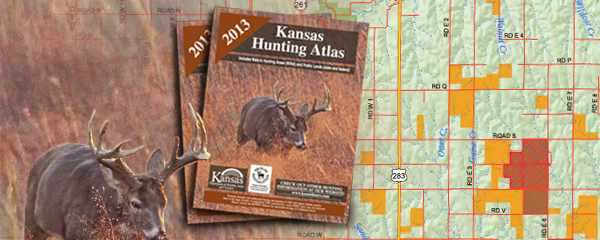
Atlas features 60 detailed maps with more than 1 million acres of prime hunting locations

PRATT – With maps showing the location of more than 1 million acres of land open to hunting, the 2013 Kansas Hunting Atlas, available online now, is a must-have for hunters. Whether you’re looking for the perfect duck hunting marsh, scouting for land rich with upland birds, or scanning woodlots for the perfect place to set up your tree stand, Kansas Department of Wildlife, Parks and Tourism’s hunting atlas is the perfect tool Better than ever, the newly-redesigned hunting atlas features maps with shaded relief backdrops, county road names (where available), stream names, and much more. All state, federal and Walk-in Hunting Access areas are shown, color-coded for ease of use.
The atlas also features 2013 season dates and an outline of new regulations, making it quick and easy for hunters to get up-to-speed on important changes.
To view the atlas online, visit ksoutdoors.com and click “Hunting,” then “Where to Hunt,” then then “2013 Fall Hunting Atlas.” Hunters can also download an electronic version of the atlas from the KDWPT website, and file downloads that can be loaded onto Garmin GPS units. There are also file downloads for Android and iOS devices that can be used with Google Earth. The 2013 Hunting and Furharvesting Regulations Summary is also available on the KDWPT website. Printed versions of both pamphlets will be distributed in early September.

Sunday, August 11, 2013

2013 DUCK AND GOOSE SEASONS SET

English: crop of File:Bgforhunting.jpg Taken b...

Goose daily bag limits increased; possession limits for ducks and geese increased
YATES CENTER – The Kansas Wildlife, Parks and Tourism Commission listened to department staff recommendations and comments from waterfowl hunters before approving the 2013 duck and goose seasons during a public hearing held in Yates Center on August 1. Summer breeding bird surveys show most species well above long-term averages, and with good to excellent nesting habitat conditions, the U.S. Fish and Wildlife Service (USFWS) provided liberal season frameworks. Waterfowl hunters may be surprised to learn that the daily bag limit for teal during the early teal season was increased from four to six, the daily bag limit for Canada geese was increased from 3 to 6 and the daily bag limit for light geese was increased from 20 to 50. Possession limits for ducks and geese were increased from twice the daily bag limit to three times the daily bag limit. The Commission approved the following waterfowl hunting seasons:
High Plains Duck Zone: Oct. 5-Dec. 2, 2013 AND Dec. 21, 2013-Jan. 26, 2014Youth: Sept. 28-29, 2013
Low Plains Early Duck Zone: Oct. 5-Dec. 1, 2013 AND Dec. 21, 2013-Jan. 5, 2014. Youth: Sept. 28-29, 2013
Low Plains Late Zone: Oct. 26-Dec. 29, 2013 AND Jan. 18-Jan. 26, 2014. Youth: Oct. 19-20, 2013
Low Plains Southeast Zone: Nov. 2-3, 2013 AND Nov. 16, 2013-Jan. 26, 2014. Youth: Oct. 26-27, 2013
Duck bag limit: Six ducks, including no more than 5 mallards, of which only 2 may be hens; 2 redheads; 3 wood ducks; 3 scaup; 2 pintails; and 2 canvasbacks. Possession limit is three times the daily bag limit.
White-fronted geese: Oct. 26-Dec. 29, 2013 AND Feb. 1-Feb. 9, 2014. Daily bag limit: 2. Possession limit is 6.
Canada geese: Oct. 26-Nov. 3, 2013 and Nov. 6, 2013-Feb. 9, 2014. Daily bag limit on Canada geese: 6. Possession limit: 18.
Light geese: Oct. 26-Nov. 3, 2013 and Nov. 6, 2013-Feb. 9, 2014. Daily bag limit: 50. No limit on possession
Light Goose Conservation Order: Feb 10-April 30, 2014. No bag or possession limit.
To view a map of duck zones and to see all 2013 hunting seasons go to www.ksoutdoors.com, click on “Hunting” then “When to Hunt.”

Saturday, August 10, 2013

DUCK BREEDING POPULATION ESTIMATES SHOW PROMISING NUMBERS

While just below last year’s record numbers, 2013 duck populations are still well above long-term averages

PRATT­– Duck populations are strong, according to the U.S. Fish and Wildlife Service (USFWS) 2013 Report on Trends in Duck Breeding Populations. The preliminary estimate of total duck populations from the traditional survey area (northcentral United States, southcentral and northern Canada, and Alaska) is 45.6 million birds­– a six percent decrease from last year’s estimate of 48.6 million birds, but a 33 percent increase from the long-term average. In addition to estimating duck populations, the survey also examines habitat conditions.
Habitat conditions during the 2013 survey were generally improved or similar to last year due to above-average precipitation, despite a delayed spring throughout most of the traditional survey area. Most of the Canadian portions of the traditional survey area were rated as good to excellent, in contrast to 2012 when drier conditions existed across northern Alberta and Saskatchewan. Although the U.S. prairies received record snowfall in April, habitat conditions were still rated only fair to poor, similar to last year. The total pond estimate (prairie Canada and the north-central United States combined) is 6.9 million, 24 percent higher than the 2012 estimate of 5.5 million ponds and 35 percent above the long-term average.
In the eastern survey area – eastern Ontario, Quebec, the Maritime Provinces and Maine – estimated mallard abundance is 500,000 birds. Habitat conditions across most of the eastern survey area generally were good with the exception of Maine and the southern Maritimes, which were rated only as fair.
The report also notes:
  • Estimated mallard abundance is 10.4 million birds, similar to the 2012 estimate of 10.6 million birds and 36 percent above the long-term average.
  • Blue-winged teal estimated abundance is 7.7 million. Although this is 16 percent below the 2012 estimate of 9.2 million, the blue-wing population is 60 percent above the long-term average. Similarly, the green-winged teal estimate of 3.1 million is 12 percent below last year, but still 51 percent above the long-term average.
  • The northern pintail estimate of 3.3 million is similar to the 2012 estimate of 3.5 million and 17 percent below the long-term average.
  • Estimated abundance of American wigeon is 2.6 million and 23 percent above the 2012 estimate and similar to the long-term average.
  • The combined lesser and greater scaup estimate of 4.2 million decreased 20 percent from last year and is 17 percent below the long-term average of 5 million.
  • The canvasback estimate of 787,000 is similar to the 2012 estimate and 37 percent above the long-term average.
The surveys are conducted by the USFWS and Canadian Wildlife Services’ Waterfowl Breeding Population and Habitat Survey, sampling more than 2 million square miles of waterfowl habitat across Alaska, the northcentral and northeastern United States and southcentral, eastern and northern Canada.
The information guides the USFWS waterfowl conservation programs under authority of the 1918 Migratory Bird Treaty Act. The USFWS then works in partnership with state biologists from the four flyways – the Atlantic, Mississippi, Central and Pacific – to establish regulatory frameworks for waterfowl hunting season lengths, dates and bag limits. 2013 Kansas duck hunting season dates and bag limits will be approved at the Aug. 1 commission meeting in Yates Center.
For more information about the U.S. Fish and Wildlife Service 2013 Report on Trends in Duck Breeding Populations, visitwww.fws.gov/migratorybirds.
For more information on Kansas waterfowl hunting, visit ksoutdoors.com and click “Hunting/Migratory Birds/Ducks.”

Tuesday, August 28, 2012

KWPT Commission Approves Duck and Goose Seasons

English: Canada Geese landing on water
 (Photo credit: Wikipedia)

Low Plains Southeast Zone duck season to open Nov. 15
GREAT BEND – The Kansas Wildlife, Parks and Tourism Commission approved season dates for the 2012-2013 duck and goose seasons at a public hearing conducted at the Kansas Wetlands Education Center near Great Bend on Aug. 23. Duck seasons are as follows: High Plains Unit – Oct. 6-Dec. 30 and Jan. 19-27, 2013; Low Plains Early Zone – Oct. 6-Dec. 2 and Dec. 15-30, 2012; Low Plains Late Zone – Oct. 27-Dec. 30 and Jan. 19-27, 2013; Low Plains Southeast Zone – Nov. 15, 2012-Jan. 27, 2013.

The 2012-2013 goose seasons are as follows: White-fronted geese – Oct. 27-Dec. 30 and Feb. 2-10, 2013; Canada and brant geese – Oct. 27-Nov. 4 and Nov. 7, 2012-Feb. 10, 2013; Light geese (Ross’ and snow) – Oct. 27-Nov. 4 and Nov. 7, 2012-Feb. 10, 2013; Light geese conservation order – Feb. 11-April 30, 2013.
Shooting hours for duck and goose hunting are one-half hour before sunrise to sunset. The daily bag limit for ducks is 6 ducks with species and sex restrictions as follows: 5 mallards (only 2 of which may be hens), 3 wood ducks, 2 pintails, 2 redheads and 1 canvasback. Daily bag limit for mergansers is 5 (only 2 of which may be hooded). Daily bag limit for coots is 15. Daily bag limits for geese are as follows: 3 Canada geese, 2 white-fronted geese, and 20 light geese. Possession limit for ducks and geese is twice the daily bag limit, except there is no possession limit for light geese. During the conservation order for light geese, there is no daily bag or possession limit.

Special youth waterfowl seasons allow youth 15 and younger to hunt under the supervision of an adult 18 years old or older. The adult may not hunt. Shooting hours and bag limits are the same as during the regular duck and goose seasons. Youth seasons are as follows: High Plains Unit and Low Plains Early Zone – Sept. 29-30; Low Plains Late Zone – Oct. 20-21; and Low Plains Southeast Zone – Nov. 3-4.

The Commission also approved changes to the falconry regulations, which bring Kansas state regulations in compliance with federal requirements and allows falconers to operate under a state-managed system with federal oversight.

Changes were approved to rehabilitation permit regulations as a result of changes in the falconry regulations related to the possession requirements for treatment of injured animals.
The Kansas Wildlife, Parks and Tourism Commission will meet next on October 18 at Flint Oak, Fall River.

Wednesday, February 22, 2012

MARAIS DES CYGNES WILDLIFE AREA HAS BANNER YEAR

English: crop of File:Bgforhunting.jpg Taken b...
Image via Wikipedia

Record duck harvest recorded despite dry year
PLEASANTON — Marais des Cygnes Wildlife Area, near the Missouri border in Linn County, reported a record breaking-year for waterfowl hunters in the 2011-2012 season. Duck hunters reported harvesting more than 8,300 ducks during the 74-day season, shattering the old record of 6,220 in 1997. Duck hunters made 5,160 trips to the wildlife area, bagging an average of 1.6 ducks per hunter trip.
“The hunter success rate we had in the 2011-2012 season is particularly remarkable when one considers the hot, dry summer we had,” says area manager Karl Karrow. “Marsh vegetation that provides habitat for ducks does not produce well under the conditions we had during last year’s growing season, so we used additional management tools — notably pumping water to irrigate marsh plants during the summer — to provide good habitat. And relatively mild weather this winter didn’t freeze the wetlands. That was a huge factor.”
Nearly 70 percent of ducks harvested were mallards, a species prized by hunters. Green-winged teal were a distant second, comprising only 10 percent of ducks harvested.
“While this is great news for hunters,” Karrow adds, “this is also important to communities near the wildlife area. Most duck hunters come from outside of the local area, and traveling hunters spend money on gas, food, and other supplies at local stores. We saw hunters from North Carolina, Alabama, Iowa, and other states. Any activity that brings more than 5,000 visitors to the area helps the local economy.”
In addition to the regular duck season, early teal season and goose seasons provide opportunities for waterfowl hunters on Marais des Cygnes Wildlife Area. For more information, phone Karrow at 913-352-8941, or visit KDWPT’s website,ksoutdoors.com, and click on “Hunting/Where To Hunt In Kansas.”

Thursday, January 19, 2012

JANUARY AND FEBRUARY OFFER GREAT HUNTING OPPORTUNITIES

English: crop of File:Bgforhunting.jpg Taken b...
Image via Wikipedia

Excellent waterfowl, small game, upland game, more await winter hunters
PRATT — Sometimes the best things are saved for last. This winter, make it so with a late-season Kansas hunt. For those hunters still in pursuit of upland birds, the last two weeks of the season can be very productive. Cold weather often bunches birds together and makes them hold tighter while competition for hunting spots is light. And although waterfowl seasons have been open for more than two months, there’s still time for good duck and goose hunting.
Quail, pheasant, prairie chicken (Northwest and East units only), and fall turkey seasons are open through Jan. 31, and rabbit and squirrel seasons provide additional opportunities for the avid hunter.
In most areas, crops have been cut, concentrating birds in draws and thick grass, such as CRP. Late-migrating geese and ducks, especially mallards, are often abundant where open water can be found. And as hunting pressure eases, private landowners are often more receptive to hunters looking for new places to pursue game.
Heavy pressure can make public hunting areas less desirable than private land in early seasons, but public areas may provide better hunting in late season. Wildlife management practices on public lands usually provide excellent cover and food supplies, making them good late-season options as hunting pressure decreases.
Hunters looking for a place to stay can rent one of more than 100 cabins at state parks and wildlife areas across the state. Most cabins are open year-round and provide a range of amenities, many with full bathrooms and kitchens. Click "Cabin Reservations" in the upper right-hand corner of the Kansas Department of Wildlife, Parks and Tourism (KDWPT) website,www.kdwpt.state.ks.us, for more information.
Those seasons still open or opening soon include the following:
  • ducks High Plains Zone (west of U.S. 283) — Jan. 21-29;
  • ducks Low Plains Late Zone — Jan. 21-29;
  • ducks Low Plains Southeast Zone — Jan. 21-29;
  • Canada geese (including Brant) — through Feb. 12;
  • white-fronted geese — Feb. 4-12;
  • light geese — through Feb. 12;
  • Light Goose Conservation Order — Feb. 13-April 30;
  • pheasant and quail — through Jan. 31;
  • prairie chicken (Northwest and East units) — through Jan. 31;
  • fall turkey — through Jan. 31;
  • exotic dove (Eurasian collared and ringed turtle) — through Feb. 28;
  • squirrel — through Feb. 29;
  • rabbit — year-round;
  • extended archery antlerless only whitetail deer (management Unit 19 only) — through Jan. 31;
  • coyote — year-round;
  • furbearer hunting and trapping — through Feb. 15; and
  • beaver trapping — through March 31.
For detailed information, consult the Kansas Hunting & Furharvesting Regulations Summary, available at most license vendors, KDWPT offices, or online at www.kdwpt.state.ks.us.

Friday, December 16, 2011

DUCK SEASON CORRECTION

A duck hunter with three mallards. A Labrador ...
Image via Wikipedia

Low Plains Late Zone and Low Plains Southeast Zone dates incorrect in news release
PRATT — In a Kansas Department of Wildlife, Parks and Tourism news release dated Dec. 15, 2011, an article entitled “HUNTING CHRISTMAS BREAK” lists dates of hunting seasons currently open or which will be open in December and January. Under the listing for duck hunting, dates for the Low Plains Late Zone and Low Plains Southeast Zone are reversed.
Duck hunting dates for these zones should read as follow:
  • ducks, Low Plains Late Zone — Oct. 29-Jan. 1, 2012 and Jan. 21-29, 2012; and
  • ducks, Low Plains Southeast Zone — Nov. 5-Jan. 8, 2012 and Jan. 21-29, 2012.