Showing posts with label Flint Hills. Show all posts

Thursday, July 7, 2016

Conservation Easements Conserve Flint Hills Vistas, Wildlife

TOPEKA – The Nature Conservancy of Kansas (TNC) has protected 3,285 acres of Flint Hills tallgrass native prairie with a conservation easement in Chase and Lyon counties. The landowners, Bill and Maggie Haw of Shawnee Mission, are firm believers in conservation easements, having previously donated to TNC easements on other land they own and manage in the Flint Hills. This recent easement brings their total land protection contribution to more than 17,000 acres, including 16 scenic miles of highway frontage along the Kansas Turnpike (I-35) and the Flint Hills National Scenic Byway (K-177).
Tallgrass prairie is the most altered major habitat type in North America in terms of acres lost. Yet, in Kansas, a significant swath of tallgrass prairie – the Flint Hills –remains intact. TNC views conservation easements as a golden opportunity to help landowners conserve this intact and fully functioning tallgrass prairie ecosystem.
A conservation easement is a legally recorded agreement between the granting landowner and a land trust. The agreement permanently restricts uses of the property that would damage its conservation values. Conservation easements do not interfere with traditional uses of the land, such as grazing and prescribed fire, but it may restrict incompatible activities, including many types of development. Public access is generally not required by a conservation easement, and, like all other easement provisions, it must be agreed to by the landowner. An eased property may be sold, transferred or inherited, and the easement conditions transfer to each subsequent landowner.
“By placing these acres under the protection of a conservation easement, the property’s ranching legacy, as well as its economic and ecological integrity, will endure,” said Brian Obermeyer, director of the TNC’s Flint Hills Initiative.
“Maggie and I are committed to the idea of preserving not only the pristine views but also the wonderful cattle culture of this area where generations of same-family cowboy caretakers have learned to operate the best yearling grazing operations in the world,” said Bill Haw. “It is the perfect convergence of an important food-producing activity that maintains the ecosystem, which developed with bison grazing over thousands of years. The Nature Conservancy is the perfect partner to recognize and enforce those two compatible goals for many generations to come.”
The recent Haw easement takes TNC over the 100,000-acres-preserved mark in Kansas.
For more information about The Nature Conservancy and conservation easements, contact Shelby Stacy at sstacy@tnc.org or (785) 233-4400.

Tuesday, July 28, 2015

Kansas Native Plant Society to Host 2015 Annual Wildflower Weekend

LAWRENCE – Wildflower enthusiasts from across Kansas are encouraged to meet in Manhattan on September 25-27 for the Kansas Native Plant Society’s 37th Annual Wildflower Weekend (AWW). Those attending the three-day event will enjoy opportunities to explore and learn about the native plants in the northern Flint Hills.

Six unique sites will be visited, including the Konza Prairie and Tuttle Creek Lake, and attendees will also have the opportunity to hear from guest speakers Kelly Roccaforte and Shelly Wiggam, doctoral candidates at Kansas State University, as they discuss their prairie pollinator research projects.

The annual meeting, speaker presentations, awards ceremony, and silent auction will take place Saturday evening.

For more details on this event, and to register, visit www.kansasnativeplantsociety.org/annual_event.php

Sunday, September 21, 2014

2014 KANSAS UPLAND BIRD HUNTING FORECAST NOW AVAILABLE

2014 Upland bird forecast shows improvements in pheasant, quail, prairie chicken populations
PRATT – A copy of the 2014 Kansas Upland Bird Forecast is now available and from the looks of things, upland bird hunters will see improved populations this fall. Although below-average harvests areksoutdoors.com and click “Hunting,” then “Upland Birds.”
expected this year, hunters should see more birds and have more opportunities than the 2013 season. To view the entire forecast, visit
PHEASANT
After three consecutive years of statewide declines, spring breeding populations for pheasant stabilized in 2014. The only region showing a significant decrease was the Northern High Plains. Summer brood counts show an increase of 70 percent when compared to 2013. This increase should offer improved hunting opportunities, and the best hunting this year will likely be in the Smoky Hills region. Kansas still contains one of the best pheasant populations among states and the fall harvest will again be among the best in the country; however, Kansas will again have a below-average pheasant harvest this fall.
Regular Season: Nov. 8, 2014 - January 31, 2015; Youth Season: November 1-2, 2014. Daily Bag Limit: 4 cocks in regular season, 2 cocks in youth season.
QUAIL
Roadside surveys for quail showed a statewide increase of 50 percent compared to 2013. However, statewide populations are still below historic averages, and Kansas will likely have a below-average quail harvest this fall. Populations in much of the central and western portions of the state have not fully recovered from the drought. While opportunities will be better throughout most of the state this year, the best opportunities will likely remain in the eastern third of the state, particularly in the Flint Hills region.
Regular Season: November 8, 2014 - January 31, 2015; Youth Season: November 1-2, 2014. Daily Bag Limit: 8 in regular season, 4 in youth season.
PRAIRIE CHICKEN
Prairie chicken populations are generally up where the appropriate habitat exists. Hunting opportunities should be improved throughout the greater prairie chicken hunting unit; however, the best opportunities this fall will be in the Smoky Hills Region.
Early Season (Greater Prairie Chicken Unit): Sept. 15 - Oct. 15, 2014; Regular Season (Greater Prairie Chicken Unit): Nov. 15, 2014 - Jan. 31, 2015. Daily Bag Limit: 2. Southwest Unit closed to all prairie chicken hunting.
To view the complete forecast, including detailed regional information, visit ksoutdoors.com and click “Hunting / Upland Birds.”

Sunday, March 2, 2014

YOUTH HUNTERS WANTED FOR MELVERN SPRING TURKEY HUNT

Melvern Wildlife Area to host 2nd Annual Spring Turkey Hunt for youth
READING – The thundering gobble of a turkey in its roost, the spit and drum of a strutting tom, and the sight of a long-beard in full fan are experiences that fuel the passion in Kansas
turkey hunters. However, for many Kansas youth, the journey to becoming a turkey hunter has yet to begin.
A perfect start to the journey could be the Second Annual Spring Turkey Hunt at Melvern Wildlife Area. In an effort to share the spring turkey hunting experience with youngsters age 11-16, the Kansas Department of Wildlife, Parks and Tourism, in cooperation with Flint Hills Gobblers Chapter of the National Wild Turkey Federation (NWTF), will host the hunt on Saturday, April 5.
Designed to show beginning turkey hunters how exciting and fun spring turkey hunting is, this event will involve participants not only in the hunt, but also in its preparation. Young hunters will be provided an opportunity to pattern their shotgun, learn about turkeys and turkey hunting, and scout hunting locations the evening before the hunt.
The morning of the hunt, breakfast will be provided courtesy of the NWTF Flint Hills Gobblers chapter before youth will be guided to nearby public and private land where encounters with these magnificent game birds are likely. Program volunteers will arrange transportation to hunting sites and will be available to assist in the hunt. 
Interested parties can apply by March 12 by contacting Melvern Wildlife Area Assistant Manager Clint Bowman at (620) 699-3372. Spots are limited, so early registration is encouraged.

Saturday, February 8, 2014

NEW KANSAS OUTDOOR, TRAVEL GUIDES AVAILABLE

Planning a Kansas excursion is easy with print, online tools
TOPEKA – The 2014 edition of “Kansas Outdoors,” the official guide to the Sunflower State’s outdoor destinations and experiences is now available. Published by the Kansas Department of Wildlife, Parks and Tourism (KDWPT), “Kansas Outdoors” is crammed with 57 pages of
stunning photographs and brief descriptions of a variety of outdoor opportunities, such as camping, hiking, hunting, fishing, wildlife watching, boating, biking and Kansas Byway driving. For the truly adventurous, there is information on skydiving, endurance biking and kayaking. The guide also lists a large number of activities, events and places to experience.
The “2014 Kansas Travel Guide” features more than 130 pages of stunning photography; brief stories about a variety of Kansas destinations, activities and events along with hundreds of listings for things to see and do and places to stay or eat. Subscribers to Kansas! magazine will find the travel guide bundled with their magazine.  
“Kansas Outdoors” and the “2014 Kansas Travel Guide” are perfect companions to KDWPT’s two websites – TravelKS.com and KSOutdoors.com, so the right tool to help adventurers explore the state is within easy reach.
TravelKS.com is a one-stop-shop for travelers. Aptly titled, “There’s No Place Like Kansas,” visitors can use the site to plan their trip, learn about a variety of activities, events, dining and lodging options, subscribe toKansas!magazine and locate places to buy Kansas products. Special deals and coupons are even available for a number of destinations and dining, shopping and lodging locations. TravelKS.com also features information devoted to the Flint Hills, Kansas Byways, Agritourism and the Kansas River National Water Trail. Kansas travel industry professionals can use TravelKS.com to reach a wide audience.
KSOutdoors.com offers a “boat load” of helpful content for the outdoor enthusiast, including important information on hunting, fishing, boating, the state parks and purchasing licenses and permits.     
“Kansas Outdoors” and “Kansas Travel Guide” are free, and a free official Kansas travel map is included with all orders. To request a guide, visit TravelKS.com and click on the Travel Guide photo at the top of the page, or call 1-800-2Kansas or email tourism@travelks.com

Friday, November 15, 2013

PRAIRIE CHICKEN SEASON UNIQUE HUNTING OPPORTUNITY

Kansas harbors highest prairie chicken population in world
PRATT – What may be the most unique upland bird hunting opportunity in North America begins on
the third Saturday in November. The 2013 regular prairie chicken season opens Nov. 16 and runs through Jan. 31, 2014 in the Northwest and East units. It endsDec. 31, 2013 in the Southwest Unit. Kansas is home to lesser and greater prairie chickens, both iconic prairie grouse species of our Midwest grasslands.
In Kansas, the more numerous greater prairie chicken inhabits the tallgrass prairie of the Flint Hills, in east-central Kansas, and mixed grass prairies of the Smoky Hills, in northcentral and northwest Kansas. Less than 4 percent of the 400,000 square miles of tallgrass prairie that once covered North America still remain, and two-thirds of that is in the Kansas region known as the Flint Hills. This region in east-central Kansas still provides large, unbroken expanses of tallgrass prairie, thanks to the stewardship of private cattle ranchers, and a shallow layer of chert, or flint, that protects it from the plow.
The more rare lesser prairie chicken inhabits the shortgrass prairies of southwest Kansas. Because of habitat loss and population declines in four other states where lesser prairie chickens exist (Colorado, New Mexico, Oklahoma and Texas), Kansas is the only state where lesser prairie chickens can be hunted. In fact, the U.S. Fish and Wildlife Service (USFWS) will announce next spring whether or not the lesser prairie chicken will be added to the Threatened and Endangered Species List. To address habitat losses, wildlife agencies in the five states formed a working group that collaborated with the Western Association of Fish and Wildlife Agencies to develop a comprehensive management plan. State biologists hope the plan will dissuade the USFWS from listing the lesser prairie chicken, allowing state agencies to implement a variety of private land habitat enhancement programs designed to benefit lesser chickens.
Hunting lesser prairie chickens in Kansas has no impact on the population, and provides a truly unique upland bird hunting opportunity. The daily bag limit in the Southwest Unit is one prairie chicken per day with a possession limit of four.
Daily bag limit in the Northwest and East units is two prairie chickens per day, and the possession limit is eight. Most prairie chickens taken during the regular season are taken by pass shooting. Hunters position themselves along the edges of feed fields in the early morning or late evening hours and wait for chickens to fly in from the grasslands. Success depends on prior scouting, patience and luck. It also requires shooting skill because prairie chickens fly deceptively fast, especially with any type of tailwind.
In addition to a hunting license, unless exempt, prairie chicken hunters are required to have a $2.50 Prairie Chicken Permit. The special permit allows KDWPT to gain valuable management information from hunters who pursue prairie chickens.
The Smoky Hills region is expected to hold some of the highest densities and greatest hunting opportunities in the state for greater prairie chickens. Hunters may also find success in the Flint Hills, where reduced burning allowed for more residual grass cover for nesting compared to most years. For more details, view the 2013 Upland Bird Forecast atksoutdoors.com.

Friday, November 8, 2013

KANSAS PHEASANT AND QUAIL SEASONS GENERATE EXCITEMENT

Hunters return each fall to reconnect with land, friends, family and hunting traditions
PRATT – The Kansas pheasant and quail seasons openSaturday, Nov. 9, 2013-Jan. 31, 2014and you can bet avid bird hunters will be in the field. It’s a time-honored tradition where spending time with
friends and family, renewing acquaintances with landowners, and experiencing the Kansas countryside becomes more important than the number of birds bagged.
While the extended severe drought was broken this summer in many parts of the state, rains came too late to have significant impacts on pheasant nesting and brood survival success. The forecast for most of the traditional pheasant regions in Kansas predicts below average bird numbers. Rains have improved habitat conditions in many areas, and if the trend continues, nesting and brood habitat will be much better this spring.
There are pockets with decent pheasant numbers in the northcentral and northwestern regions of Kansas. Hunters will have to work to find birds, and they may have to travel within the regions to locate these pockets.
Quail populations in eastern Kansas have improved and some of the best quail hunting will be found in the Flint Hills and southeast regions of the state.
For more details on the pheasant, quail and prairie chicken forecast for 2013, go to www.ksoutdoors.com. A copy of the2013 Kansas Hunting and Furharvesting Regulations Summary and the 2013 Kansas Hunting Atlas can be downloaded, as well. Printed publications are available wherever licenses are sold. More than 1 million acres are enrolled in the Walk-In Hunting Access (WIHA) program, and the atlas includes maps showing all WIHA tracts, as well as all state and federal public hunting lands.
Pheasant and quail hunters should remember that they must have permission to hunt private land, whether that land is posted or not. Land marked with purple paint requires written permission from the landowner. All resident hunters age 16-74 must have a Kansas resident hunting license, and all hunters born on or after July 1, 1957 must have completed an approved hunter education course. Youth 15 and younger may hunt without hunter education as long as they are under the direct supervision of an adult. Hunters 16 and older may purchase an apprentice license that is a one-time purchase and allows them to hunt without hunter education while also under adult supervision. A resident hunting license is $20.50. A resident youth multi-year license, valid from age 16-21, is available for $42.50. Resident hunters age 65-74 can purchase an annual hunting license for $11.50 or a lifetime combination hunt/fish license for $42.50. A nonresident hunting license is $72.50 for hunters 16 and older and $37.50 for youth hunters 15 and younger.
While hunting is one of the safest outdoor activities, simple safety precautions will ensure you have a safe and enjoyable hunt. Most hunting-related incidents in Kansas occur when a hunter swinging on game fires and hits another hunter in the line of fire. Maintaining safe zones of fire, keeping track of other hunters in your party, and wearing blaze orange clothing can help prevent this type of incident. Other safety rules include: always point your shotgun’s muzzle in a safe direction; keep your safety on until right before you shoot; know your target and what is beyond, and transport your shotgun unloaded and in a case.

Saturday, October 12, 2013

2013 KANSAS UPLAND BIRD FORECAST NOW AVAILABLE

Despite drought during the reproductive season, some upland game hunters may experience a memorable harvest this fall

PRATT – The 2013 Upland Bird Forecastis now available for viewing online at ksoutdoors.com, and although population levels are projected to be less than favorable, upland bird hunters willing to travel to northern Kansas, may find a silver lining to the season.
Since extreme drought conditions persisted in most of the state again this year, ideal vegetation conditions were scarce going into the breeding season. This left most upland game birds without sufficient brood rearing cover and insect abundance, and thus led to a lower than average chick survival rate. Although the precipitation that fell across much of the state in late summer came too late to improve the upcoming season, biologists anticipate upland bird hunters may see enhanced conditions and a potential for better production next summer as vegetation conditions continue to improve.
As with any forecast, predictions are general and regional in nature. Although survey data indicate below average bird populations, hunters willing to work will likely find pockets with adequate bird numbers. Going from poor to fair hunting can often be as simple as driving 30 miles.
Listed below are statewide summaries on pheasant, quail, and prairie chickens. For the full forecast, including region-specific summaries, visit ksoutdoors.com and click “Hunting / Upland Birds / Upland Bird Regional Forecast.” For a printed copy of the 2013 Upland Bird Forecast, 2013 Kansas Hunting and Furharvesting Regulations Summary, and 2013 Kansas Hunting Atlas, call (620) 672-5911.
PHEASANT – Pheasant populations in Kansas continue to suffer from the extended drought. Breeding populations dropped across their range from 2012 to 2013 resulting in less adult hens in the population to start the 2013 nesting season. However, opportunities will still exist to harvest roosters in the Sunflower State, especially for those willing to work for their birds. Though the drought has taken its toll, Kansas still has one of the best pheasant populations and the fall harvest will again be among the best in the country. The best areas this year will likely be pockets in northwest and northcentral Kansas.
QUAIL – The statewide bobwhite breeding population decreased in 2013 compared to 2012, but there is some variation across the state. Areas east of the Flint Hills showed improved productivity this year. Populations have rebounded over the last two years in eastern Kansas, but overall populations are still below historic averages. The best quail hunting will likely be found within the Flint Hills and southeast regions.
PRAIRIE CHICKEN – The spring prairie chicken lek survey indicated that most populations remained stable or declined slightly from last year. Areas within the Flint Hills and southcentral regions fared the best, while areas in the northern and western regions, where the drought was most severe, experienced the sharpest declines. Many areas in the Flint Hills were not burned this spring due to drought conditions. This resulted in slightly more residual grass cover for nesting compared to recent years. There have been some reports of prairie chicken broods in these areas, and hunting will likely be somewhat improved compared to recent years.
Upland Game Bird Seasons
PHEASANT
  • Regular: November 9, 2013 - January 31, 2014
  • Youth: November 2-3, 2013
  • Area Open: Statewide
  • Daily Bag Limit: 4 cocks in regular season, 2 cocks in youth season
  • NOTE: Pheasants in possession for transportation must retain intact a foot, plumage, or some part that will determine sex.
QUAIL
  • Regular: November 9, 2013 - January 31, 2014
  • Youth: November 2-3, 2013
  • Area Open: Statewide
  • Daily Bag Limit: 8 in regular season, 4 in youth season
PRAIRIE CHICKEN (Permit required)
  • Early (East and Northwest zones): Sept. 15 - Oct. 15, 2013
  • Daily Bag Limit: 2 (single species or in combination)
  • Regular (East and Northwest zones): Nov. 16, 2013 - Jan. 31, 2014
  • Daily Bag Limit: 2 (single species or in combination)
  • Southwest Zone: Nov. 16 - Dec. 31, 2013
  • Daily Bag Limit: 1

Sunday, April 8, 2012

PRAIRIE CHICKEN SPRING DANCE A BIRDERS DELIGHT

Tympanuchus cupido English: A male Greater Pra...
 (Photo credit: Wikipedia)

April 5, 2012
From March through May, male chickens dance, fight, and call to attract mates
PRATT — Each spring, one of the most extraordinary mating rituals in all of nature occurs right here in Kansas — the courtship of the prairie grouse, more commonly known as the prairie chicken. On specific sites in otherwise indistinguishable tracts of natural prairie landscape, groups of male chickens gather at dusk and dawn in elaborate dances designed to attract females.
These areas — called leks, or booming grounds — are actually formed in fall when the order of dominance is established among the males. At this time, mature males gather in these relatively high, flat areas and attempt to establish their own small territories as close to the center of the lek as possible, where activity will be highest in spring. Although young males visit the lek, they are kept to the edges and seldom given the opportunity to establish their own territories.

While the fall activity is important and interesting, it is the spring lekking, or “booming,” activity that most fascinates naturalists, both professional and amateur. Beginning in March and lasting through the end of May, male chickens display an incredible array of vocalizations and maneuvers to win the right to mate.

Avid bird watchers and novices alike are mesmerized by this site, and it’s not difficult to find a place to witness it. For a list of prairie chicken viewing opportunities, visit the Natural Kansas website www.naturalkansas.org/birding.htm#PCV or phone the Kansas Department of Wildlife, Parks and Tourism’s Emporia Office at 620-342-0658 or the Pratt Operations Office at 620-672-5911.

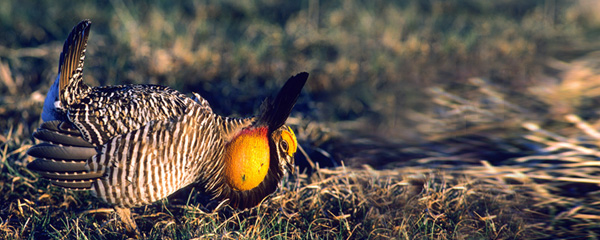
In the mating ritual, the male chicken's tail is elevated; horn-like feathers (called pinnae) on the neck are raised over the head; and the wings are lowered with the primary feathers spread. The bird stamps its feet while moving forward or in circles, and this is followed by a series of rapid tail snaps and fans. At the same time as the tail is clicked open and shut, a whoom-AH-oom sound is given as the bright orange air sacs on the neck of the greater prairie chicken (orange to plume in the lesser) are inflated for maximum exposure. The lesser prairie chicken exhibits similar behavior, but the sound is higher-pitched, and the air sacs are a reddish color.

A second major display is flutter-jumping with associated cackling calls. The male jumps several feet into the air, flies forward, and lands. In so doing, the bird advertises its presence as well as the location of the lek. Flutter-jumping is typical of the peripheral males when females are near the center of the display ground.

A female will typically fly to the edge of a lek and walk slowly toward the center. When the hen enters a male’s territory, the male's behavior changes greatly. Lekking is performed with high frequency and extreme posturing. The male will display in circles around the female, showing all aspects of its plumage. At the peak of this performance, the dancer often spreads his wings and lays his head flat to the ground, as if bowing to the hen. If suitably impressed, the hen will stoop low to the ground, signaling that she is ready to mate.

Occasionally, fights break out among competing males. This is mostly ritual, as well, involving short jumps; striking with feet, beak, and wings; and face-offs in which the competitors whine and attempt to stare each other down. Injuries do occur but are seldom serious.

With its large, colorful air sacs, horn-like pinnae, and feathers growing all the way to its feet, the prairie chicken is one of the most beautiful birds in Kansas. And its mating ritual makes it one of the most fascinating birds to watch. Kansans are lucky to have the largest population of prairie chickens in the world, so viewing opportunities are good.

Two species of prairie chicken can be found in Kansas. The greater prairie chicken, the most populous, can be found throughout portions of northcentral and eastern Kansas, especially in the Flint Hills region. The lesser prairie chicken, which is slightly smaller and has reddish-orange air-sacs, can be found in pockets of native sandsage and shortgrass prairie in western Kansas. The lesser prairie chicken male produces a higher-pitched, bubbly sound, or "gobble," leading to the term "gobbling grounds" for their leks. On a quiet spring morning, the sounds of both species can carry as far as 2 miles across the open prairie.

Thursday, January 12, 2012

SEATING AVAILABLE FOR SECOND GOVERNOR’S FLINT HILLS VISIONING SUMMIT

Flint Hills
Image via Wikipedia

Jan. 12, 2012
Topeka event will help develop ongoing strategy for the Flint Hills region
TOPEKA — Persons who want to attend the Second Governor’s Flint Hills Visioning Summit on Tuesday, Jan. 17, are encouraged to register soon. The event will be held from 9 a.m. to 4 p.m. in the Shawnee Ballroom at the Capitol Plaza Hotel and Convention Center in Topeka. The summit will bring together stakeholders from throughout the Flint Hills Region and across Kansas. There is a $20 registration fee with a limit of 300 participants. Lunch will be provided for those who register in advance. A legislative reception will follow from 4:30 p.m. to 6:30 p.m.
The meeting is a follow up to the successful first summit held in May 2011, and is focused on growing the Kansas economy and creating jobs. Governor Sam Brownback’s administration will continue to use the input gathered from this summit to help develop an ongoing strategy for the Flint Hills region. Regional stakeholders and policy makers will make presentations to help participants understand the challenges and strategies. During breakout sessions, participants will discuss specific issues and offer feedback, recommendations, and direction for the future. In addition to Governor Brownback, Kansas Wildlife, Parks and Tourism (KDWPT) Secretary Robin Jennison also will attend.
Public involvement is crucial to the success of the program. The second summit will be another step to creating thriving rural communities throughout the Flint Hills of Kansas.
Presentation portions of the summit will be streamed live over the Internet for those unable to attend in person. Links will be displayed on the KDWPT website, www.kdwpt.state.ks.us; on the summit website, fhs.ksoutdoors.com; and on the Kansas tourism industry website, TravelKSIndustry.com
To register or learn more about the meeting, visit the Flint Hills Visioning Summit website at fhs.ksoutdoors.com. Advance registration is strongly encouraged. For additional information, email Linda Craghead, KDWPT assistant secretary, at Linda.craghead@ksoutdoors.com or phone 785-296-2281.
If notified in advance, the department will have an interpreter available for the hearing impaired. To request an interpreter, phone the Kansas Commission for the Deaf and Hard of Hearing at 1-800-432-0698. Any individual with a disability may request other accommodations by contacting KDWPT at 785-296-2281.

Friday, November 25, 2011

2011 KANSAS STATE ECO-MEET BRINGS HEAVY COMPETITION


Courtesy KDWPT
Nov. 24, 2012
Twenty-six teams, 101 students, 20 high schools display conservation knowledge
ELMDALE — On Nov. 3, the 13th Annual State Finals ECO-Meet competition was held at Camp Wood YMCA facility near Elmdale. The event was held in the Flint Hills, making for a great day of competition. The event proved to be an exciting, hard-fought contest, with the following results posted:
Overall Team Competition
  • First Place — Maize High School Team B, Ana Fornoza, Deanna Hazelton, Samm Nguyen, Zac Thiessen, and team coach Jay Super — $300 student scholarships;
  • Second Place — St. Mary’s-Colgan High School of Pittsburg, Hayden Compton, Ben Cortes, Joe Otter, Taylor Thomas, and team coach Donna Maus — $200 student scholarships; and
  • Third Place — Maize High School Team A, Luke Bartz, Maureen McCafferty, Shannon Nelson, Kris Super, and team coach Jay Super — $100 student scholarships.
Individual Events
  • Ornithology — First Place, Stephen DeHart, Olathe South High School, $200 scholarship — Second Place, Blake Bradford, Clay Center High School, $100 scholarship; and
  • Woodlands Ecosystem — First Place, Stephen DeHart, Olathe South High School, $200 scholarship — Second Place, Shannon Nelson, Maize High School, $100 scholarship.
Twenty-six teams consisting of 101 students from 20 high schools across the state competed. An additional seven students qualified as individuals from five other schools in the two test events. Nine regional qualifying competitions determined representatives from across the state. Regional locations were Wilson Reservoir in Russell County, the Sternberg Museum in Hays, the Milford Nature Center near Junction City, the Lakewood Discovery Center in Salina, the Great Plains Nature Center in Wichita, the Dillon Nature Center in Hutchinson, Prairie Park Nature Center in Lawrence, the Southeast Kansas Education Service Center at Greenbush, and the Ernie Miller Nature Center in Olathe. The Kansas ECO-meet committee is considering at least two new locations for 2012 to host regional competitions.
Sponsors of the Kansas ECO-Meet include the Kansas Wildscape Foundation; the Kansas Chapter of the National Wild Turkey Federation, Simpson Farm Enterprises of Ransom, Superior/Essex of Hoisington, Barton Community College of Great Bend, Friends of Milford Nature Center, Mid-America Awards of Salina, Goodwin Sporting Goods of Hays, and the Wildlife Education Service Section of the Kansas Department of Wildlife, Parks and Tourism.
To view the results from all regional events and the state competition or for more information about the Kansas ECO-Meet, go online to www.kansasecomeet.org, email Mike Rader at mike.rader@ksoutdoors.com or phone 620-672-0708.

Thursday, November 3, 2011

NOVEMBER USHERS UPLAND OPENERS

Konza Prairie, in the Flint HillsImage via Wikipedia
Pheasant, quail, and prairie chicken bring family and friends together

PRATT — For many hunters, Kansas pheasant and quail hunting ranks right up there with Thanksgiving and Christmas — and often coincides. Family and friends who may not have seen each other for a year or more get together and enjoy the outdoors, camaraderie, and putting meat on the table in a time-honored tradition. This winter, pheasant and quail seasons run Nov. 12-Jan. 31, 2012, and while the forecast for bird numbers is down from recent years, the excitement of rekindling old relationships still runs high.

Although good numbers of pheasants and quail will be found in some areas, severe drought and record high temperatures throughout much of the birds’ range last spring and summer resulted in fewer birds overall. Generally, the best pheasant hunting in 2011 will be north of I-70 in western Kansas and the best quail hunting will be in the central part of the state. Details can be found in Upland Bird Regional Forecast on the Kansas Department of Wildlife, Parks and Tourism’s (KDWPT) website,www.kdwpt.ks.us, under “Hunting/Upland Birds.”

KDWPT reminds all hunters to avoid standing crops. While most crops have been harvested already, some fields remain uncut, even as late as mid-November. Hunters are asked to stay out of standing crop fields because most farmers do not want these fields disturbed until after harvest. Permission is required to hunt private land, whether it is posted or not.

The season on Kansas’ third upland bird — the prairie chicken — runs Nov. 19-Jan. 31 in the Northwest and East units and Nov. 19-Dec. 31 in the Southwest Unit. The best greater prairie chicken hunting should be in native grasslands from the northern Flint Hills westward throughout the Smoky Hills along the I-70 corridor.

The daily bag limit on pheasants is four roosters, and the daily bag on quail is eight birds. The daily bag limit on prairie chicken in the East and Northwest units is two, and the daily bag in the Southwest Unit is one. The possession limit on all three upland species is four times the daily bag limit.

A valid Kansas hunting license is required of all residents ages 16 through 64. Nonresidents must purchase a $72.50 nonresident hunting license, except that those nonresidents younger than 16 may purchase a youth nonresident license for $37.50. Anyone born on or after July 1, 1957, must have completed a certified hunter education course, except that youth 15 and younger may hunt under direct adult supervision without hunter education certification. Youth 12 through 15 may hunt without adult supervision if they have completed a certified hunter education course. Anyone 16 or older may purchase a one-time deferral of hunter education, called an “apprentice hunting license,” for the same price as a regular hunting license. This license is valid only through the calendar year in which it is purchased, and the holder must be under the direct supervision of a licensed adult 18 or older. A hunting license and hunter education are not required while hunting one’s own land.

For complete hunting regulation information, consult the 2011 Kansas Hunting and Furharvesting Regulations Summary, available wherever licenses are sold or online atwww.kdwpt.state.ks.us.

Sunday, September 25, 2011

HEAT AND DROUGHT IMPACT 2011 UPLAND BIRD FORECAST

Flint HillsImage by kswx_29 via Flickr
While some areas of central, northcentral, and northwest Kansas may offer good hunting, drought and heat have reduced bird numbers
PRATT — Kansas upland bird hunters enjoyed a banner season in 2010, but this summer’s heat and drought in parts of the state have hurt upland bird prospects for 2011. The Kansas Department of Wildlife, Parks and Tourism (KDWPT) has released its 2011 Kansas Upland Bird Forecast, and although good numbers of pheasants and quail will be found in some areas, severe drought and record high temperatures throughout much of the birds’ range resulted in fewer birds overall.
Generally, the best pheasant hunting in 2011 will be north of I-70 in western Kansas, the best quail hunting will be in the central part of the state, and the best greater prairie chicken hunting should be in native grasslands from the northern Flint Hills westward throughout the Smoky Hills.
Central and western Kansas had a relatively mild 2010-2011 winter, and over-winter survival was very high for upland game throughout most of the state. Breeding populations in central and western areas neared all time highs, especially for pheasant. However, drought that began in the summer of 2010 and persisted through the 2011 nesting season (May through July) and the summer hampered growth of wheat — primary nesting habitat for pheasants — especially in western Kansas. Areas in northwest and northcentral parts of the state received rain in May, which improved nesting conditions in those areas but likely hurt nest success where rainfall was excessive. In July and August, some severe hailstorms hit these areas, possibly decreasing chick survival in localized areas.
The southern half of the state endured prolonged drought through the rest of the summer. Southwest and southcentral Kansas had particularly bad reproductive conditions for pheasants, quail, and prairie chickens.
So what does this mean for Kansas upland bird hunters this fall? Here’s the statewide breakdown by species.

Pheasants
Unfortunately, drought through much of the state hampered pheasant reproduction this year. A substantial number of hens nest in winter wheat in the primary pheasant range (western Kansas). This year, much of western Kansas, especially southwest, had much-reduced wheat production. Nest success was likely much lower in these areas due to poor vegetative structure. Additionally, earlier wheat harvest dates due to poor growing conditions likely caused losses to nests or young broods. Thus, like many other pheasant states, Kansas will experience a substantial decline in the pheasant population this year.
The timing and quantity of early summer precipitation also plays a direct role in game bird productivity. Success of nests and survival of young is generally best when rain comes slowly and in near average amounts during May and June. Most of the areas in Kansas’ primary pheasant range did not meet that prescription this year and had little or no precipitation. Additionally, a few areas where there was reproductive success (northwest and northcentral Kansas) received heavy rainfall and/or hail during the peak reproductive period. Although these storms were often localized, in some counties they occurred multiple times. Counties affected by hail include portions of Norton, Graham, and Rooks.
Compared to 2010, pheasant numbers will be considerably lower throughout their range. This will especially be true in northeastern, southwestern, and southcentral Kansas. In those parts of northwestern and northcentral Kansas not affected by severe summer storms, pheasant numbers will be relatively good compared to other areas of the state but still down from last year.
Quail
The bobwhite breeding population in 2011 was generally stable compared to 2010, except for southwestern Kansas, where there were severe declines. However, 2011 summer brood surveys indices were down throughout much of the state for quail, indicating a general decline. There were some indications of higher reproductive success in the northcentral, southcentral, and southeast parts of Kansas although good areas may be spotty.
Because quail breed later than pheasants and prairie chickens, early summer moisture may have provided better conditions for nesting and brood-rearing in central and eastern Kansas. In past years, heavy precipitation and flooding associated with summer storms has negatively impacted bobwhite productivity in many parts of central and eastern Kansas. Fortunately, these conditions were absent this year. Counties that reported higher quail reproductive success are Pratt, Reno, Woodson, Phillips, and Rooks.
The best quail hunting will be found throughout the central part of the state. However, extreme southcentral Kansas experienced prolonged drought, likely hampering reproduction. Quail numbers declined considerably in southwestern and northeastern Kansas, and opportunities will likely be limited in those areas. Bobwhite numbers in far northwestern Kansas continue to improve, but that portion of the state is at the fringe of the bird’s range, and densities will still be low compared to central Kansas. Although southeast Kansas may see an improvement in reproduction this year, numbers remain far below historic levels in that region.
Prairie Chicken
Kansas is home to greater and lesser prairie chickens. Both species require a landscape of predominately native grass. Lesser prairie chickens are found in westcentral and southwestern Kansas in native prairie and nearby stands of native grass within the Conservation Reserve Program (CRP). Greater prairie chickens are found primarily in the tallgrass and mixed grass prairies in the eastern one-third and northern half of the state.
The spring prairie chicken lek survey indicated that the lesser prairie chicken breeding population was similar to last year, except at the northern extent of their range in westcentral Kansas, where there were increases. This area is occupied by both greater and lesser prairie chickens. Nesting and brood rearing conditions for lesser prairie chickens were generally not good this summer throughout most of their range due to drought in southcentral and southwest Kansas. It is likely that populations will be down from last year, and the best hunting will be in the central and northern portions of the lesser prairie chicken range.
Greater prairie chicken breeding populations were generally down in the eastern parts of the state (Flint Hills), but up considerably in the northcentral (Smoky Hills) and northwest (grasslands in the northern High Plains) parts of Kansas. In the core of the Flint Hills of eastern Kansas, the majority of occupied habitat was burned again this spring, leaving little nesting cover. While periodic burning is essential to prevent woody encroachment into the prairie, burning the same acreage annually in early spring greatly reduces the potential for successful nesting, even when weather is favorable.
Conditions were comparatively better for production throughout the northern Flint Hills due to less spring burning and more rainfall. Conditions were good for production throughout most of the Smoky Hills region that spans across northcentral and northwest Kansas. The best greater prairie chicken hunting should again be found in native grasslands from the northern Flint Hills westward throughout the Smoky Hills.
A detailed 2011 Kansas Upland Bird Hunting Forecast is available online at the KDWPT website,www.kdwpt.state.ks.us. Click "Hunting/Upland Birds/Upland Bird Regional Forecast" for the complete report.
The following table includes the upland birds seasons for 2011. Possession limits are four times the daily bag limits.

SeasonOpen DatesDaily BagOpen Areas
Prairie chicken (Early)Sep. 15 –Oct. 152East of Hwy. 281
Youth PheasantNov. 5-62Statewide
Youth QuailNov. 5-64Statewide
PheasantNov. 12 – Jan. 314Statewide
QuailNov. 12 - Jan. 318Statewide
Prairie chicken
East and Northwest Units
Nov. 19 –Jan. 312North of I-70 & east of Hwy. 281
Prairie chicken
Southwest Unit
Nov. 19 –Dec. 311South of I-70 & west of Hwy. 281