Showing posts with label Midwestern United States. Show all posts

Sunday, July 7, 2013

KDWPT BIOLOGIST RECEIVES AWARD FROM MIDWEST ASSOCIATION OF FISH AND WILDLIFE AGENCIES

PRATT ­– The Midwest Association of Fish and Wildlife Agencies (MAFWA)
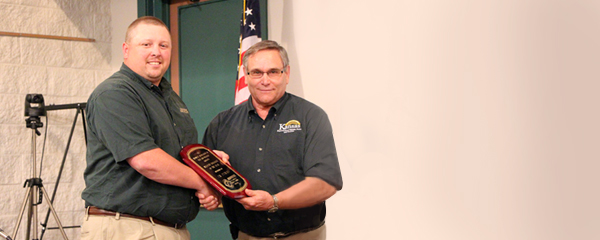
recently recognized Kansas Department of Wildlife, Parks and Tourism (KDWPT) small game coordinator Jim Pitman as the 2013 “Wildlife Biologist of the Year.” Pitman was presented the award by KDWPT Assistant Secretary Keith Sexson at the June 27 Kansas Wildlife, Parks and Tourism Commission meeting.

Each year, MAFWA recognizes an individual who has shown an unparalleled initiative toward the better understanding of wildlife and their conservation, and Pitman couldn’t have been a better choice.

“It is a huge honor to be recognized my peers,” said Pitman. “A person's peers are usually the toughest critics, so winning an award from that group is the most meaningful recognition anyone could receive. I'm very appreciative of that recognition and humbled by it.”

Pitman’s most recent endeavor has been developing conservation strategies to address the potential listing of the lesser prairie chicken as a threatened or endangered species by the U.S. Fish and Wildlife Service.

Pitman is the second KDWPT biologist in recent years to receive this award from MAFWA. In 2011, KDWPT Big Game Program Coordinator Lloyd Fox was also named Wildlife Biologist of the Year.

Comprised of 13 state and 3 provincial Midwest fish and wildlife agencies, MAFWA is an organization that strives to provide a common forum for fish and wildlife agencies to share ideas, information, pool resources, and form action initiatives to better manage and conserve fish and wildlife resources.

For more information on MAFWA and Pitman’s award, visit www.mafwa.org.

Sunday, August 26, 2012

COAST GUARD ISSUES LOW WATER RIVER ADVISORY


Submerged structure, commercial vessels pose greater threat in low water
ST. LOUIS — Many waterways throughout the Midwest are experiencing lower than average water levels this year. This poses particular hazards to recreational boaters. Areas that were navigable in past months or years may be too shallow to operate in now. River structures such as dikes may be closer to the surface, posing potential grounding threats, and channel widths may be smaller than expected. This can affect all waters in the Mississippi drainage, including the Missouri and Kansas rivers in the Sunflower State.
As a result, the U.S. Coast Guard has issued a boating advisory for all waters in the drainage. Boaters should follow simple precautions while using these waters:
  • always have approved life jackets for everyone onboard;
  • operate in areas you are familiar with, at safe speeds;
  • do not operate near fleeting areas, commercial vessels, or barges — larger vessels and structures can create strong eddies, undertows, and wakes;
  • do not operate near underwater river structures, such as dikes;
  • have light and sound signaling devices onboard;
  • tell someone where you are going, when you will be there, and how to contact you to verify your safety; and
  • for boating safety tips and classes, contact your local Coast Guard Auxiliary for support or visit the Kansas Department of Wildlife, Parks and Tourism Boating Education website,ksoutdoors.com/news/Boating/Boating-Education.

Saturday, February 18, 2012

ASIAN CARP CAUGHT IN AUGUSTA CITY LAKE

Asian Carp in the Wabash River
Asian Carp in the Wabash River (Photo credit: LouisvilleUSACE)

Strange-looking fish puzzles anglers
AUGUSTA — On Jan. 25, anglers were taking advantage of a fish salvage order as Augusta City Lake was being drained for renovation. During a fish salvage, anglers can take sportfish with equipment not ordinarily allowed, such as seines, snagging rigs, bow and arrow, and gigs. Most of the prizes hauled in were large flathead catfish, but one angler snagged a fish estimated to weigh about 55 pounds that no one could identify. Officials with the Kansas Department of Wildlife, Parks and Tourism (KDWPT) became involved with the catch when a picture of the fish appeared on local television. It was immediately identified as an aquatic nuisance species (ANS), an Asian carp.
“This report supports our long-standing recommendation that fish should not be moved between waters,” said Jason Goeckler, KDWPT aquatic nuisance specialist. “Here is a case of a lake with Asian carp that we didn't even know about.”
Asian carp were imported to the U.S. in the 1970s for aquaculture purposes but escaped into Midwestern rivers and streams. Previously, they had been found only in the Kansas, Missouri, Big Blue, and Wakarusa rivers and Browning Oxbow Lake in northeastern Kansas. Officials believe that the fish was released into Augusta City Lake or waters above the lake.
Two species of Asian carp have been discovered in Kansas — bighead and silver carp. Both species have scaleless heads, and silver carp may grow to more than 60 pounds and as long as 4 feet. This fish, however, was a bighead carp, which may grow to more than 100 pounds. Both species have low-set eyes and a large upturned mouth without barbels (“whiskers”).
Asian carp directly compete with other fish for food resources, grow quickly, and feed voraciously. They can consume 40 percent of their body weight each day. Silver carp pose physical danger to boaters because of their leaping ability. Anyone boating in silver carp-infested waters should be aware that these large fish may jump into their boat.
Shortly after news reports of the Augusta City Lake Asian carp, KDWPT began receiving calls and emails.
“We want to thank the public for sending in reports,” Goeckler said. “Unfortunately we did not hear about this discovery prior to press-time. But the big news is that we received countless emails, calls, and online reports from the public. They shared our concern about the discovery, and their reports help us monitor these species.”
Anyone who catches an Asian carp should not release the fish back into any body of water. Anglers who catch Asian carp somewhere other than the Kansas, Missouri, Big Blue, and Wakarusa rivers should freeze the fish in a sealed plastic bag, note the date and location, and call the KDWPT Emporia Research Office at 620-342-0658 or emailjason.goeckler@ksoutdoors.com.