Showing posts with label Lake. Show all posts

Thursday, August 28, 2014

BOATING SAFETY REMINDER FOR LABOR DAY WEEKEND

Safety key to successful holiday on busy lakes
PRATT – Labor Day weekend is the last big outdoor holiday at Kansas lakes, and the Kansas
Department of Wildlife, Parks and Tourism (KDWPT) reminds boaters that being safe on the water is key to an enjoyable weekend. Overall, boating is a very safe outdoor pursuit, but it only takes one small mistake or oversight for a fun day on the water to turn tragic.
Being safe on the water isn’t complicated. By following regulations and a few common-sense rules, boat operators can ensure that everyone in their party stays safe. The first rule is to have everyone onboard wear a life jacket. Accidents can happen quickly, anyplace or anytime on the water. Although every boat must have a life jacket on board for every person on the boat, Kansas law only requires those age 12 and younger to wear a life jacket at all times while on a boat. Those 13 and older are not required to wear a life jacket but must have one available that is easily accessible and fits properly. "Easily accessible" means the jackets must be within reach and in plain view. Life jackets stowed under seats or in storage compartments do not meet this requirement.
Life jackets, like seat belts in cars, must be worn to save lives. There are many excuses given for not wearing life jackets, but life jackets are no longer the orange, hot, bulky vests commonly thought of. New developments have produced smaller, sleeker, and more comfortable life jackets, leaving boaters with no reason not to wear them.
Another common sense safety rule on the water is to avoid alcohol or have a designated boat driver. Alcohol affects a person’s judgment and reflexes, and a high percentage of boating accidents are alcohol-related. And being outdoors on a warm sunny day exacerbates the effects of alcohol. KDWPT boating enforcement officers will be on the lookout for impaired boat operators. Operating a recreational vessel with a blood alcohol concentration of .08 or higher is against Kansas state law. Anyone caught operating a boat under the influence can have their vessel impounded and incur penalties including arrest, fines, and loss of boating privileges.
And finally, several recent incidents on Kansas lakes put boaters in danger unnecessarily. While it falls under “use common sense,” individuals were “lost” after being left to float on a large reservoir. Both had floatation devices and both survived, but it could have been worse. Never leave anyone floating in open water outside of designated swimming areas. Wave action can make a solitary swimmer almost impossible to see for other boaters and hard to find for anyone looking for them.
This Labor Day, have fun, stay safe and “Wear It Kansas.”

Sunday, March 23, 2014

ARTIFICIAL WALLEYE SPAWNING A LABOR OF LOVE

A female walleye can release as many as 300,000 eggs, but less than 10 percent will survive in nature
PRATT – In late March, a placid lake surface might lead some to believe major fish activity has yet to begin, but for walleye, waves of commotion are occurring beneath the surface as males and females begin spawning. As soon as water temperatures hit 45-50 degrees, walleye begin the annual process, as other fish species do each spring. 
Most spawning activity occurs at night when female walleye search for the perfect rocky shoreline to lay their eggs, and male walleyes, who’ve been waiting on the spawning ground for days, fertilize them. With large females producing as many as 300,000 eggs, it’s hard to believe this species would need assistance with the process, but even the best laid plans are no match for Mother Nature. In Kansas lakes, less than 10 percent of naturally-spawned walleye eggs will hatch.
However, hatching success rates can be as high as 70 percent in a hatchery setting. That’s why every year about this time, you’ll see Kansas Department of Wildlife, Parks and Tourism (KDWPT) fisheries biologists working tirelessly at select Kansas lakes. Biologists set nets to capture spawning walleye, then harvest the eggs of ripe females. Once collected, the eggs are then taken to a station where they are fertilized with milt, or sperm, taken from male walleyes caught from the same body of water. After fertilization, the eggs are immediately delivered to the Pratt and Milford fish hatcheries where fish culturists work around the clock to ensure high hatch and survival rates of young walleye, which are then stocked into Kansas lakes as is, or used to produce other hybrid fish species. Last year, KDWPT’s Walleye Culture Program produced 43 million walleye fry (just hatched fish) and 660,000 walleye fingerlings (2-inch fish). With that same batch of eggs, KDWPT staff were also able to produce 7.5 million saugeye fry, 400,000 saugeye fingerlings (walleye/sauger hybrids).
In addition to walleye, KDWPT hatcheries also produce bluegill, channel catfish, crappie, largemouth bass, redear sunfish, sauger, saugeye,smallmouth bass, striped bass, and wipers.
For more information on KDWPT hatcheries and the fish they produce, visit www.ksoutdoors.com and click “Fishing/Hatcheries.”

Monday, February 3, 2014

CATCH FIRST GLIMPSE OF 2014 FISHING REGULATIONS SUMMARY ONLINE

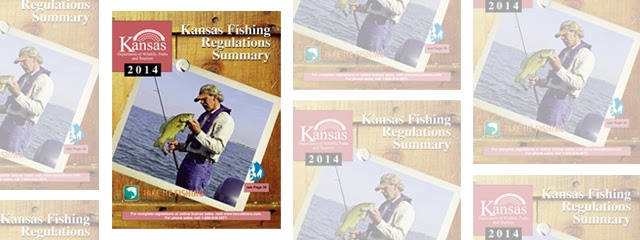
 For anglers, timely, quality information can be the difference between getting a couple tugs on a lure and a grill lined-to-the-brim with your favorite catch. Cram-packed with all the information you need to set up for a perfect day of fishing, the 2014 Kansas Fishing Regulations Summaryis the closest you can get to having a game warden, a fisheries biologist, ksoutdoors.com by clicking “Fishing / Fishing Regulations.” Print copies will be available wherever licenses are sold within one to two weeks.
and a hatchery manager at your beck and call. This free, easy to use, full-color pamphlet can be downloaded online now at

Apart from information on important fishing regulations such as special seasons, creel and length limits, license fees and legal fishing methods, anglers will also find a helpful section highlighting new regulations for the 2014 season in the summary. This publication is a must-have for anglers because creel and length limits vary from lake to lake.

Included in a special 16-page section, this pamphlet also lists all public waters, along with their location and any special regulations in effect. At the turn of a page, anglers can see which community lakes don’t charge extra fees for fishing, as well as community lakes designated as Family Friendly Facilities (FFF)thatwill include flush toilet facilities, security patrols, security lighting, easy access to the water and do not allow alcohol.

Information is also provided on aquatic nuisance species (ANS), as well as regulations governing the use of live baitfish. Five pages are devoted to fish identification, featuring color illustrations by Joe Tomelleri. Current state record fish are listed, and there is also a Master Angler Application for anglers who catch fish that qualify forthis certificate award program.

The2014 Kansas Fishing Regulations Summarypamphlet is truly an angler’s “Bible.” Grab a copy, read it, and keep it by your side. Available at more than 200 outlets statewide, and online, there’s no excuse to ever find yourself without one.

Saturday, October 19, 2013

MILFORD FISH HATCHERY SUPPLY LAKE NEW WINTER HOURS IN PLACE NOW

Hatchery supply lake, known as the Gathering Pond, open to fishing only on weekends under winter
hours

JUNCTION CITY – The Milford Fish Hatchery Supply Lake, known locally as the Gathering Pond, located below the dam of Milford Reservoir will be open to fishing under reduced winter hours beginning immediately. The new winter hours will open the lake from 8:30 a.m. to 4:30 p.m. on weekends only and will be in place through March 16, 2014.

Winter hours started Nov. 1 last year, but the decision was made to begin 2013 winter hours immediately after the recent government shutdown ended. On weekdays, the gate just beyond the River Walk Trail parking lot will be closed. Fishing is restricted to weekend days. Other activities such as wildlife viewing and hiking will be permitted by foot traffic during the weekdays.

The supply lake reopened in 2012 to restricted hours and controlled access after being closed when zebra mussels were discovered in Milford Reservoir in 2009. Kansas Department of Wildlife, Parks and Tourism staff were concerned about the potential for zebra mussels being introduced into the supply lake and ultimately into the hatchery. During the closure, staff worked with the U.S. Army Corps of Engineers to develop procedures designed to prevent zebra mussel infestation. Following the two-year closure, the lake was reopened with controlled access, limited hours and restrictions prohibiting boats and live aquatic bait. A gate attendant informs the public and conducts surveys. All efforts have been made to minimize the impact to recreational users during this time period. Spring/summer restrictions and hours will begin on March 17, 2014.

Friday, February 22, 2013

FISHING FORECAST TAKES GUESS WORK OUT OF WHERE TO FISH


The Kansas Department of Wildlife, Parks and Tourism (KDWPT) 2013 Fishing Forecast features the ins and outs of fish populations in public waters around the state, helping anglers to better decide where to cast their lines. Comprised of sampling efforts conducted during annual lake monitoring, the fishing forecast gives anglers detailed information on the best bodies of water to fish for their specific fishing needs.

The data collected is divided into three categories based on the size of the body of water sampled. Reservoirs are defined as bodies of water larger than 1,200 acres, lakes are defined as bodies of water from 10 to 1,200 acres, and bodies of water smaller than 10 acres are defined as ponds. Since not every lake is sampled each year, the forecast provides a three-year average of each location to provide anglers with the best available information.
In addition to what species of fish can be caught at any given body of water, the fishing forecast also includes tables with a Density Rating, Preferred Rating, Lunker Rating, Biggest Fish (the largest fish sampled), Biologist’s Rating and the previously-mentioned Three-Year Average of popular species.

The Density Rating is the number of fish that were high-quality size or larger sampled per unit of sampling effort. High-quality size, listed in parentheses at the top of the Density Rating column, is the length of fish considered acceptable to most anglers and is different for each species. The higher the Density Rating, the more high-quality-sized or larger fish per surface acre in the lake. Theoretically, a lake with a Density Rating of 30 has twice as many high-quality-sized fish per acre as a lake with a Density Rating of 15.

The Preferred Rating identifies how many above-average-sized fish a water contains. For example, a lake may have a good density of crappie, but few fish over 10 inches. The Preferred Rating tells an angler where to go to for a chance to catch bigger fish.

The Lunker Rating is similar to the Density Rating, but it tells you the relative density of lunker-sized fish in the lake. A lunker is a certain length of fish considered a trophy by most anglers. It also differs with each species and is listed in parentheses at the top of the Lunker Rating column. For example, most anglers consider a channel catfish longer than 28 inches a lunker. Many lakes may have a lunker rating of 0, but this does not mean there are no big fish in that lake. It just means that no lunker fish were caught during sampling, and they may be less abundant than in lakes with positive Lunker Ratings.

You can use the Density Rating and Lunker Rating together. If you want numbers, go with the highest Density Rating. If you want only big fish, go with the Lunker Rating. Somewhere in the middle might be a better choice. A lake with a respectable rating in all three categories will provide the best overall fishing opportunities.
The Biggest Fish column lists the weight of the largest fish caught during sampling. A heavy fish listed here can give the lunker fishermen confidence that truly big fish are present.

The Biologist’s Rating adds a human touch to the forecast. Each district fisheries biologist reviews the data from annual sampling of their assigned lakes. This review considers environmental conditions that may have affected the sampling. They also consider previous years’ data. A rating of P (poor), F (fair), G (good), or E(excellent) will be in the last column. Sometimes the Density Rating may not agree with the Biologist’s Rating. This will happen occasionally and means the Density Rating may not accurately reflect the biologist’s opinion of the fishery.

The Three-Year Average rating refers to the averaging of the Density Rating over the previous three years of sampling to help show a trend for a particular lake.

Whether anglers are simply looking for a new spot to cast, or are searching for that elusive trophy fish, the 2013 Fishing Forecast is an invaluable tool for any fisherman.

A copy of this year’s forecast can be found in the March/April issue of Kansas Wildlife and Parks magazine, any KDWPT office or license vendor.

To view an electronic version of the 2013 Fishing Forecast, visit www.ksoutdoors.com and click “Fishing/Fishing Forecast.”

Sunday, August 12, 2012

KINGMAN STATE FISHING LAKE TO BE DRAINED FOR REHAB

Shoreline and fishery improvements scheduled; no fish salvage allowed
KINGMAN — In an effort to improve fishing and eliminate an expanding white perch population — an aquatic nuisance species (ANS) — Kingman State Fishing Lake (SFL) is scheduled to be drained and renovated this fall. Periodic renovations are standard practice in small lakes when fish populations became unbalanced due to expansion of undesirable fish species. Kingman SFL has been drained and rehabilitated six times since 1947. Currently, the majority of the fish biomass in the lake is composed of common carp, gizzard shad, and white perch. The quality and quantity of sport fish has decreased in the lake, and the fishery is not currently meeting the needs of anglers. Angler use in 2011 was approximately one-third of that seen during the last angler survey at Kingman in 1999.

Biologist believe hot, dry weather has created the best conditions for renovating this fish population because the drought has dried up many upstream pools that may have harbored undesirable fish species. After the lake is drained, the existing water in the lake basin will be treated with rotenone, a fish toxicant. Because Kingman is an ANS-designated water due to white perch, fish salvage will not be allowed, reducing the risk of white perch transfer into non-infested waters.

Dewatering of the lake will begin in mid-August. During renovation, a number of lake improvement projects will take place, including fish habitat placement, boat ramp extension, and chemical treatment of problematic shoreline vegetation. Upon refilling of the lake, largemouth bass, northern pike, bluegill, and channel catfish will be restocked.

“Hopefully, fall rains and increased spring flow will fill the lake by spring of 2013,” says Sean T. Lynott, Kansas Department of Wildlife, Parks and Tourism’s regional fisheries supervisor for southern Kansas. “After the renovation, the lake will not be closed to fishing because some adult fish will be stocked immediately to prey on any undesirable fish not eliminated by the chemical treatment. Additionally, the newly-stocked fish should grow quickly without competition from rough fish, so fishing should quickly improve in the years to come.”

Monday, June 4, 2012

LATE MAY AND JUNE PULL WALLEYE INTO SHALLOWS

LATE MAY AND JUNE PULL WALLEYE INTO SHALLOWS
May 31, 2012
Shallow points, flats, and underwater roadways lure anglers to big fish
PRATT — Many anglers pursue walleye in late March and early April, when breeding fish move onto the rip-rap of lake dams to spawn. But the best time to catch walleye is in May and June, when water temperatures warm and walleye move into shallows to feed. At this time, walleye fishing heats up over shallow points, flats, and underwater roadbeds, where walleye feeding is most intense.
While a boat gives an angler more access to lake structure, walleye can also be caught by wading anglers. Look for fish in water 3 to 15 feet deep, along shallow points and submerged roadbeds.
These post-spawn walleye are often aggressive and can be caught trolling with crankbaits or drifting a jig and night crawler combination. Jig size varies depending on the amount of wind and water depth, but usually a - or -ounce jighead works well. Popular lure colors include chartreuse, red, orange, pink, and white.
According to the Kansas Fishing Forecast, the best walleye fishing reservoirs this year are Webster, Kirwin, Glen Elder, Milford, and Cedar Bluff. And anglers shouldn't overlook smaller community lakes. The best smaller lakes rated are Pratt County Lake, Banner Creek Lake near Holton, Lower Barber State Fishing Lake, Herington City Lake, and Jeffery Energy Center Make-Up Lake.
Much credit for successful walleye fishing in Kansas can be attributed to the Kansas Department of Wildlife, Parks and Tourism’s (KDWPT) aggressive walleye stocking program. This year, KDWPT fisheries biologists harvested approximately 100 million walleye eggs and stocked almost 54 million fry. In addition, length limits allow walleye to grow to reproductive age, and in some reservoirs, prime habitat produces excellent walleye populations year after year.
Because of their size and reputation as great table fare, walleye are among the most popular sportfish in Kansas. Take advantage of this great angling resource. Conditions for walleye fishing can change daily, so visit the KDWPT Fishing Reports for the latest information.

Monday, May 28, 2012

HORTON MISSION LAKE EAST RENOVATION COMPLETE

Micropterus salmoides
 (Photo credit: Wikipedia)
Revitalized fishery, improved water quality, new facilities enhance lake
HORTON — Renovation of Horton Mission Lake East (½ mile north of Highway 20 on the east edge of Horton) is complete, and it is time to get out and enjoy this revitalized fishery. Mission Lake was opened to fishing on May 23.
Since the fishery was cleaned out last August, several thousand fish have been stocked, including fathead minnows, bluegill, black crappie, and largemouth bass. Some of these were smaller hatchery fish; however, a good portion were adults that were relocated from surrounding waters.
Is there a keeper fish behind every clump of vegetation or in every new brush pile? Probably not, but when Kansas Department of Wildlife, Parks and Tourism (KDWPT) biologists sampled the lake in mid-May, they saw a healthy young fishery. And since the renovation, water clarity has improved to more than 4 feet, much better than the 4-7 inches the lake used to have.
In addition to improving the fishery, staff have made several new additions to lake facilities, including a concrete boat ramp, courtesy dock, several fishing piers, two fish feeders, and several new campsites with electrical hookups.

Friday, May 25, 2012

STATE FISHING LAKES OFFER GREAT MEMORIAL DAY OUTINGS

STATE FISHING LAKES OFFER GREAT MEMORIAL DAY OUTINGS
May 24, 2012
Survey indicates highly-satisfied Memorial Day weekend visitors
PRATT — Looking for a peaceful, uncrowded Memorial Day weekend outdoor experience? Try one of the more than 40 Kansas state fishing lakes. Anglers surveyed who fished state fishing lakes reported low levels of crowding, high satisfaction, and sufficient access from shore at these small Kansas gems. In most cases, there is minimal to no wait time to launch a boat and plenty of parking available.
In addition to fishing, picnicking and primitive camping are popular activities at state fishing lakes. Some — including Kingman, McPherson, Mined Land, and Ottawa — offer modern, affordable cabins for those who prefer not to camp. Many state fishing lakes also have ADA-compliant facilities, such as accessible docks and piers.
You don’t need a boat to enjoy the state fishing lake angling experience because numerous piers, jetties, and accessible shoreline are available for easy access. Almost half of anglers visiting these lakes fish from shore and find plenty of access without a boat.
As the name suggests, most state fishing lakes are managed for anglers, so no pleasure boating, skiing, or swimming is allowed. However, because Crawford, Meade, and Scott are also state parks, they provide full-service camping and allow swimming, and Crawford and Scott allow some recreational boating and offer recreational facilities such as sand volleyball courts, bathhouses, and horseshoe pits. Chase State Fishing Lake also has a swimming beach. Water-use restrictions may limit their appeal to some outdoor users, but for others, the limitation may be a peaceful plus.
Most visitors do not feel crowded at Kansas state fishing lakes, even on this busiest weekend of the year, so these lakes are great alternatives to large federal reservoirs. If you just want to enjoy nature, camp, and fish, you may be able to find a great family-friendly spot all to yourself.

Thursday, February 2, 2012

KDWPT FISHING FORECAST NOW ONLINE

English: Wilson Dam and Wilson Lake on the Sal...
Image via Wikipedia

PRATT — Each year, the Kansas Department of Wildlife, Parks and Tourism (KDWPT) prepares the Kansas Fishing Forecast, an indispensable tool that forecasts fishing prospects in public waters throughout the state.
The 2012 Kansas Fishing Forecast, now online at www.kdwpt.state.ks.us (click Fishing/Fishing Forecast), assembles results of biologists' sampling efforts into a format that can help anglers select lakes that will most likely provide the best opportunity to catch the kind and size of fish they prefer. The information is formulated from data collected by fisheries management biologists through annual lake monitoring, which includes test netting and electroshocking.
Water bodies are separated into three categories — reservoirs (waters larger than 1,200 acres), lakes (waters from 10 to 1,200 acres), and ponds (waters smaller than 10 acres). This helps anglers understand that while a water body may have a high rating, if it is small, its overall opportunity may be limited.
Table categories have been created for popular species and include a Density Rating, Preferred Rating, Lunker Rating, Biggest Fish (the largest fish taken in sampling), Biologist’s Rating, and Three-Year Average. The Three-Year Average rating is included because not every lake can be survey every year.
The Density Rating is the number of high-quality size or larger fish per unit of sampling effort. High-quality size, listed in parentheses at the top of the Density Rating column, is the length of fish considered acceptable to most anglers and is different for each species. The higher the Density Rating, the more high-quality sized or larger fish per surface acre in the lake. Theoretically, a lake with a Density Rating of 30 has twice as many high-quality sized fish per acre as a lake with a Density Rating of 15.
The Preferred Rating identifies how many above-average-sized fish a water contains. For example, a lake may have a good density of crappie, but few fish over 10 inches. The Preferred Rating helps anglers select which lake to go to for a chance to catch bigger fish.
The Lunker Rating is similar to the Density Rating, but it indicates the relative density of lunker-sized fish in the lake. A lunker is a certain length of fish considered a trophy by most anglers. It also differs with each species and is listed in parentheses at the top of the Lunker Rating column. For example, most anglers consider a channel catfish longer than 28 inches a lunker. Many lakes may have a lunker rating of 0, but this does not mean there are no big fish in that lake. It just means that no lunker fish were caught during sampling, and they may be less abundant than in lakes with positive Lunker Ratings.
Anglers can use the Density Rating and Lunker Rating together. For those who want numbers, go with the highest Density Rating. For those who want only big fish, go with the Lunker Rating. Somewhere in the middle might be a better choice. A lake with a respectable rating in all three categories should provide the best overall fishing opportunities.
The Biggest Fish column lists the weight of the largest fish caught during sampling. A heavy fish listed here can give the lunker angler confidence that truly big fish are present.
The Biologist’s Rating adds a human touch to the forecast. Each district fisheries biologist reviews the data from annual sampling of their assigned lakes. This review considers environmental conditions that may have affected the sampling. They also consider previous years’ data. A rating of P (poor), F (fair), G (good), or E (excellent) will be in the last column. Sometimes the Density Rating may not agree with the Biologist’s Rating. This will happen occasionally and means the Density Rating may not accurately reflect the biologist’s opinion of the fishery.
Printed copies of the forecast will be available at KDWP offices by the end of February, and the March/April issue of Kansas Wildlife & Parks magazine will present the forecast as a full-color article. (For subscriptions, phone 1-800-288-8387.)
Whether the angler is after big fish or more fish, the forecast will help find them. Weekly reports on fishing conditions at waters throughout the state are also posted on the website and complement the forecast.

Friday, November 4, 2011

FISH SALVAGE ORDER FOR EMPORIA’S JONES PARK WEST POND


Pond undergoing renovation; fish may be taken by any means

EMPORIA — Jones Park West Pond in Emporia is undergoing renovation, and Kansas Department of Wildlife, Parks and Tourism (KDWPT) Secretary Robin Jennison has issued a fish salvage order for the lake. The order will take effect when the lake is posted and remain in effect until the notices are removed.

During this time, it will be legal to take fish from this lake by any legal means, as well as snagging, seine, bow and arrow, gig, and hand.

“This is a 1.4-acre pond, and about 40 percent of the upper end is filled with silt,” area fisheries biologist Carson Cox said, explaining the reason for the renovation. “It has a history of fish kills due to filamentous algae, and it is overgrown with trees around the upper end, limiting shoreline angling. During renovation, we will construct a nutrient trap wetland like the one at Emporia Jones Park East Pond.”

Those 16 and older taking fish during this salvage order must have a fishing license. For more information, phone the KDWPT Emporia Research and Survey Office at 620-342-0658.

Monday, October 24, 2011

TROUT SEASON OPEN, SOME STOCKINGS DELAYED


Weather stalls cold-water species stocking
PRATT — From Oct. 15 through April 15, the Kansas Department of Wildlife, Parks and Tourism (KDWPT) stocks rainbow trout in select waters across the state. During this time, some waters stocked with trout require a $12.50 trout permit for all anglers 16 or older, whether they are fishing for trout or not (Type 1 Waters). Other waters require a trout permit only for anglers fishing for or possessing trout (Type 2 Waters).
Type 1 trout waters are Cedar Bluff Stilling Basin, Dodge City Lake Charles, Ft. Scott Gun Park Lake, Garnett Crystal Lake, Glen Elder State Park (SP) Pond, Kanopolis Seep Stream, KDOT East Lake in Wichita, Lake Henry in Clinton SP, Mined Land WA Unit No. 30, Pratt Centennial Pond, Sandsage Bison Range and WA Sandpits, Vic’s Lake and Slough Creek in Sedgwick County Park, Topeka Auburndale Park, Walnut River Area in El Dorado SP, Willow Lake at Tuttle Creek SP, and Webster Stilling Basin.
Type 2 trout waters are Atchison City Lake No. 1, Belleville City Lake (Rocky Pond), Cimarron Grasslands Pits, Ft. Riley Cameron Springs, Ft. Riley Moon Lake, Great Bend Veterans Memorial Park Lake, Holton-Elkhorn Lake, Hutchinson Dillon Nature Center Pond, Lake Shawnee, Salina Lakewood Lake, Scott State Fishing Lake, Scott State Park Pond, Sherman County Smoky Gardens Lake, and Solomon River between Webster Reservoir and Rooks County No. 2 Road, and Syracuse-Sam’s Pond.
Trout fishing at Mined Land Wildlife Area Unit No. 30 requires a trout permit year-round. Trout permits are valid for the calendar year, so permits purchased last January or later are valid through Dec. 31. All residents 16-64 years old and all nonresidents 16 and older must also have a valid fishing license.
The daily creel limit is five trout unless otherwise posted (two trout for anglers 15 and younger who do not have a trout permit). The possession limit is three times the daily creel.
While most designated trout waters in the state will be stocked with trout in time for opening day, the following waters will be delayed (see following text for details):
  • Cedar Bluff Reservoir Stilling Basin;
  • Cimarron Grasslands Fishing Pits;
  • Lake Charles in Dodge City;
  • Glen Elder Park Pond — second week in November;
  • Great Bend Veteran’s Park;
  • Kanopolis Reservoir Seep Stream;
  • Pratt Centennial Pond;
  • Rocky Pond in Belleville — second week in November;
  • Scott State Fishing Lake; and
  • Sedgwick County Park Slough Creek — low water.
Other areas may have to delay stocking, as well. Before a trout fishing expedition, anglers are encouraged to check for updated information on stocking of trout waters by visiting the KDWPT website, www.kdwpt.state.ks.us. Type "trout stocking schedule" in the search box.
As of Oct. 10, the Cedar Bluff Stilling Basin had yet to experience fall turnover, which occurs as surface water cools. When this happens, dissolved oxygen levels in the water can drop, and it takes time for the system to recover and provide conditions safe for trout. Rather than risk a fish kill for newly stocked trout, biologists have decided to delay the stocking. Conditions will be monitored, and if the basin is ready, trout will be stocked in late October.
Trout stocking at Cimarron Grasslands Fishing Pits, Dodge City-Lake Charles, Great Bend Veteran’s Park, Pratt Centennial Pond, and Scott State Fishing Lake will be delayed, but the recent cool weather should allow stocking early during the week of October 17.
The Kanopolis Reservoir Seep Stream is currently laden with duckweed and filamentous algae, creating water-quality problems. The seep stream is closed to all fishing, with plans to stock trout in early November, provided conditions have improved.
Smoky Gardens and the Sand Sage Bison Range Pond are currently dry. Both will need precipitation before trout can be stocked.
The Solomon River above Webster Reservoir is not stocked in the fall, nor is it stocked each year. Stocking is dependent upon flows. In years when flows are adequate, stocking generally occurs in January, February, and March.
The Glen Elder Park Pond is not stocked in October. The first stocking of the season is scheduled for mid-November each year in order to allow time for the water to cool.
Trout permits are available at the KDWPT website, at KDWPT offices, and license vendors.

Sunday, September 11, 2011

KANOPOLIS RESERVOIR TO UNDERGO PERIODIC DAM INSPECTION

U.S. Army Corps of Engineers (USACE) logoImage via Wikipedia
Lake level being reduced to below conservation pool
MARQUETTE — The U.S. Army Corps of Engineers at Kanopolis Reservoir has scheduled a periodic inspection of Kanopolis Dam for Sept. 27-30. Conducted every five years, the periodic inspection provides multi-disciplined teams a routine opportunity to conduct a detailed assessment of the embankment, control tower, outlet works, and associated structures.
To prepare for the inspection, the lake level is being reduced to below conservation pool. A gradual drawdown of the lake began on Aug. 26, and it is expected that the lake will be near elevation 1462.50 feet mean sea level during the inspection.
Pumping and cleaning of the Kanopolis stilling basin is also a component of the inspection. Corps of Engineers staff will assist Kansas Department of Wildlife, Parks and Tourism staff with a basin fish salvage during the morning of Sept. 26. Nongame fish will be made available to the public while game fish species will be returned to the lake or other public waters.
It is anticipated that the Outlet Area of Kanopolis Reservoir will be closed to the public throughout the inspection. All other recreation areas will remain open. Questions regarding the periodic inspection should be directed to the Kanopolis Project Office at 785-546-2294.

Fishing Tips and Info

Sunday, August 21, 2011

SALVAGE ORDER ISSUED FOR SALINE STATE FISHING LAKE

I-135 in Salina, Kansas.Image via Wikipedia
Low water due to drought makes salvage necessary; fishing license required
SALINA — As a result of drought that has severely lower the water level at Saline State Fishing Lake, northwest of Salina, Kansas Department of Wildlife, Parks and Tourism (KDWPT) Secretary Robin Jennison has issued a fish salvage order for the lake. The order will take effect when the lake is posted and remain in effect until the notices are removed.
During this time, it will be legal to take fish from this lake by any legal means, as well as snagging, seine, gig, and hand.
Those 16 and older taking fish during this salvage order must have a fishing license. For more information, phone the KDWPT Region 1 Office at 785-628-8614.

Enhanced by Zemanta

Thursday, August 11, 2011

GRIDLEY CITY LAKE TO UNDERGO REHABILITATION

Micropterus salmoidesImage via Wikipedia
Lake open to public salvage before work begins
GRIDLEY — Over the past few years, Gridley City Lake has diminished from one of the best small fishing lakes in Kansas to a poor-quality lake with a high number of large carp competing with the game fish and spoiling the water quality. Now, the city of Gridley — with the help of Coffey County, the Kansas Department of Wildlife, Parks and Tourism, and the Walter S. and Evan C. Jones Foundation — have formed an alliance to rehabilitate the 33-acre lake and recreate the high-quality sport fishery the lake once offered.

The lake was opened to public salvage on August 9, and all state and city creel and length limits have been rescinded. Anglers may use seines, snagging, bow and arrow, and gigs to harvest fish as the lake is drawn down over the next several weeks.

On the morning of Sept. 10, the lake will be totally drained. A fence will be placed just below the dam to hold the fish back, and the public will be invited to pick up all the fish they want. A city permit will still be required to harvest fish at the lake. Seasonal and daily permits are available at the lake iron ranger, city hall, the grocery store, and the gas station in Gridley.

When the lake is finished draining and begins to dry out, heavy equipment will be brought in to build fishing piers, deepen many areas, and build up islands. This will create more shoreline habitat and deeper water, as well as diminish wave erosion on the shoreline. The rehabilitation project will improve water quality and eliminate unwanted fish species from the lake and watershed. Brush piles and rock piles will be added to create more fish habitat.

If weather permits, the earthwork should be completed by late winter, and the lake will be ready for refilling and stocking in early spring. Channel catfish, largemouth bass, crappie, bluegill, redear sunfish, walleye, smallmouth bass, and wiper, as well as fathead minnows for forage, will be stocked. The lake will be closed for as long as two years while the fish grow, and they will be fed to increase growth and carrying capacity.

For more information, phone 620-432-4857.

Enhanced by Zemanta

Friday, June 24, 2011

LAKE MEADE STATE PARK OPEN FOR CAMPING AND OUTDOOR FUN


Some access to lake closed, but park remains open
Despite the many false reports, Lake Meade State Park is open for business. The only thing that has been shut down, due to the recent blue green algae bloom, is swimming and wading in the lake. The Kansas Department of Health and Environment (KDHE) recommends no full body contact with lake water. This following statement is from the KDHE website:

Some blue-green algae produce toxins that could pose a health risk to people and animals when they are exposed to them in large enough quantities, yet the mere presence of blue-green algae is not a cause for alarm. Health effects could occur when surface scums or water containing high levels of blue-green algal toxins are swallowed, through contact with the skin or when airborne droplets containing toxins are inhaled while swimming, boating, and skiing. A large percentage of the public will report "allergic" type reactions after exposure to blue-green algae, such as intestinal problems, respiratory problems, or skin irritations.


Faucet water in the state park is treated and safe to drink, and there are many activities available, including camping, fishing (clean the fish well, eat only the fillet and discard the rest), hiking, and boating. In fact, the park will be hosting a Car and Bike Show on July 17, 2011. The park is currently included in a countywide burn ban. For cooking purposes, a propane grill with a lid is being allowed. On red flag days, there will be no types of fires allowed.

KDHE will continue to monitor the situation and rescind this warning as soon as conditions warrant. For more information on any lake advisories, KDHE can be contacted during normal business hours at 866-865-3233. For information about the Lake Meade State Park, call the office at 620-873-2572.
More information on algae and algae blooms can be found at KDHE’s website, www.kdheks.gov/algae-illness/index.htm.


Enhanced by Zemanta

Wednesday, June 22, 2011

PUBLIC HEALTH ADVISORY ISSUED FOR MEADE STATE FISHING LAKE

Cyanobacteria (blue-green algae): Arthrospira ...Image via Wikipedia
Blue-green algae bloom still toxic
MEADE — On June 22, Kansas Department of Wildlife and Parks (KDWP) Secretary Robin Jennison issued Emergency Secretary Order closing some recreational access to the waters and beach areas of Meade State Park, in Meade County. A few days earlier, the Kansas Department of Health and Environment (KDHE) had found a blue-green algae bloom in Meade State Fishing Lake at the park. Direct water contact activities such as swimming and wading are prohibited until further notice.
In the meantime, authorities will continue to monitor lake conditions. KDHE recommends the following precautions at Meade State Fishing Lake:
  • do not drink lake water;
  • avoid swimming, wading, or other activities with full body contact of lake water;
  • clean fish well, consume only the fillet portion, and discard all other body parts;
  • keep pets from having contact with or drinking the water.
Contact with the water, such as wading or swimming, can cause a skin rash, as well as eye, ear and throat irritation. Ingestion or inhaling aerosols (such as from personal watercraft or boating) of contaminated water can cause diarrhea, vomiting, abdominal cramps, fever, fatigue and flu-like symptoms. If you develop similar symptoms after contact with the lake water, seek medical care from your healthcare provider.
Animals, especially dogs, can also become ill as a result of coming into contact with, or ingesting the water. If your pet becomes ill soon after contact with the water, contact your veterinarian right away.
KDHE and KDWP will continue to monitor the situation and rescind this advisory as soon as conditions warrant. If the public has any questions or concerns, KDHE can be contacted during normal business hours at 785-296-6603.
Further information on algae and algae blooms can be found online at www.kdheks.gov/algae-illness/index.htm

Enhanced by Zemanta

Friday, May 27, 2011

JEFFERY ENERGY CENTER LAKE LATEST ZEBRA MUSSEL VICTIM

A shell of the zebra mussel, Dreissena polymorphaImage via Wikipedia
PRATT — The Kansas Department of Wildlife and Parks (KDWP) has confirmed the presence of zebra mussels in the Jeffery Energy Center Make-Up Lake, 6 miles east of St. Marys. KDWP fisheries biologist Ely Sprenkle was checking his zebra mussel monitoring devices the week of May 23 when he discovered three small zebra mussels attached to the PVC sampler.

“The discovery of a newly infested lake is always a difficult thing,” said Jason Goeckler, aquatic nuisance specialist for KDWP, “but in this case, staff was prepared for the discovery. Upstream infestations at Milford and Wilson reservoirs guaranteed spread because Jeffery Energy Center make-up water comes directly from the Kansas River. This brings the total number of zebra mussel infested lakes in Kansas to 11. We anticipate three more lakes to be added to the list later this summer because they are downstream of known infestations.”

Three simple steps — clean, drain, and dry — can help prevent the spread of mussels. Anglers and boaters must take these precautions to avoid transporting mussels from infested lakes to other waters:
  • never move fish or water from one body of water to another;
  • empty bait buckets on dry land, not into lakes;
  • inspect boats, trailers, skis, anchors, and all other equipment and remove any visible organisms and vegetation; and
  • wash equipment and boat with hot (140-degree) water or dry for at least five days to remove or kill species that are not visible.

Zebra mussels are native to the Black and Caspian Sea in Europe and were introduced to the Great Lakes from the ballasts of ships in the1980s. They have now been confirmed in seven Kansas waters, beginning with El Dorado in 2003. Others include Cheney, Winfield City Lake, Marion, Perry, and Lake Afton. Zebra mussels are a problem because they filter water, up to a liter a day, to eat plankton. Although this filtering action may clear up the water, clear water does NOT mean clean water and the clear water zebra mussels leave behind will often lead to algal blooms that are harmful to people. The clear water can also let UV rays damage fish eggs laid during the spawn. Larval fish and native mussels rely on this same plankton to survive. Zebra mussels also clog pipes by forming colonies inside of the pipes. Nationwide expenditures to control zebra mussels in electric generating plants are estimated at $145 million/year. In addition, zebra mussels also have sharp shells that cut the unprotected skin of people and pets.

If an individual is caught transporting live zebra mussels in Kansas, they may face up to six months in jail and fines up to $5,000. More information on zebra mussels and strategies to contain their spread, including an instructive video, is available at the KDWP website, www.kdwp.state.ks.us. Click "Fishing/Aquatic Nuisance Species" and then click on the picture of the zebra mussel.

Enhanced by Zemanta