Showing posts with label Walleye. Show all posts

Sunday, March 23, 2014

ARTIFICIAL WALLEYE SPAWNING A LABOR OF LOVE

A female walleye can release as many as 300,000 eggs, but less than 10 percent will survive in nature
PRATT – In late March, a placid lake surface might lead some to believe major fish activity has yet to begin, but for walleye, waves of commotion are occurring beneath the surface as males and females begin spawning. As soon as water temperatures hit 45-50 degrees, walleye begin the annual process, as other fish species do each spring. 
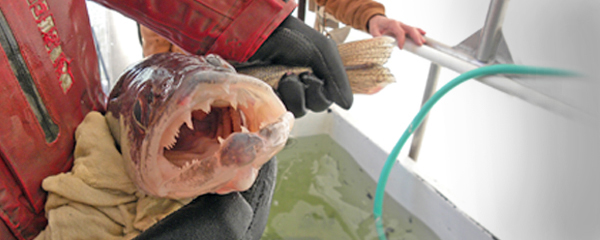
Most spawning activity occurs at night when female walleye search for the perfect rocky shoreline to lay their eggs, and male walleyes, who’ve been waiting on the spawning ground for days, fertilize them. With large females producing as many as 300,000 eggs, it’s hard to believe this species would need assistance with the process, but even the best laid plans are no match for Mother Nature. In Kansas lakes, less than 10 percent of naturally-spawned walleye eggs will hatch.
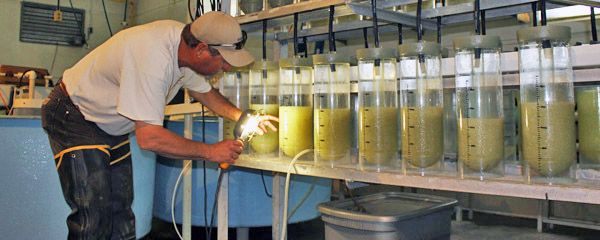
However, hatching success rates can be as high as 70 percent in a hatchery setting. That’s why every year about this time, you’ll see Kansas Department of Wildlife, Parks and Tourism (KDWPT) fisheries biologists working tirelessly at select Kansas lakes. Biologists set nets to capture spawning walleye, then harvest the eggs of ripe females. Once collected, the eggs are then taken to a station where they are fertilized with milt, or sperm, taken from male walleyes caught from the same body of water. After fertilization, the eggs are immediately delivered to the Pratt and Milford fish hatcheries where fish culturists work around the clock to ensure high hatch and survival rates of young walleye, which are then stocked into Kansas lakes as is, or used to produce other hybrid fish species. Last year, KDWPT’s Walleye Culture Program produced 43 million walleye fry (just hatched fish) and 660,000 walleye fingerlings (2-inch fish). With that same batch of eggs, KDWPT staff were also able to produce 7.5 million saugeye fry, 400,000 saugeye fingerlings (walleye/sauger hybrids).
In addition to walleye, KDWPT hatcheries also produce bluegill, channel catfish, crappie, largemouth bass, redear sunfish, sauger, saugeye,smallmouth bass, striped bass, and wipers.
For more information on KDWPT hatcheries and the fish they produce, visit www.ksoutdoors.com and click “Fishing/Hatcheries.”

Wednesday, April 3, 2013

KDWPT VIDEO FEATURES WALLEYE PRODUCTION PROCESS

“Walleye For Tomorrow,” a 15-minute video produced by the Kansas Department of Wildlife, Parks and
Video takes viewers along on walleye egg-taking journey
Tourism (KDWPT), shows each step in the process of producing walleye for Kansas lakes. Populations of this popular sport fish in Kansas lakes depend on the artificial spawning program that produces millions of walleye for stocking each spring.

The full-length video, which has only recently been digitized and posted for viewing on KDWPT’s website, is a must-watch for any dedicated Kansas walleye angler.

The video can be seen at http://ksoutdoors.com/Walleye-for-tomorrow.

Monday, March 18, 2013

ANGLERS, WALLEYE BENEFIT FROM ARTIFICIAL SPAWNING

Artificial spawning practices produce abundant fish populations
Spring marks the beginning of spawning season for several fish species, but it also marks the start of artificial spawning for walleye. Kansas Department of Wildlife, Parks and Tourism (KDWPT) biologists and culturists will work tirelessly this season artificially producing walleye to stock state reservoirs and lakes.

This highly-prized sport fish naturally spawns during March and April when temperatures reach around 45-50 degrees Fahrenheit. Female walleye will typically lay their eggs in a rocky area during the night, secreting upwards of 300,000 eggs. Although females produce eggs in abundant numbers, less than 5 percent of their young will successfully hatch in the wild due to various environmental factors.

When conditions are right, fisheries biologists will work long hours at select Kansas lakes to capture spawning walleye. Eggs are taken from ripe females, fertilized, then delivered to the Pratt and Milford fish hatcheries where employees work around the clock to ensure the success of the walleye young.

A non-native species to Kansas, walleye were first introduced to Kansas waters in the 1960’s through the KDWPT walleye culture program. In addition to walleye, KDWPT also artificially produces bluegill,channel catfish, crappie, largemouth bass, redear sunfish, sauger, saugeye, smallmouth bass, striped bass, and wipers.

KDWPT also operates hatcheries located at Farlington and Meade, as well as a rearing pond at Woodson State Fishing Lake. These hatcheries produce approximately 39.5 million fry, 3.5 million fingerlings, and 385,000 intermediate fish each year.

For more information on KDWPT hatcheries, visit www.ksoutdoors.com and click “Fishing/Hatcheries.”

Monday, June 4, 2012

LATE MAY AND JUNE PULL WALLEYE INTO SHALLOWS

LATE MAY AND JUNE PULL WALLEYE INTO SHALLOWS
May 31, 2012
Shallow points, flats, and underwater roadways lure anglers to big fish
PRATT — Many anglers pursue walleye in late March and early April, when breeding fish move onto the rip-rap of lake dams to spawn. But the best time to catch walleye is in May and June, when water temperatures warm and walleye move into shallows to feed. At this time, walleye fishing heats up over shallow points, flats, and underwater roadbeds, where walleye feeding is most intense.
While a boat gives an angler more access to lake structure, walleye can also be caught by wading anglers. Look for fish in water 3 to 15 feet deep, along shallow points and submerged roadbeds.
These post-spawn walleye are often aggressive and can be caught trolling with crankbaits or drifting a jig and night crawler combination. Jig size varies depending on the amount of wind and water depth, but usually a - or -ounce jighead works well. Popular lure colors include chartreuse, red, orange, pink, and white.
According to the Kansas Fishing Forecast, the best walleye fishing reservoirs this year are Webster, Kirwin, Glen Elder, Milford, and Cedar Bluff. And anglers shouldn't overlook smaller community lakes. The best smaller lakes rated are Pratt County Lake, Banner Creek Lake near Holton, Lower Barber State Fishing Lake, Herington City Lake, and Jeffery Energy Center Make-Up Lake.
Much credit for successful walleye fishing in Kansas can be attributed to the Kansas Department of Wildlife, Parks and Tourism’s (KDWPT) aggressive walleye stocking program. This year, KDWPT fisheries biologists harvested approximately 100 million walleye eggs and stocked almost 54 million fry. In addition, length limits allow walleye to grow to reproductive age, and in some reservoirs, prime habitat produces excellent walleye populations year after year.
Because of their size and reputation as great table fare, walleye are among the most popular sportfish in Kansas. Take advantage of this great angling resource. Conditions for walleye fishing can change daily, so visit the KDWPT Fishing Reports for the latest information.

Wednesday, May 18, 2011

Walleye Fishing Strategies in Kansas Waters


Shallow points, flats, and underwater roadways lure anglers to big fish

PRATT — The state record walleye is more than 13 pounds, but who knows? Someone may break it this spring as weather warms and walleye move into shallow water to feed. Because of their size and reputation as great table fare, walleye are among the most popular sportfish in Kansas. And as May and early June weather warms both water and air, walleye fishing heats up because the fish move over shallow points, flats, and underwater roadbeds to feed. While fishing from a boat is the preferred method, walleye can be caught at this time by wading. Look for fish in water 3 to 15 feet deep.

These post-spawn walleye are often aggressive and can be caught trolling with crank baits or drifting a jig and nightcrawler combination. Jig size varies depending on the amount of wind and water depth, but usually an eighth- or quarter-ounce jighead works well. Popular lure colors include chartreuse, red, orange, pink, and white.
According to the Kansas Fishing Forecast, the best walleye fishing reservoirs this year are Wilson, Cheney, El Dorado, Glen Elder, and Milford. And anglers shouldn't overlook smaller community lakes. The best smaller lakes are rated as Banner Creek Lake in Holton, Alma City Lake, Critzer Lake in Mound City, Scott State Fishing Lake, and South Owl Lake in Yates Center.

Much credit for successful walleye fishing in Kansas can be attributed to the Kansas Department of Wildlife and Parks' (KDWP) aggressive walleye stocking program. This year, KDWP fisheries biologists harvested approximately 80 million walleye eggs and produced almost 55 million fry. In addition, length limits allow walleye to grow to reproductive age, and in some reservoirs, prime habitat produces excellent walleye populations year after year.

Conditions for walleye fishing can change daily, so visit the KDWP Fishing Reports and the Public Fishing Reports, ksfishing.blogspot.com, for the latest information.

Enhanced by Zemanta

Wednesday, March 16, 2011

BIOLOGISTS ANGLING FOR WALLEYE FISHERMEN

Walleye (Sander vitreus, formerly Stizostedion...Image via Wikipedia
Early spring walleye spawning attracts anglers, fisheries biologists
PRATT — In late March and early April, walleye migrate to rocky shallows in Kansas reservoirs to spawn. At this time, anglers gather along rip-rapped dams hoping to catch large walleye by casting jigs, rattle traps, crank baits, and stick baits from shore. Some even wade to cast parallel with the shore. But anglers aren’t the only ones interested in this activity although their interests are at stake. Kansas Department of Wildlife and Parks (KDWP) fisheries biologists take advantage of the spawn to harvest walleye eggs, which are then taken to agency hatcheries where increased hatching success means more fish for anglers in years to come.

This year, three reservoirs will provide KDWP with walleye eggs. Egg-taking will begin on March 21 at Cedar Bluff Reservoir, March 21 at Hillsdale Reservoir, and March 28 at Milford Reservoir. Nets will be placed to catch spawning females that provide eggs both walleye and saugeye hatching programs. Fall test netting revealed large populations of big walleye in these three lakes.

Infestations of zebra mussels, white perch, and other aquatic nuisance species (ANS) in several Kansas reservoirs require special care during egg-taking to prevent the spread of these potentially-destructive species. All sperm and egg collection will take place on each lake and the fish returned to that lake immediately. Eggs will be fertilized at the lake, as well, so no fish will be moved.
On March 14, KDWP biologists began catching male sauger and milking them for milt (sperm) for the saugeye hatching program. (The saugeye is a walleye/sauger hybrid.) Milt is preserved in vials that are taken to Milford Reservoir to fertilize walleye eggs.

Biologists will work for the next few weeks collecting and fertilizing eggs, transporting them to KDWP's hatcheries at Farlington, Milford, and Pratt, and eventually stocking fish throughout the state. Some fry are stocked in hatchery ponds to be raised to fingerling size and stocked later in late May and early June. Others are stocked directly into lakes as fry.

In addition to walleye, the Milford Hatchery will produce the saugeye. Saugeye grow faster and larger than sauger and are thought to be less prone to wash-out high flow-through reservoirs than the walleye. To prevent production of fertile saugeye that have the potential to breed with walleye already in a lake — and potentially diluting that walleye population's genetics — a "triploid induction" process is used on some of the saugeye produced. Triploid induction is a technique that allows genetic manipulation of a chromosome number to create a potentially faster-growing, but sterile, saugeye.

KDWP's statewide harvest goal for 2011 is 77 million eggs, with a production goal of 37 million walleye, 8 million saugeye, and 1.2 million sauger. Because fewer than 5 percent of eggs hatch in the wild, artificial spawning and hatching is used to increase egg survival rates as much as 40-50 percent. When hatchery-bound eggs reach their destination, biologists monitor incubation closely. Water flows are checked to ensure constant but controlled movement. Water temperatures and oxygen content are also routinely checked. Dead eggs rise to the top of the jars and are siphoned off each day. With a water temperature of 60 degrees, hatching generally occurs on the eighth or ninth day of incubation. As the fry break out of their egg cases, they are carried upward by the water into large circular holding tanks where they are held for two to four days. Then they are ready for stocking.

All this activity may not be high-profile, but it makes Kansas walleye fishing much more productive. And as waters warm and days grow longer in late March and early April, many anglers take their cue from fisheries biologists and enjoy the opportunity to take walleye from the shore.