Showing posts with label Outdoors. Show all posts

Saturday, June 7, 2014

HOW TO FIND A FISHING HOLE THIS SUMMER

Finding a fishing hot spot in Kansas this summer is easier than you think
PRATT ­– If you’ve ever been fishing, you know there are a multitude of questions that can
flutter through an angler’s mind – why were the fish biting yesterday and not today? Did I put the right line on? Should I use a chartreuse or white spinner bait? All of these are valid questions, but where to fish shouldn’t be one of them. The Kansas Department of Wildlife, Parks and Tourism (KDWPT) has several tools available to help make your day on the water as successful as possible.
By visiting ksoutdoors.com, and clicking “Fishing,” anglers can access four invaluable resources that will give any angler an edge this summer, including: the 2014 Fishing Forecast, 2014 Fishing Atlas, up-to-date fishing reports, and stocking records.
2014 FISHING FORECAST
The 2014 Fishing Forecast uses data gathered from sampling efforts of public waters during annual lake monitoring, and because of this, anglers can rest assured they are receiving the best possible information on where to fish and what to fish for. In addition to what species of fish can be caught at any given body of water, the forecast also includes tables with Density Ratings, Preferred Ratings, and Lunker Ratings, as well as information on the Biggest Fish sampled, Biologist’s Ratings, and a Three-Year Average of popular species.
2014 FISHING ATLAS
The 2014 Fishing Atlas is a 60-page compilation of detailed, easy-to-read maps, making it a must-have for any angler. In addition to maps of public waters, anglers can also find maps of Fishing Impoundment and Stream Habitats (F.I.S.H.) waters, Community Fisheries Assistance Program (CFAP) leased properties, and lakes deemed as Family Friendly Facilities (FFF).
FISHING REPORTS
If you’re looking for the most up-to-date information on a specific body of water, fishing reports are the way to go. Compiled and entered in by KDWPT field staff, each week these fishing reports share everything from fishing success and water temperature, to lake levels and other pertinent information for that specific location. Anglers can even find out what baits and lures are catching the most fish.
STOCKING RECORDS
To improve fishing opportunities in urban areas where the demand for fish exceeds the supply, the Department created an urban fish stocking program. Seventy-seven lakes currently are stocked with 3/4- to 1 1/2-pound channel catfish, hybrid sunfish, and wipers as often as every two weeks from April through September. If you live in Atchison, Butler, Douglas, Finney, Johnson, Leavenworth, Lyon , Ottawa, Pottawatomie, Reno, Riley, Saline, Sedgwick, Shawnee, or Wyandotte county, you have an urban lake near you. These are great locations for a quick family fishing trip. Just throw the gear in the car and make the short drive to the nearest designated urban fishing lake. Click on the “Urban Fishing Program” link under “Special Fishing Programs For You” at ksoutdoors.com for stocking records and more information.
With a little time and research, anglers can experience truly one-of-a-kind public fishing on Kansas’ some 24 reservoirs, 40 state fishing lakes, 200 community lakes, and several streams and rivers – you just have to know where to look.
Enhanced by Zemanta

Monday, March 17, 2014

KICK START THE NEW SEASON WITH A SHED HUNT

One deer’s trash can be one hunter’s trophy after a successful shed hunt
PRATT – No one really knows why deer evolved to shed their antlers every year, but for
hunters looking for a way to connect with the world of big game outside of hunting season, knowing “why” isn’t nearly as important as “where” deer shed their antlers.
“We know the mechanisms of the process, but can only speculate on the why. Why would a species spend so much effort and energy to produce these large antlers and then give them up and go through the same process again each year?” says Kansas Department of Wildlife, Parks and Tourism (KDWPT) big game program coordinator, Lloyd Fox. “One reason might be because antlers get broken each year and the males want to have their most impressive rack, a new set, prior to the rut. Otherwise the old bucks would have busted remnants within a few years. Another speculation is that carrying around those large antlers is an energy drain and deer without antlers will spend less energy (thus have higher survival) as they go through the wintertime with its reduced food availability. Nobody really knows.”
Commonly referred to as “sheds,” deer antlers that have disconnected from a deer’s skull can provide hunters with valuable information about the buck that was carrying it. Most importantly, a shed antler tells a hunter that a particular buck survived the hunting seasons. A shed may also tell us whether the deer was a whitetail or mule deer, it’s approximate age, whether it was part of a “typical” or “non-typical” rack, and  it can provide information on a past location of the deer. 
The bulk of Kansas whitetail bucks,shed their antlers in February. Just like with any biological process, not every deer is the same. Some bucks have been known to shed as early as November/early December, while others have kept their antlers well into mid-April.
“Bucks will shed antlers over a wide time period, but each individual sheds about the same time each year,” said Fox. “In fact, some data has shown bucks to shed their antlers within a week of the same day each year of their life. It just depends.”
When in search of these left-behind treasures, hunters are encouraged to keep the following things in mind:
-Familiarize yourself with department procedures and the distinction between a shed and a skull with antlers. (Possession of a skull with antlers attached requires a salvage tag.)
-Shed hunting is allowed on KDWPT- managed lands except WIHA, but it’s a good idea to check ahead of time because it’s not allowed on U.S. Fish and Wildlife Service national wildlife refuges. Landowner permission is required on all private land.
-During the spring, ticks can be widespread, so the use of an insect-repellent made with DEET can be a good defense.
For a list of public lands where you can shed hunt, visit ksoutdoors.com and click “KDWPT Info / Locations / Wildlife Areas.”

Tuesday, March 11, 2014

35 SPRING TURKEY SPECIAL HUNTS STILL AVAILABLE

35 special hunts are still up for grabs this Spring
PRATT­­– The 2014 Spring Special Hunts draw may be over, but for several lucky turkey hunters, there’s still a chance to enjoy a special hunt this season. A total of 35 special hunts have remained unspoken for as of March 5, 2014. These hunts range anywhere from one day
to one month and are offered on a variety of different lands, including state parks, wildlife areas, Walk In Hunting Areas (WIHA's), national wildlife refuges, city and county properties, and other locations throughout the state.
Of the 35 hunts still available, 21 are “mentor” hunts, 12 are “youth” hunts, and two are “open” hunts. Mentored hunts are open to both youth and novice hunters supervised by a mentor 21 or older who may also hunt. Youth hunts require parties to include at least one youth 18 or younger, accompanied by an adult 21 or older who will not hunt. And open hunts are available to all successful applicants, regardless of age or hunting experience.
To view a complete list of the special hunts still available, visit ksoutdoors.com and click “Hunting/Special Hunts Information.” To receive a permit for one of these hunts, contact the Region 1 Hays Office at (785) 628-8614.

Sunday, March 2, 2014

YOUTH INVITED TO HUNT TURKEY AT JEFFREY ENERGY CENTER

Applications will be accepted through March 14, or until all spots are filled
TOPEKA – Westar Energy invites youth age 12-17 to participate in a spring turkey hunt, April 1-20, at Jeffrey Energy Center, located seven miles north of St. Marys. The event is open to all youth who meet the age requirement and have yet to harvest a turkey. Participants must be accompanied by an adult mentor, preferably one who does not have turkey hunting experience.  Participants will need a shotgun; however, no special clothing, calls or decoys will be required. Hunters 15 years and younger must purchase a youth spring turkey permit. Hunters 16 years and older will need a unit three turkey permit, hunting license and hunter education card.
Participants will hunt from enclosed blinds around small crop fields scattered over the property where turkeys are abundant. Hunts will take place primarily in the mornings and on weekends, but weekdays and afternoons are possible based on volunteer guide availability.
Registration will be open through Friday, March 14, or until all slots are filled. Applications will be accepted on a first-come, first-served basis with preference given to inexperienced mentors. For more information and to apply, contact Barb Cornelius at (785) 575-8125.
This project is supported by Westar Energy Green Team volunteers who are veteran hunters available to assist the youths and their mentors.

Friday, February 14, 2014

2014 SPRING TURKEY SPECIAL HUNTS APPLICATION ON-LINE

Hunters have untilFeb. 24 to apply for spring special hunts
HAYS ­– Snow might be covering your block, but spring is just around the corner, and that Feb. 1-24, hunters can apply for a special hunt at ksoutdoors.com by clicking “Hunting/Special Hunts.” Following the application period, a random drawing will be held with notifications sent to successful and unsuccessful applicants vie e-mail. 
means turkey season is on its way. Spring turkey hunters can get a head start on the season by applying now for exclusive entry into areas with limited access through the Kansas Department of Wildlife, Parks and Tourism (KDWPT) Special Hunts Program. While there is no guarantee of success, this special access usually means a higher quality hunt and potentially greater harvest rates. From
This year, the Spring Turkey Special Hunts Program is offering 202 different individual turkey hunts on 23 properties.  Half the hunts are “Open,” 58 are “Youth” hunts and 43 are “Mentor” hunts. The spring turkey special hunts occur on lands not normally open to public hunting including, but not limited to, wildlife areas, state parks, Corps of Engineers properties, National Wildlife Refuges, city and county parks and on private lands enrolled in the special hunts program. 
Open hunts are available to all hunters with no age or experience restrictions. Youth hunts are open to hunters 16 and younger accompanied by an adult. Mentor hunts are open to youth and novice hunters accompanied by an adult mentor. Both the youth/novice and the mentor may hunt during a mentor hunt. A novice is defined as a hunter who has not hunted turkeys in the last three years. Hunts can range from one day to several days, with some open the entire spring turkey season.
To view a list of current special hunts available, visit www.ksoutdoors.com and click “Hunting/Special Hunts Information.”
-30-

Monday, February 3, 2014

CATCH FIRST GLIMPSE OF 2014 FISHING REGULATIONS SUMMARY ONLINE

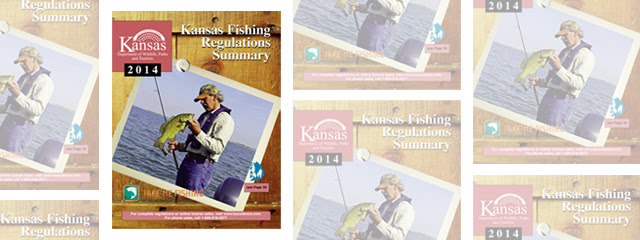
 For anglers, timely, quality information can be the difference between getting a couple tugs on a lure and a grill lined-to-the-brim with your favorite catch. Cram-packed with all the information you need to set up for a perfect day of fishing, the 2014 Kansas Fishing Regulations Summaryis the closest you can get to having a game warden, a fisheries biologist, ksoutdoors.com by clicking “Fishing / Fishing Regulations.” Print copies will be available wherever licenses are sold within one to two weeks.
and a hatchery manager at your beck and call. This free, easy to use, full-color pamphlet can be downloaded online now at

Apart from information on important fishing regulations such as special seasons, creel and length limits, license fees and legal fishing methods, anglers will also find a helpful section highlighting new regulations for the 2014 season in the summary. This publication is a must-have for anglers because creel and length limits vary from lake to lake.

Included in a special 16-page section, this pamphlet also lists all public waters, along with their location and any special regulations in effect. At the turn of a page, anglers can see which community lakes don’t charge extra fees for fishing, as well as community lakes designated as Family Friendly Facilities (FFF)thatwill include flush toilet facilities, security patrols, security lighting, easy access to the water and do not allow alcohol.

Information is also provided on aquatic nuisance species (ANS), as well as regulations governing the use of live baitfish. Five pages are devoted to fish identification, featuring color illustrations by Joe Tomelleri. Current state record fish are listed, and there is also a Master Angler Application for anglers who catch fish that qualify forthis certificate award program.

The2014 Kansas Fishing Regulations Summarypamphlet is truly an angler’s “Bible.” Grab a copy, read it, and keep it by your side. Available at more than 200 outlets statewide, and online, there’s no excuse to ever find yourself without one.

Saturday, November 30, 2013

LANDOWNER PERMISSION A MUST WHEN HUNTING PRIVATE LAND

Hunters must ask for permission before hunting on private land
PRATT – Hunters can face serious penalties for hunting on private land without landowner
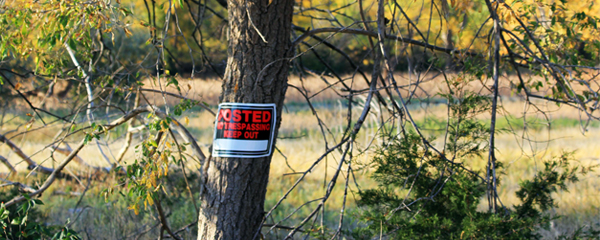
permission, and however tempting a trophy-sized buck, or a pond covered in greenheads may be, the consequences will always outweigh the perceived reward. With firearm season just around the corner, the Kansas Department of Wildlife, Parks and Tourism (KDWPT) reminds all hunters that it is illegal to hunt on private land, posted or not, without the owner's permission. Whether someone actually enters private land without permission or shoots onto it from the road or another landowner's property without permission, it is illegal.
Trespassing affects more than just the immediate parties involved. The perception of the hunting community as a whole and our hunting heritage are just a couple pieces of the puzzle affected by illegal hunting practices. Because trespassing harms landowner-hunter relations — and because the penalties for trespassing can be severe — hunters should be aware of the following trespass issues:
  • landowner permission should be obtained before pursuing wounded game onto private property. If the landowner cannot be found, contact a local natural resource officer or sheriff's office;
  • hunting from roads or railways without legal permission is a form of trespassing called criminal hunting;
  • conviction of trespass or criminal hunting may prevent the convicted person from enjoying hunting privileges in other states. KDWPT is a member of the Wildlife Violator Compact, that includes 34 other states. Under this compact, anyone who has had hunting, fishing, or furharvesting privileges revoked or suspended in a member state cannot hunt, trap, or fish in other member states;
  • conviction of simple criminal hunting can result in a maximum fine of $500, plus court costs, and one month in jail on the first conviction. Additionally, the court can suspend or revoke license privileges for up to a year. A second conviction requires at least a one-year suspension of privileges in addition to any fines or jail time;
  • if big game or turkey hunting is involved, the penalties get stiffer. Upon first conviction, the law states that the violator "shall not be fined less than $500 nor more than $1,000 or be imprisoned in the county jail for not more than six months, or both." The law requires fifth and subsequent conviction penalties of a minimum $1,000 fine and minimum 90 days in jail;
  • criminal trespassing is when the violator does not leave property when told;
  • it is illegal to hunt on land posted with written permission signs or marked with purple paint without having written permission on one's person;
  • in any of these cases, hunting privileges may also be revoked; and
  • by law, all hunters must have permission whether the land is posted or not.
Kansas’ wildlife resources should not only be revered, but respected. Before a hunter contemplates hunting on private land without landowner permission, the long term and widespread affect those actions will have on the future of Kansas hunting should be considered.
If you witness trespassing or illegal hunting, report it to your local natural resource officer, sheriff's office, or call the Operation Game Thief toll-free hotline at 1-877-426-3843. A list of phone numbers for all natural resource officers, listed by counties they cover, can be found in the 2013 Kansas Hunting & Furharvesting Regulations Summaryavailable wherever licenses are sold, or online at www.ksoutdoors.com.

Thursday, October 17, 2013

TREESTAND HUNTERS ARE ENCOURAGED TO HARNESS UP

Fall-restraint systems can be a life-saving tool when hunting from a treestand


PRATT – The deer rut can be some of the best hunting all year for bowhunters, and in the whirlwind of activity that takes place during this special time, it can be easy to get lackadaisical about safety practices. Every year, a surprising number of treestand hunters fall from treestands, some suffering serious injury or death.

“I’ve found that approximately 50 percent of all treestand hunters do not use any form of fall arrest devise,” says Kansas Department of Wildlife, Parks and Tourism assistant hunter education coordinator Aaron Austin, “so it’s not surprising that up to 30 percent of hunters who hunt from treestands will have an incident sometime in their lives.” Since treestand incidents aren’t required to be reported the way firearm-related hunting incidents are, Austin believes the number is a lot higher.

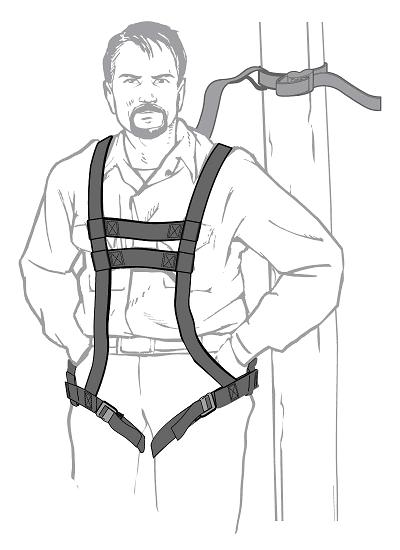
“As a bowhunter, I feel that being 20 feet up in a tree is part of the tradition of deer hunting, but it is important for hunters to be aware of the dangers of treestand hunting,” says Austin. “There are some great products on the market that fix this problem such as the Hunter Safety System Lifeline used in conjunction with a safety harness. This system allows the hunter to stay attached to the tree from the ground to the stand using a simple Prusik knot that slides up and down the line while ascending or descending the tree.”

Apart from using a proper-fitting full-body fall arrest system, Austin recommends treestand hunters keep the following in mind to stay safe this season:

-Select a live, straight tree to hang a stand on, and never hang a stand on a power pole.

-While hanging a stand or climbing a tree for the first time, use a full-body fall arrest system that is equipped with a lineman style climbing belt. A climbing rope, such as a HSS Lifeline, can then be permanently attached above the stand and to the base of the tree so that the hunter is always attached to the tree.

-Permanent stands are particularly dangerous and should be avoided because nails always pull out over time.

-ALWAYS maintain three points of contact with your steps or ladder while climbing up or down the tree.

-Use a haul line to raise or lower hunting equipment instead of trying to carry it.

-While the hunter is seated, there should be little to no slack in the tether that secures the hunter to the tree. Failure to keep the tether above the hunter could result in the hunter being unable to reboard the stand platform after a fall.

-Cold weather can effect the body and mind in several ways, including a delayed down reaction time, tightened muscles, and numbness, therefore treestand hunters should take every precaution to stay as warm as possible while hunting.

-Hunters should be cautious of any surface on the treestand that is wet, frosty or muddy. Failure to take notice of this can cause a hunter to lose traction, creating a potentially serious hazard.

For more information, including videos and current statistics on treestand safety, visit www.projectstand.net.

Sunday, October 13, 2013

WESTAR ENERGY GREEN TEAM INVITE YOUTH ON DEER HUNT

Applications for the Jeffrey Energy Center youth deer hunt dueNov. 1
TOPEKA – The Westar Energy Green Team will host a youth rifle deer hunt at the Jeffrey Energy
Center, seven miles north of St. Marys, Dec. 4-15and Jan. 1-12. Youth 12 and older are invited to attend and submit an application by Nov. 1. A limited number of spots are available, so hunts will be awarded on a first-come, first-served basis.
Hunts will be conducted from ground blinds in the early morning and late afternoon, and will be led by volunteer, experienced hunters. Hunters must be accompanied by an adult mentor and are encouraged to bring their own rifle; however, one can be provided upon request. Hunters must have a Unit 9 deer permit and hunters 16 and older must possess a hunting license and hunter education certificate.
An orientation session will be held on Nov. 16 to instruct hunters on safety, deer biology, and assist youth with sighting-in rifles. To apply for the hunt, contact Barb Cornelius at (785) 575-8125. Hunters successful in receiving a spot will be notified by Nov. 8.
The Green Team’s annual youth deer hunts are part of an initiative designed to introduce youth to hunting, and encourage hunting as a life-long tradition.

Sunday, October 6, 2013

ANGLER EDUCATION CLASS TO BE HELD AT OLATHE BASS PRO

Participants can be certified to teach fishing techniques in Kansas
PRATT – The Kansas Department of Wildlife, Parks and Tourism, along with Fishing’s Future, is excited to announce the Bass Pro Shops in Olathe as the site of the next angler education course on Saturday, Nov. 2, 2013. The class will be held from 9 a.m. to 1 p.m. in the Conservation Room on the second floor. There is no cost to attend; however pre-registration is required through the Fishing’s Future website (fishingsfuture.org). The Olathe Bass Pro Shops is located at 12051 Bass Pro Drive, Olathe, Kan. 66061.
“Conducting a Kansas Angler Instructor Certification Class at Olathe Bass Pro Shops provides a fun and professional atmosphere for our future instructors to learn in,” said KDWPT Community Fisheries Assistance Program coordinator Bryan Sowards. “We are grateful for Olathe Bass Pro Shops’ cooperation with our new Angler Education Program, and we hope to see many more events like this in the future.”
The Angler Education program, which was launched earlier this year, certifies anglers who successfully complete the course to teach fishing techniques within the state. Apart from becoming certified, participants will also be given valuable information regarding working with children, sample curriculums, and tips for preparing a class or clinic. Other subjects covered in the four-hour class include current fishing rules and regulations, species identification, fishing ethics, equipment, knot-tying, casting, fish habitat, aquatic nuisance species, and conservation practices.
“This class allows us to recruit fishing instructors who will eventually be able to act as volunteers on KDWPT's behalf, educating the public on fishing and the wonderful fishing resources our state provides,” said Sowards. “Kansas offers some of the best public fishing opportunities in the nation, and we think this is a great way for anglers to pass on their passion for fishing to those who may have yet to experience Kansas fishing.”
Anglers interested in registering for the Nov. 2 course can sign up by visiting fishingsfuture.org and clicking “upcoming events,” then “Kansas Angler Education Training Program.”
For more information, contact Fishing’s Future local coordinator Kevin Reich at kevin.reich@fishingsfuture.org, or by phone at (785) 577-6921.

Saturday, October 5, 2013

FIRST EVER PRE-RUT WHITETAIL ANTLERLESS SEASON OPENS OCT. 12

Firearm deer hunters will have an additional opportunity to take antlerless whitetails during
this special two-day season
PRATT – As part of a legislative mandate last year that required the state of Kansas to open a pre-rut firearm deer season, deer hunters may now hunt white-tailed antlerless deer Oct. 12-13, 2013. This new two-day season has been designed as an effort to create additional opportunities for hunters wishing to take antlerless whitetails.
After careful consideration, several commission meetings, and input from the public, it was decided that a two-day season over Oct.12-13 would provide a unique opportunity without infringing on established traditional seasons. During this two-day season, any permit that allows the harvest of a white-tailed antlerless deer is valid during this season. Equipment and unit restrictions listed on permits will still be in effect, and all deer hunters are required to wear hunter orange.
For more information, consult the 2013 Kansas Hunting and Furharvesting Regulation Summary, or visitksoutdoors.com and click “Hunting / Hunting Regulations.”

Saturday, September 7, 2013

DEER SEASON DEBUTS WITH ARCHERY AND MUZZLELOADER

Hunters are always encouraged to refer to the 2013 Kansas Hunting & Furharvesting before hitting the field
Regulations Summary
PRATT­ – For some, the beginning of fall is heralded by leaves changing colors, for others it’s cooler temperatures and shorter days, but for hunters fall is marked by the start of deer season. In less than two weeks, hunters will take to tree stands and blinds throughout the state, bow in hand and powder horn packed.
The 2013 muzzleloader season will begin Sept. 16 and run through Sept. 29. New this year, hunters are allowed to use muzzleloading rifles, muskets and pistols, .40 caliber or larger.
The 2013 archery season will begin Sept. 16 and run through Dec. 31. New this year, crossbows are legal archery equipment for all archers. However, anyone who hunts big game or turkeys with a crossbow must obtain a free Crossbow Survey ID Number available online at www.ksoutdoors.com.
Hunter orange, a hat and vest, must be worn by all hunters during the muzzleloader season, and shooting hours are one-half hour before sunrise to one-half hour after sunset.
The next deer season will be the new two-day Pre-rut Whitetail Antlerless Only season from Oct. 12 - Oct. 13, 2013, followed by the Regular Firearm season Dec. 4 - Dec. 15, 2013.
To download an electronic version of the 2013 Kansas Hunting & Furharvesting Regulations Summary, visitksoutdoors.com and click “Hunting / Hunting Regulations.” Printed copies can be found at local license vendors and at any Kansas Department of Wildlife, Parks, and Tourism regional office.

Saturday, August 24, 2013

2013 HUNTING ATLAS NOW AVAILABLE ONLINE

Atlas features 60 detailed maps with more than 1 million acres of prime hunting locations

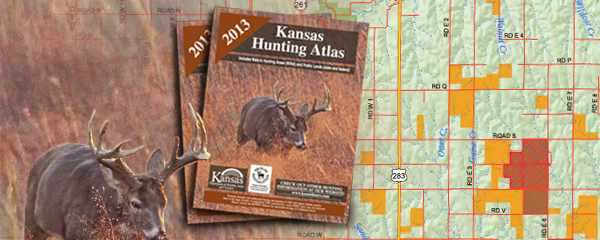
PRATT – With maps showing the location of more than 1 million acres of land open to hunting, the 2013 Kansas Hunting Atlas, available online now, is a must-have for hunters. Whether you’re looking for the perfect duck hunting marsh, scouting for land rich with upland birds, or scanning woodlots for the perfect place to set up your tree stand, Kansas Department of Wildlife, Parks and Tourism’s hunting atlas is the perfect tool Better than ever, the newly-redesigned hunting atlas features maps with shaded relief backdrops, county road names (where available), stream names, and much more. All state, federal and Walk-in Hunting Access areas are shown, color-coded for ease of use.
The atlas also features 2013 season dates and an outline of new regulations, making it quick and easy for hunters to get up-to-speed on important changes.
To view the atlas online, visit ksoutdoors.com and click “Hunting,” then “Where to Hunt,” then then “2013 Fall Hunting Atlas.” Hunters can also download an electronic version of the atlas from the KDWPT website, and file downloads that can be loaded onto Garmin GPS units. There are also file downloads for Android and iOS devices that can be used with Google Earth. The 2013 Hunting and Furharvesting Regulations Summary is also available on the KDWPT website. Printed versions of both pamphlets will be distributed in early September.

Wednesday, August 21, 2013

LOVEWELL STATE PARK TO HOST ANNUAL CAMPGROUND CHRISTMAS EVENT

Campers will trade in “hot and humid” for “ho, ho, ho” during this holiday decorating contest

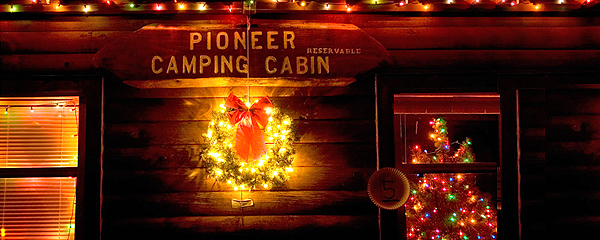
PRATT ­– Do the hot and humid days of summer have you wishing for a winter wonderland? Well look no farther than Lovewell State Park because your wish is about to be granted. Lovewell State Park, located in Jewell County in northcentral Kansas, will host the 11th Annual Campground Christmas event Saturday, Aug. 17. Campers will compete in a two-day decorating contest by adorning their campsites and cabins with yuletide themes.
The decorations will then be available for public viewing, followed by a formal judging at 8 p.m. Saturday evening. Prizes will be awarded at 11 a.m. the following morning.
Campers interested in entering the contest must register at the Lovewell State Park Office no later than 5 p.m., Saturday, Aug. 17. Those interested in viewing the campsites must have a vehicle permit to enter the park. Daily permits can be purchased for $5.00, annual permits for $25.00. For more information, contact Lovewell State Park manager Thane Loring at (785) 753-4971.
For a list of park events near you, visit ksoutdoors.com and click “State Parks/Event Calendar.”

Friday, July 12, 2013

Kansas Hunting News and More for July 12, 2013

Hunting News
You may wish to get your hunter education class scheduled if you need it for the http://goo.gl/877Z5.  Here you will find the class schedules and locations.
Fall hunting season.  If you were born on or after July 1, 1957 (ever wonder where they come up with dates like this?), you must have this to hunt in Kansas.  Kids 15 and under do not have to take the certification so long as under direct supervision of someone 18 or older who is certified.  More info at

On the Kansas deer hunting front, the KDWPT says they still have nonresident permits remaining in Deer Management Units 9, 10, 11, 13, and 14. As of a couple of days ago there were a little over 900 left. For more information visit http://goo.gl/kgefx.

As a reminder, Kansas hunters looking for public land have a new tool to use at Kansas Public Hunting Land.

Some areas that are not usually accessible to hunters will be open via drwaing.  These hunts see less pressure, more game, and higher success rates.  The application period begins on July 16th.  It closes August 11th.  There are literally hundreds these special hunts available.  For more information visit http://goo.gl/oHCva.

Sad 4th of July News
Five people died during the first week of July in drowing accidents around Kansas.  These kinds of accidents are needless, and following some basic safety rules, as well as obviously eliminating alcohol from the activity, would prevent the vas majority of them.  We are sorry for the victims and their families. For more details on this and some basic water safety rules, visit http://goo.gl/0LeV6


Saturday, June 29, 2013

APPLICATION DEADLINE FOR LIMITED RESIDENT ELK PERMITS JULY 12

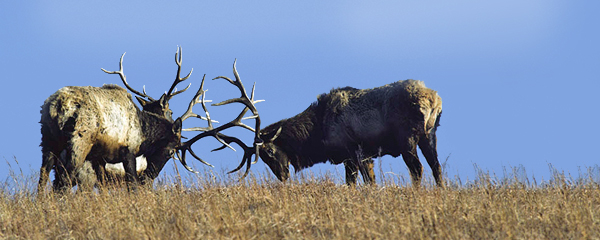
Boasting body weights that can easily reach a quarter-ton, elk are one of the largest land mammals to roam Kansas. Known for their brute
strength and the extraordinary antlers of males, these members of the deer family are prized by big game hunters far and wide, and were native on the Kansas prairie before settlement.

Although individuals and small herds exist throughout the state, most Kansas elk are concentrated on Fort Riley in elk management unit 2a. This summer, hundreds of hunters and military personnel will apply for a Fort Riley elk permit, however only about 25 will receive one. Fort Riley elk permits issued this year will include 10 either-sex and 15 antlerless-only. The 15 antlerless-only permits will be divided evenly among three segments: October, November, and December.

For other who wish to hunt elk outside of Fort Riley, general resident, landowner/tenant, and hunt-own-land permits are available. An unlimited number of resident and landowner/tenant either-sex or antlerless-only permits authorized for Unit 3 are available online and over-the-counter July 30, 2013 through March 14, 2014. Unlimited hunt-own-land either-sex and antlerless-only elk permits authorized for Units 2 and 3 will also be made available online and over-the counter through March 14, 2014. Hunt-own-land permits are valid during any season with equipment authorized for that season.

Elk permit prices are as follows:
Any-Elk (Either-sex)
  • General Resident: $252.50
  • Hunt-own-land: $127.50
  • Resident Youth (15 and younger): $127.50
Antlerless-Only Elk
  • General resident: $102.50
  • Hunt-own-land: $52.50
  • Resident Youth (15 and younger): $52.50
Elk season dates are as follows:
On Fort Riley (Elk management unit 2a)
  • Muzzleloader and Archery Season: Sept. 1 - Sept. 30, 2013
  • Firearms Season for Holders of Any-Elk Permits: Oct. 1 - Dec. 31, 2013
  • Firearms Antlerless First Segment: Oct. 1- Oct. 31, 2013
  • Firearms Antlerless Second Segment: Nov. 1 - Nov. 30, 2013
  • Firearms Antlerless Third Segment: Dec. 1 - Dec. 31, 2013
Outside Fort Riley (Elk management units 2 and 3)
  • Muzzleloader Season: Sept. 1 - Sept. 30, 2013
  • Archery Season: Sept. 16 - Dec. 31, 2013
  • Firearms Season: Dec. 4 - Dec. 15, 2013 and Jan. 1 - Mar.15, 2014
To apply for or purchase an elk permit, visit ksoutdoors.com and click “Hunting / Applications and Fees / Antelope & Elk.” A fee of $7.69 will be applied to every elk permit application and to those purchasing a bonus point.

Tuesday, June 11, 2013

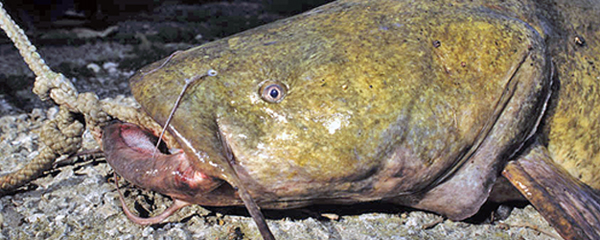
FLATHEAD CATFISH HANDFISHING SEASON RUNS JUNE 15-AUG. 31

The increased popularity of television shows like “Hillbilly Handfishin’,” “Catfishin’ Kings,” and “Mudcats,” proves that handfishing for large catfish can be an exciting and fast-paced sport. Luckily, Kansas is one of June 15-Aug. 31.
Special fishing season offers anglers a
more “hands on” way of catching flatheads
a handful of states that offer this special season. With a special permit, anglers can handfish for flathead catfish in select waters from sunrise to sunset

Commonly referred to as “noodling,” handfishing consists of finding a suspected catfish hole, barricading any possible exits the fish might escape through, using your hands as bait and sticking your arm inside the hole to catch the catfish bare-handed. Although seemingly easy, this sport can prove to be very dangerous for inexperienced anglers.

Adding to the challenge of handfishing, no man-made objects that attract fish, such as a barrel, box, or bathtub may be used. Handfishing anglers are also prohibited from using snorkel or scuba gear, as well as any hooks. A stringer may be used, but not until the catfish is caught by hand and is at or above the water’s surface.

Kansas waters open to handfishing include:
  • the entire length of the Arkansas River,
  • all federal reservoirs from beyond 150 yards of the dam to the upstream end of the federal property, and
  • the Kansas River from its origin, downstream to its confluence with the Missouri River.
Handfishing permits can be obtained for $27.50 at select license vendors or online. Anglers participating in this special season will need to have a handfishing permit in addition to a regular fishing license. New for 2013, handfishing permit-holders are no longer required to complete and submit a questionnaire following the close of the season.
To purchase a handfishing permit online, visit ksoutoors.com and click “License/Permits.”