Showing posts with label Oklahoma. Show all posts

Friday, March 14, 2014

LESSER PRAIRIE-CHICKEN RANGE-WIDE PLAN REACHES 2.5 MILLION ACRES IN FIVE STATES, INDUSTRY ENROLLMENT PROVIDES NEARLY $15 MILLION FOR HABITAT CONSERVATION

U.S. Fish and Wildlife Service Approves Oil and Gas Industry Candidate Conservation
Agreement with Assurances
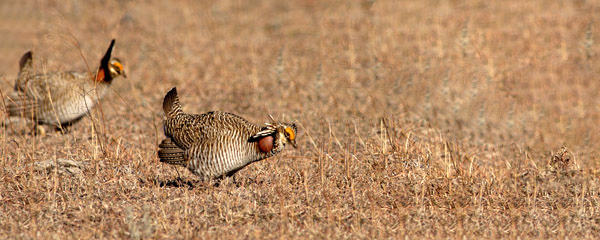
Private companies in five states have now enrolled more than 2.5 million acres in the Lesser Prairie-Chicken Range-wide Conservation Plan, representing oil and gas, pipelines, electric transmission and wind energy, resulting in nearly $15 million for habitat conservation over the next three years. Added to more than 1.3 million acres of oil and gas leases under conservation agreements in New Mexico, this brings the total industry commitment close to 4 million acres.
Range-wide plan enrollment now includes 14 electric transmission companies, representing most of the electric grid across the species’ range in New Mexico, Oklahoma, and Texas. Also, eight oil and gas companies have enrolled more than 2 million acres across all five states. And, two wind energy developments and one natural gas pipeline company have signed on, with more in the process of enrollment.
Last Friday, the U.S. Fish and Wildlife Service announced it had signed a Range-wide Oil and Gas Industry Candidate Conservation Agreement with Assurances (CCAA) with the western association, under the range-wide plan developed by WAFWA and state wildlife agencies in Colorado, Kansas, New Mexico, Oklahoma, and Texas. The service also announced an accompanying Environmental Assessment. The service has proposed listing the bird as threatened under the federal Endangered Species Act, with a final determination expected by March 31.
“Under the range-wide plan, a broad coalition of government, industry, agriculture and conservation interests is demonstrating unprecedented collaboration, showing we can take care of this bird and its prairie habitat without needing to list it,” said Bill Van Pelt, Western Association of Fish and Wildlife Agencies (WAFWA) grassland coordinator.
“When you consider all acreage enrolled in the range-wide plan, plus various CCAAs, Farm Bill programs, and other conservation programs across the lesser prairie-chicken’s range, the total area is about the size of the states of Vermont and New Hampshire combined. This is also approximately half the size of the species’ current range. We believe this sets a record for conservation delivery on predominantly private land for a species under listing consideration.”
The range-wide CCAA provides another option for oil and gas companies, which can also enroll directly in the range-wide plan. CCAAs are prelisting conservation tools, where enrollment must occur prior to a listing decision. Unlike the CCAA, enrollment under the range-wide plan can occur at any time before or after the listing decision.
Enrolling companies get regulatory assurances through a special USFWS rule or a CCAA permit, so that if the species is listed the companies have a pathway to continue operations and development in the region. The companies agree to pay modest enrollment fees, follow a list of guidelines to minimize impacts on the bird, and agree to pay for impacts they cannot avoid. The money goes to farmers, ranchers and landowners to protect and restore habitat for the bird. 
Complementing the range-wide plan, landowner CCAAs offer legal assurances for farmers and ranchers in New Mexico, Texas and Oklahoma. These cover a total of nearly 2.3 million acres across the three states. Landowners in Colorado and Kansas, who do not have access to a ranching CCAA, can enroll their lands under the RWP and receive the same assurances.
The range-wide plan includes habitat management goals and conservation practices to be applied throughout the lesser prairie-chicken’s range, guided by the Crucial Habitat Assessment Tool (CHAT) online database and mapping system.
The range-wide plan can be viewed on the WAFWA website. Industry representatives with questions about the plan may contact Sean Kyle, chairman of the Lesser Prairie Chicken Interstate Working Group, at sean.kyle@wafwa.org. Farmers, ranchers, and landowners may contact their local state fish and wildlife agency biologist to answer questions about enrollment in the plan.

Monday, February 25, 2013

PUBLIC INPUT SOUGHT ON DRAFT LESSER PRAIRIE CHICKEN MANAGEMENT PLAN


Anyone interested in lesser prairie chicken management encouraged to attend

PRATT – The Kansas Department of Wildlife, Parks and Tourism (KDWPT) has been working with the Lesser Prairie Chicken Interstate Working Group to produce a draft Range-wide Conservation Plan for the Lesser Prairie Chicken. The plan addresses the decline of the lesser prairie chicken in Kansas, Oklahoma, New Mexico, Texas and Colorado and is intended to benefit the wildlife resources, people, and economies of these states by providing a framework for effective lesser prairie chicken management and habitat improvement. The ultimate goal is to increase the range-wide population of lesser prairie chickens. The draft plan emphasizes incentives and tools that encourage landowners to partner with agencies in conservation efforts while achieving their land use needs.

In December, the U.S. Fish and Wildlife Service announced a proposal to list the lesser prairie chicken as a threatened species under the Endangered Species act. A final decision will be made next fall. The Interstate Working Group’s management plan could influence the USFWS’s decision if it can show that lesser prairie chicken populations can be managed at sustainable levels.

Public meetings were held in southwest Kansas in November to gain input from landowners, producers and other stakeholders as the plan was being developed. Now that a draft plan has been assembled, three additional public meetings are scheduled to continue the dialog.

March 5: WaKeeney, 7 p.m.-9 p.m., WaKeeney City Library, 610 Russell Ave.
March 6: Lakin, 7 p.m.-9 p.m., Kearny County Library, 101 E. Prairie.
March 7: Greensburg, 7 p.m.-9 p.m., Community Center (by fairgrounds), 720 N Bay.
More information about the planning process can be found at the project website: http://www.ksre.k-state.edu/p.aspx?tabid=275

Friday, February 1, 2013

U.S. FISH AND WILDLIFE SERVICE SEEKS LESSER PRAIRIE CHICKEN COMMENTS


The U.S. Fish and Wildlife Service (USFWS) will conduct a public meeting in Garden City on Thursday, February 7, 2013 to gather public comments on the proposed listing of the lesser prairie chicken. The meeting will be conducted at Garden City Community College, 801 N. Campus Drive, and will begin at 6:30 p.m.
In November, the USFWS announced it was initiating a process to consider whether the lesser prairie chicken should be recognized as a threatened species under the Endangered Species Act based on scientific evidence that the species and its habitat are in decline. The USFWS will make a final determination on whether to add the lesser prairie chicken to the list based on the best available science. Members of the public and scientific community are encouraged to review and comment on the proposal during the 90-day public comment period.
The Kansas Department of Wildlife, Parks and Tourism (KDWPT) is participating in a five-state effort to develop a range-wide conservation plan to address the decline of the lesser prairie chicken in Kansas, Oklahoma, New Mexico, Texas and Colorado. The conservation plan is intended to benefit the wildlife resources, people, and economies of these states by providing a framework for effective lesser prairie chicken management and habitat improvement that will increase the range-wide population of lesser prairie chickens. The plan will emphasize incentives and tools that encourage landowners to partner with agencies in conservation efforts while achieving their land use needs.

Friday, June 1, 2012

KDHE Modifies Public Health Advisory for Arkansas River

Downtown Wichita, Kansas, skyline at night fro...
Downtown Wichita, Kansas, skyline at night from The Keeper of the Plains at the Arkansas River (Photo credit: Wikipedia)
Friday work will permanently plug leak at Wichita’s wastewater treatment plant
TOPEKA, Kan.—The Kansas Department of Health and Environment (KDHE) has modified the public health advisory first issued on May 25 for the Arkansas River. Water samples collected by KDHE and the city of Wichita indicate that bacteria concentrations above the 47th Street bridge are safe for recreation. Therefore, KDHE is modifying the current health advisory to include the portion of the Arkansas River from the 47th Street bridge to the state line.

Last week, elevated levels of bacteria were recorded during routine stream sampling by KDHE’s ambient water quality monitoring program. The city then discovered a leak at an intermediate pump station at the wastewater treatment plant. Work crews constructed a temporary fix for the leaking valve, and it has been partially successful. Therefore, the city is implementing a permanent solution that is scheduled to be completed on June 1.

KDHE advises individuals to have no contact with the Arkansas River from the 47th Street bridge in central Wichita to the Oklahoma state line. Residents are also advised to keep their pets and livestock from making contact with the water.

State and local officials will continue working to assess the situation and are committed to minimizing the impact downstream. The affected portion of the Arkansas River is south, or downstream, of Wichita's Riverfest activities, which begin June 1.

KDHE will continue to follow up with water testing to determine when this advisory can be lifted.

Monday, May 28, 2012

HORTON MISSION LAKE EAST RENOVATION COMPLETE

Micropterus salmoides
 (Photo credit: Wikipedia)
Revitalized fishery, improved water quality, new facilities enhance lake
HORTON — Renovation of Horton Mission Lake East (½ mile north of Highway 20 on the east edge of Horton) is complete, and it is time to get out and enjoy this revitalized fishery. Mission Lake was opened to fishing on May 23.
Since the fishery was cleaned out last August, several thousand fish have been stocked, including fathead minnows, bluegill, black crappie, and largemouth bass. Some of these were smaller hatchery fish; however, a good portion were adults that were relocated from surrounding waters.
Is there a keeper fish behind every clump of vegetation or in every new brush pile? Probably not, but when Kansas Department of Wildlife, Parks and Tourism (KDWPT) biologists sampled the lake in mid-May, they saw a healthy young fishery. And since the renovation, water clarity has improved to more than 4 feet, much better than the 4-7 inches the lake used to have.
In addition to improving the fishery, staff have made several new additions to lake facilities, including a concrete boat ramp, courtesy dock, several fishing piers, two fish feeders, and several new campsites with electrical hookups.

Saturday, May 26, 2012

Public Health Advisory Issued for Portion of Arkansas River

English: Map of the Arkansas River watershed i...
Map of the Arkansas River watershed in the south-central United States. (Photo credit: Wikipedia)
Advisory extends from Lincoln Street Bridge in Wichita to Oklahoma state line
TOPEKA — The Kansas Department of Health and Environment (KDHE) has issued a public health advisory for a portion of the Arkansas River due to elevated levels of bacteria discovered during routine stream sampling by KDHE’s ambient water quality monitoring program. KDHE has also confirmed a report of a fish kill in the Arkansas River in areas where there is black, odiferous water.

The health advisory covers a the stretch of the Arkansas River from the Lincoln Street Bridge in central Wichita to the Oklahoma state line.

KDHE advises individuals to have no contact with the Arkansas River between the locations identified above until further notice. Residents are also advised to keep their pets and livestock from making contact with the water.

The cause has not been identified. KDHE is conducting an investigation and will follow up with additional water testing to determine when this notice can be lifted.

Sunday, March 18, 2012

AERIAL SURVEY TO SEARCH LESSER PRAIRIE CHICKEN RANGE

English: Lesser Prairie Chicken (Tympanuchus p...
Image via Wikipedia
Helicopters will be used to search for new breeding grounds; data may help prevent endangered species listing
PRATT — Kansas Department of Wildlife, Parks and Tourism (KDWPT) biologists are cooperating with the Western Association of Fish & Wildlife Agencies (WAFWA) to find new lesser prairie chicken breeding grounds, called “leks,” in western Kansas. WAFWA received funding to evaluate an aerial survey technique that can be used for uniform monitoring across the five-state range of the lesser prairie chicken.

During the survey this spring, surveyors will fly low-elevation transects in helicopters within several randomly chosen 10-square kilometer blocks throughout the lesser prairie chicken range, which includes portions of western Kansas, southeastern Colorado, western Oklahoma, north Texas, and eastern New Mexico. Field crews will train on March 29-31 in Trego County and conduct official survey work across all of western Kansas until the middle of May.

“Everyone in western Kansas is asked to be on the alert for prairie chicken leks,” says KDWPT small game coordinator Jim Pitman. “We are trying to acquire better information on the distribution and population of lesser prairie chickens to help guide an impending Endangered Species Act listing decision being developed by the U.S. Fish and Wildlife Service. This data, coupled with U.S. Department of Agriculture conservation efforts, provide us with the information that may help prevent listing of the lesser prairie chicken.

“If a lek is observed this spring, we are asking that it be reported to the nearest KDWPT biologist or law enforcement officer. We also have an online reporting database. This information is extremely important to the department because it will help us target conservation programs and provide site recommendations to energy developers.”

The work was contracted to Western Ecosystems Technology, Inc., of Cheyenne, Wyo., and the aerial survey protocol was developed by the Lesser Prairie Chicken Interstate Working Group, of which KDWPT is a partner.

Sunday, February 19, 2012

MOSSY OAK EVENT LURES MONSTER BUCK POACHING SUSPECT

Map of Kansas highlighting Shawnee County
Image via Wikipedia

Topeka man enters suspected illegally-taken deer in Monster Buck Contest
TOPEKA — On Jan. 27-29, Mossy Oak Properties of the Heartland presented the inaugural Monster Buck Classic (We are Kansas) event at the Kansas ExpoCentre in Topeka. The event was designed to promote deer hunting and outdoor recreation in Kansas and to provide Kansas hunters with the latest information and equipment related to deer hunting.
In addition, the event featured a Monster Buck Contest, open to all Kansas residents, in which hunters could enter officially-scored bucks, with prizes offered to the largest deer in typical and non-typical categories for both white-tailed and mule deer. Fortunately for all law-abiding hunters, the contest helped expose the suspected illegal shooting of a big buck.
One entry, which would have potentially been a new Kansas state record, drew suspicion of Kansas Department of Wildlife, Parks and Tourism (KDWPT) law enforcement officials, and after investigation, David V. Kent was charged with poaching the deer.
On Feb. 1, eight charges were filed against Kent by Osage County Attorney Brandon Jones in the District Court of Osage County, Fourth Judicial District, including criminal discharge of a firearm, criminal hunting, illegally hunting with an artificial light, hunting outside of legal hours, illegal hunting during a closed season, using an illegal caliber for taking big game, illegal hunting from a vehicle, and hunting without a valid deer permit.
Kent has been summoned to appear in Osage County District Court in Lyndon, Kan., on March 1, 2012, at 9 a.m.
“As a developer of the Mossy Oak Properties brand in Kansas, Oklahoma, Missouri, and Iowa, I strongly condemn this type of behavior,” said Brian D. Smith, CEO of Mossy Oak Properties of the Heartland and founder of the Kansas Big Buck Classic. “In fact, we believe in the stiffest penalties possible for poaching, and we played a strategic part in exposing this case. We cooperated 100 percent.”