Showing posts with label Water. Show all posts

Friday, August 9, 2013

LAKE SHAWNEE ANGLER CATCHES ALIEN FISH

KDWPT advises anglers who catch exotic fish to not return them to water
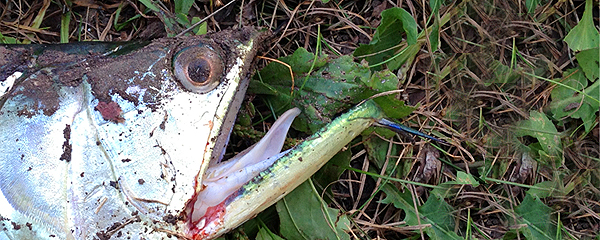
TOPEKA­– An unidentified angler landed quite a surprise at Lake Shawnee in Topeka Sunday, July 21, when he hauled in a silver arowana, a primitive freshwater fish native to the Amazon River Basin in South America. Often kept as aquarium pets, arowanas do not belong in Kansas waters. The fish was about 20 inches long and was likely released into Lake Shawnee or upstream by someone who could no longer care for it. Sold as youngsters, arowanas can grow to 2 feet long or more in captivity and can quickly outgrow their aquariums. They grow to nearly 4 feet long in the wild. Arowanas are aggressive and carnivorous, and they may eat other aquarium fish.
Jessica Howell, aquatic nuisance species coordinator for the Kansas Department of Wildlife, Parks and Tourism (KDWPT), cautioned that people should not release aquarium animals into the wild. “It’s against state and federal law to release any exotic species into Kansas waters, and new regulations also make it illegal to dump any fish into waters where they don’t originate,” she said. “Responsible aquarium owners never release anything, including water, plants, snails and fish into a stream, pond, lake, ditch or storm drain.”
The angler who caught the fish asked Torrey Bevans, who was fishing nearby, for help. Bevans photographed the fish so it could be identified and correctly advised the angler to not return the fish to the lake. The fish died on the bank, although it took some time, as arowanas can get oxygen by drawing air into their swim bladders. Bevans visited a KDWPT office in Topeka on Monday to report the catch and share his photos.
Howell said Bevans gave the correct advice. “If you catch an exotic fish, do not return it to the water. Instead, let it die and photograph it or put it on ice for later identification by a KDWPT biologist. If you own exotic fish, visit ProtectKSWaters.org for suggestions on responsibly handling unwanted aquarium specimens so you don’t break the law.”
With sharply upturned lower jaws and eyes high on the sides of their heads, arowanas are specialized for feeding at the surface where they pick off insects, small fish and other animals. Two barbels (“whiskers”) on their lower jaws help arowanas sense movement and locate prey in murky water. Sometimes called monkey fish or water monkeys, they are spectacular jumpers in their native waters and can leap up to 6 feet out of the water to catch birds, snakes or frogs.
For information on aquatic nuisance species, visit ProtectKSWaters.org.
Photo courtesy of Torrey Bevans.

Thursday, November 29, 2012

SAFE COLD-WEATHER BOATING

English: A Coast Guardsman demonstrating the h...

Boating during the winter requires added precautions to ensure safety
Following basic safe boating rules is necessary whenever you’re on the water, but it takes on a new level of importance when the water is cold. As a rule of thumb, if the sum of the air and water temperatures added together equals less than 100 degrees and you fall into the water, you could be looking at a hypothermic situation.
Hypothermia occurs when your body loses heat faster than it can produce it, and cold water robs the body of heat 25 times faster than cold air. When your core body temperature drops below normal (98.6 degrees F), you become hypothermic. Your preparation and how you handle yourself following a fall into cold water will determine your odds of survival.
Remember the “1-10-1” rule. If you fall overboard, you usually have one minute to get your breathing under control. An involuntary gasp occurs when your body encounters the cold water, and this can cause you to breathe in a large amount of water, which can lead to drowning. After the initial shock, you will experience about one minute of deep and uncontrolled breathing. Calming yourself will be easier if you're wearing a life jacket because it will keep your head above the water line and help you avoid breathing in mouthfuls of water.
Over the next ten minutes, your blood flow will start to move away from your hands and feet in order to keep your body’s core warm. The body instinctively attempts to keep vital organs warm and functioning. This affects nerves and muscles farther away from your core, limiting their ability to function. It is during this crucial time that any attempt at self rescue should be made. Get out of the water. Even if your boat is capsized and upside down, crawling onto the part of the boat that is still above water will increase your odds of survival. If you are not wearing a life jacket and can’t get out of the water, you will eventually lose the ability to tread water or swim due to the lack of response from your arms and legs.
Keeping your core protected can help keep you conscious longer, and using the Heat Escape Lessening Position (HELP) will keep your core warmer longer. Wearing a life jacket makes the HELP position easier; you just pull your legs up to your chest and hug your knees. This keeps your body compact and surrounds your chest with protection. If you are in the water with other people, you can huddle together and share warmth. Most people will lose consciousness in one hour, but if you are wearing a life jacket, your face will be above the water and you will still be able to breathe even if you start to fade.
Always dress for the weather by wearing layers that can be removed if the weather warms, and avoid cotton clothing. Cotton will keep the water trapped by your body instead of wicking it away, and it takes a long time to dry. But if you do end up soaking wet, never remove your clothing and shoes unless you have a dry set to change into. Even though the clothes are cold and wet, they provide insulation to your body and will actually keep you warmer. By understanding how hypothermia affects your body and the 1-10-1 rule -- one minute to control your breathing, 10 minutes to rescue yourself and one hour before you lose consciousness -- you can increase your chance for survival if you run into problems while boating in cold water. Of course, wearing life jacket is always the smart choice while boating during any time of the year.

Saturday, November 5, 2011

KANSAS STATE PARKS OPEN FOR WINTER BUSINESS

Tent op kampImage by florisla via Flickr
Cold weather months limit facilities, but parks still offer outdoor opportunities

PRATT — Kansas state parks began their off-season on Oct. 1, and it runs through March 31. During this time, many state parks cut down on services although all remain open. Hours and services vary from park to park, but most offices are open 8 a.m. to 4:30 p.m. Monday through Friday but are closed on holidays.

In addition, most unheated toilets and shower buildings with running water are shut down for the cold season. Most heated buildings remain open through the regular firearms hunting seasons, and some remain open year-round. While drinkable water is available at each park headquarters all year, water is shut off at campgrounds and day-use areas that are prone to freezing pipes.

Most parks have some drinkable water available at freeze-proof valves in campgrounds into late November or early December, depending on the weather. Electricity stays on year-round where it is available. Each park remains open to vehicles; however, some campground loops may be closed. Some boat ramps across the state may be closed or only usable by shallow-draft boats.
And while some facilities are reduced, so are some off-season park permit fees. A Daily Vehicle permit is $3.70 (senior/disabled, $2.60); an Annual Vehicle permit is $19.70 (senior/disabled, $11.10); a Daily Camping permit is $7.50; and a 14-Day Camping permit is $87.50.

In addition, rental cabins 20 state parks and five wildlife areas make a winter stay comfortable. For more information on cabins at state parks, go to “State Parks/Locations With Cabins” at the Kansas Department of Wildlife, Parks and Tourism (KDWPT) website, www.kdwpt.state.ks.us.
For other winter park details, look up individual state parks on the KDWPT website. Conditions may also be checked by phoning individual parks.

Friday, October 28, 2011

COLD-WATER BOATING REQUIRES ADDED PRECAUTIONS

Life Jacket (PSF)Image via Wikipedia
Anglers and hunters can protect themselves against hypothermia
PRATT — While pleasure boaters have winterized and stored their watercraft, avid waterfowl hunters and cold-weather anglers are gearing up for fall hunting and fishing seasons. But fall can be a dangerous time on the water. Most single-boat accidents take place this time of year, and with water temperatures cooling, these accidents can be deadly.
One common mistake is overloading a small boat with people and equipment. Overloaded boats are unstable and can easily capsize or cause passengers to fall overboard into frigid water. Sudden immersion into cold water delivers a brutal shock to the body, triggering a spontaneous inhalation reflex — deadly if one’s head is under water. But wearing a life jacket can be enough to keep your head above water during an involuntary gasp, keeping lungs from filling with water.
In addition, the body loses heat 25 times faster in water than in air of the same temperature. Hypothermia begins with shivering and a loss of feeling in the extremities. Within minutes of being immersed in cold water, a person can become confused and lose muscle control. By keeping capsized boaters afloat, life jackets also enable them to conserve energy and get out of the water or be rescued.
The following simple steps can make a cold water boating expedition much safer:
  • always wear a life jacket — new styles and camouflage patterns, including float coats, make wearing a life jacket much more comfortable;
  • dress properly for the cold — layered clothing can provide insulation and trap air to hold warmth;
  • avoid cotton clothing — wool and many synthetic materials are good choices, but cotton wicks cold water in toward the body;
  • never boat alone; and
  • let family members or friends know where you’re going and when you plan to return.
Boating can be an excellent way to hunt or fish in cold weather, but be safe. Planning ahead for the possibility of a cold water accident can save a life.

Saturday, August 6, 2011

ALGAE BLOOMS AGITATE FARM PONDS, FARMERS

Cyanobacteria (blue-green algae): Arthrospira ...Image via Wikipedia Fish-killing algae blooms, oxygen depletion can harm farm ponds as well as lakes
PRATT — Summer blue-green algae blooms at a number of Kansas reservoirs are not isolated to large bodies of water. Record hot temperatures this summer have created the algae blooms in farm ponds, as well, and nothing can be more disheartening than to carefully nurture a pond only to discover a fish kill on a hot summer morning. While blue-green algae blooms can be toxic to fish, fish kills can also result from oxygen depletion created by a number of factors not necessarily associated with blue-green algae blooms.
To support fish and other higher organisms, a pond or lake must have one element — dissolved oxygen. Oxygen depletion is the most common cause of fish kills, and low oxygen occurs most often during periods of calm, cloudy, hot weather. Although Kansas has not experienced many cloudy days this summer, 100-degree days have been strung together like glue, and green algae has tinted most ponds this summer.
Most dissolved oxygen in water comes from the atmosphere on windy days and as a byproduct of photosynthesis in aquatic plants such as filamentous algae (commonly called "moss"), green algae, and coontail. If less sunlight penetrates deeper water — because of clouds or murky water — vegetation and oxygen content at deeper levels are reduced. Dissolved oxygen levels can also be affected by temperature. Colder water holds oxygen better, and very warm water easily loses oxygen. Atmospheric pressure is also a factor. Oxygen solubility increases as atmospheric pressure rises.
Most fish kills occur in the early morning before the sun comes up, when dissolved oxygen levels are lowest, and, unfortunately, larger fish are usually the first to be affected. Ponds or lakes with large amounts of algae or phytoplankton can have high oxygen during the day, but at night, bacteria that feed on these dying plants use up oxygen.
Herbicides or algaecides can help control aquatic vegetation and reduce the chances of a fish kill. However, this must be done carefully to prevent rapid decomposition and further oxygen depletion. Other ways to prevent oxygen depletion include pumping or flowing water into a pond (especially in the early morning hours before sunrise); diluting runoff that adds nutrients to a pond; using a commercial aerator; reducing feed if artificial feeding is used; and maintaining proper fish density for the size of the pond.
Blue-green algae blooms such as those that have affected larger lakes in the state also can cause fish kills in ponds and small lakes. Blue-green algae blooms often resemble green or turquoise paint floating on the water. These blooms result when long-term build up of nutrients in the water (nitrogen and phosphorus) combine with hot weather and other environmental conditions to stimulate algae growth. In time, these algae blooms naturally die off.
For more information on pond management, contact the Kansas Department of Wildlife, Parks and Tourism at 620-672-5911 or visit the department website, www.kdwpt.state.ks.us. Type "Pond Management" in the search box and then click on "Producing Fish and Wildlife in Kansas Ponds."

Wednesday, June 22, 2011

PUBLIC HEALTH ADVISORY ISSUED FOR MEADE STATE FISHING LAKE

Cyanobacteria (blue-green algae): Arthrospira ...Image via Wikipedia
Blue-green algae bloom still toxic
MEADE — On June 22, Kansas Department of Wildlife and Parks (KDWP) Secretary Robin Jennison issued Emergency Secretary Order closing some recreational access to the waters and beach areas of Meade State Park, in Meade County. A few days earlier, the Kansas Department of Health and Environment (KDHE) had found a blue-green algae bloom in Meade State Fishing Lake at the park. Direct water contact activities such as swimming and wading are prohibited until further notice.
In the meantime, authorities will continue to monitor lake conditions. KDHE recommends the following precautions at Meade State Fishing Lake:
  • do not drink lake water;
  • avoid swimming, wading, or other activities with full body contact of lake water;
  • clean fish well, consume only the fillet portion, and discard all other body parts;
  • keep pets from having contact with or drinking the water.
Contact with the water, such as wading or swimming, can cause a skin rash, as well as eye, ear and throat irritation. Ingestion or inhaling aerosols (such as from personal watercraft or boating) of contaminated water can cause diarrhea, vomiting, abdominal cramps, fever, fatigue and flu-like symptoms. If you develop similar symptoms after contact with the lake water, seek medical care from your healthcare provider.
Animals, especially dogs, can also become ill as a result of coming into contact with, or ingesting the water. If your pet becomes ill soon after contact with the water, contact your veterinarian right away.
KDHE and KDWP will continue to monitor the situation and rescind this advisory as soon as conditions warrant. If the public has any questions or concerns, KDHE can be contacted during normal business hours at 785-296-6603.
Further information on algae and algae blooms can be found online at www.kdheks.gov/algae-illness/index.htm

Enhanced by Zemanta

Wednesday, June 1, 2011

KDHE ISSUES ALGAE BLOOM WATCH


Blue-green algae blooms of particular concern as weather warms

TOPEKA — As summer heat warms ponds, lakes, and reservoirs, the Kansas Department of Health and Environment (KDHE) is reminding water recreationists to be on the lookout for algae blooms. At this time of year, more Kansans spend time in the water, and the agency is asking for help and heightened awareness from those who enjoy water sports.

Algae are microscopic organisms that grow naturally in the ocean and freshwater, but under certain conditions and warmer weather, they can grow rapidly. When this happens, blue-green algae can produce toxins capable of causing illness in people and animals.

“Last year, our recorded number of cases was higher than previous years,” explains Dr. Robert Moser, KDHE secretary. “I strongly urge everyone to check KDHE’s algae website for advisories before visiting reservoirs and other public water bodies this summer. We appreciate public cooperation and assistance in making the summer season fun and safe for all Kansans.”

Moser also noted that a large percentage of the public will report "allergic" type reactions after exposure, such as intestinal problems, respiratory problems, or skin irritations.

For the latest algae advisories and warnings around Kansas, as well as detailed information on blue-green algae, go online to www.kdheks.gov/algae-illness/algae_advisories.htm.

Enhanced by Zemanta

Friday, May 27, 2011

ALL EYES ON KIDS NEAR WATER

Safe Kids Kansas campaigns to prevent childhood drowning
TOPEKA — It’s a warm summer day, and you’re at the beach with your kids. Your cell phone rings, and you answer it, shifting your focus from your kids to the conversation. Good idea? Not at all, according to Safe Kids Kansas, a coalition of more than 70 statewide and regional organizations and businesses dedicated to preventing unintentional injuries to Kansas children. In fact, taking your eyes off a child near water, however briefly, could be deadly. Children can get into trouble in a matter of seconds around water, so Safe Kids Kansas recommends that parents keep their eyes on their kids at all times when they are in or near the water.
Drowning is the second highest cause of unintentional death for children ages one to four and 10 to 14 in the U.S. And when it comes to water, “the safety of home” is an axiom that does not apply. In fact, most pool submersion deaths and injuries occur at a home pool.

In the U.S., approximately 830 children ages 14 and younger die each year due to unintentional drowning, and there are an estimated 3,600 injuries to children after near-drowning incidents each year. From 2000-2008 there were 129 unintentional injuries from near-drowning related incidents among Kansas kids age 14 and younger. From 2000-2009, there were 73 unintentional drowning-related deaths in Kansans age 14 years and younger. Three-quarters of these deaths were children age three and younger.

“Kids drown quickly and quietly,” says Cherie Sage, state director for Safe Kids Kansas. “A drowning child cannot cry or shout for help. The most important precaution for parents is active supervision. Simply being near your child is not necessarily supervising.”

To help keep kids safe near water, Safe Kids Kansas recommends the following precautions:

  • actively supervise children in and around water. Don’t leave, even for a moment. Stay where you can see, hear, and reach kids in water. Avoid talking on the phone, preparing a meal, reading, and other distractions;
  • enroll kids in swimming lessons about age four, but don’t assume swimming lessons make your child immune to drowning. There is no substitute for active supervision;
  • don’t rely on inflatable swimming toys such as “water wings” and noodles. If a child can’t swim, keep him within arm’s reach;
  • learn infant and child CPR. In less than two hours, parents can learn effective interventions that can give a fighting chance to a child whose breathing and heartbeat have stopped. Contact a local hospital, fire department, recreation department, or Red Cross office for information about local CPR classes; and
  • keep rescue equipment, a phone, and emergency numbers by the pool.
Some people bring inflatable and portable pools to state parks, and these guidelines apply to water away from the beach, as well. Even 5-gallon buckets of water can be deadly to a toddler. Such water sources should be emptied and stored out of reach when not in use.

Even a near-drowning incident can have lifelong consequences. Kids who survive a near-drowning may have brain damage, and after four to six minutes under water, the damage is usually irreversible. Although 90 percent of parents say they supervise their children while swimming, many acknowledge that they engage in other distracting activities at the same time — talking, eating, reading, or taking care of another child.

For more information about drowning and water safety, call Safe Kids Kansas at 785-296-0351 or visit www.safekids.org.

And don’t forget boating safety. The Kansas Department of Wildlife and Parks reminds boaters that all youngsters 12 and younger must wear personal flotation devices when onboard. For more information on boating safety, visit the Kansas Department of Wildlife and Parks website, www.kdwp.state.ks.us, and click “Boating.”
Enhanced by Zemanta

Wednesday, April 6, 2011

SAFETY FIRST WHEN ON THE WATER

Lifejacket from MS Estonia.Image via Wikipedia
Boaters reminded of laws, safety rules that could save a life
PRATT — It’s springtime, and outdoor recreational users are taking to the water. Fishing, skiing, tubing, sailing, and paddle sports are common activities people enjoy while boating on Kansas waters. With the new season, the Kansas Department of Wildlife and Parks (KDWP) reminds recreational enthusiasts that safety equipment, attention to rules, and properly-maintained equipment help make a safe and enjoyable trip.
The most valuable piece of equipment for both swimmers and boaters is the personal flotation device (PFD), commonly known as a life jacket. “Of the six boating-related fatalities that occurred in 2010, all were from drowning, and none of the victims wore a life jacket,” says Dan Hesket, boating law administrator for KDWP. “These tragedies illustrate the importance of obtaining and wearing a proper life jacket. New designs of life jackets, including inflatable designs, eliminate common excuses for not wearing them. These new PFDs are comfortable, fashionable, and designed to reduce any restrictions while moving around.”
Attending or completing an approved boating safety course is also highly recommended and is required for any person between the ages of 12 and 20 who wishes to operate a vessel (PWC, power boat, sailboat) without direct, on-board supervision. In addition, no one under the age of 12 may operate a vessel without direct, on-board supervision regardless of boater education certification. Information on courses may be found at the KDWP website,www.kdwp.state.ks.us. Just click “Boating/Boating Education.” This course provides information on types of equipment required on vessels, as well as others suggested to make the outing as safe as possible.
Many people are unaware that there are operating rules for boats on the water, which include being able to recognize buoy markings and the proper use of navigation lights. Knowledge of these rules can prevent dangerous, even deadly, situations.
Safety on the water is not all that is covered in a boating education course. Before turning the key, letting down the sail, or controlling a paddle, you must first get the boat to the water. Most of this involves the use of a trailer. Proper trailer inspections cover wheel bearings, trailer lights, winch straps, structural integrity of trailers, and properly-working trailer hitches.
Motorized boats and sailboats are required to be registered and properly numbered before operated on public waters of Kansas. Original registration papers must be on board and made available for inspection. Upon sale of a boat, the registration must be properly transferred to the new owner before it can be legally operated on public waters.
For more information on boating safety and boating laws, phone KDWP at 620-672-5911 and ask for Boater Education.