Showing posts with label Law. Show all posts

Wednesday, November 27, 2013

WILDLIFE CHECKPOINT PLANNED IN SOUTH CENTRAL KANSAS

Joint effort will check for drivers’ licenses and possession of wildlife
PRATT – The Kansas Department of Wildlife, Parks, and Tourism (KDWPT) and local law enforcement officials will conduct a joint checkpoint in south central Kansas in early December. The regular firearm deer season starts December 4, and upland game bird, certain waterfowl and trapping seasons are underway. The checkpoint is intended to help enforce state and federal wildlife laws, gather critical harvest and biological information and enforce the state’s driver’s licensing laws.
Local law enforcement officers will operate the first stage of the checkpoint to be sure drivers are properly licensed to be driving. If a driver does not have a valid license, appropriate enforcement actions will be taken. Travelers can expect minimal delays from this portion of the checkpoint.
Occupants of vehicles in the first check lane will be asked if they are hunters or are transporting wildlife. If yes in either case, drivers will be directed to a nearby check lane where KDWPT natural resource officers will check for required licenses and permits, count the game and gather biological, harvest, and hunter success information. This portion of the checkpoint should also cause minimal delay.
Additional wildlife checkpoints may occur around the state during the fall and winter hunting seasons.

Sunday, April 14, 2013

POTENTIAL GAME WARDEN CANDIDATES MUST COMPLETE TESTING

Applications for testing and assessment process due April 26

If you’ve ever thought about being a game warden for the Kansas Department of Wildlife, Parks and Tourism, keep reading. The department is accepting applications for the testing and assessment process required of individuals who are interested in entry-level law enforcement positions, more accurately called natural resource officers. Applicants meeting the minimum qualifications for the position will be screened, tested and assessed to be included in a pool of qualified applicants who may receive offers of employment.

There are three law enforcement vacancies eligible to be filled immediately, and additional openings may become available during the year. These are permanent, full-time positions, requiring the incumbent to live and work within an assigned area. Duties include enforcement of state and federal wildlife and boating laws and regulations, investigation, assistance to other law enforcement agencies, as well as delivery of a wide variety of other department information and education programs.

A complete application should be submitted electronically to kdwprecruitment@ksoutdoors.com or sent to Human Resources Office, Kansas Department of Wildlife, Parks and Tourism, 512 SE 25th Avenue, Pratt KS 67124, phone number (620) 672-5911. Applicants will be notified if they are selected to participate in the testing process. Potential candidates will have to complete a 1-mile run in 10 minutes or less and pass four written tests covering Kansas wildlife identification, general biological and outdoor knowledge, general wildlife law knowledge test and the Kansas Safe Boater test.

For more information concerning the written tests, minimum qualifications and what must be included in a complete application, go to www.ksoutdoors.com, click on “KDWPT Info,” then “Jobs,” then “Employment Application & Additional Info.”

Sunday, November 25, 2012

WILDLIFE CHECKPOINT PLANNED IN SOUTHCENTRAL KANSAS

Joint effort will check for drivers’ licenses and possession of wildlife
TOPEKA–The Kansas Department of Wildlife, Parks and Tourism (KDWPT) and local law enforcement officials will conduct a joint checkpoint in southcentral Kansas in early December. The regular firearm deer season starts November 28, and upland game bird seasons are underway. The checkpoint is intended to help enforce state and federal wildlife laws, as well as the state’s driver’s licensing laws.
Local law enforcement officers will operate the first stage of the checkpoint to be sure drivers are properly licensed to be driving. If a driver does not have a valid license, appropriate enforcement actions will be taken. Travelers should not expect major delays from this portion of the checkpoint.
Occupants of vehicles in the first check lane will be asked if they are hunters or are transporting wildlife. If yes in either case, drivers will be directed to a nearby check lane where KDWPT natural resource officers will check for required licenses and permits, count the game and gather biological, harvest, and hunter success information. This portion of the checkpoint should also cause minimal delay.
Additional wildlife checkpoints will occur around the state during the fall and winter hunting seasons.

Thursday, July 26, 2012

RAISED FLAG ON BOAT ILLEGAL UNLESS SKIER IS DOWN

Misunderstood law can lead to accidents
PRATT — Boating and water sports are great ways to beat the summer heat, and Kansas waters teem with recreational boaters this time of year. Some of the most popular activities involve boating and being pulled by boats — such as skiing, boarding, or tubing — at high speeds. High-speed boating is fun but potentially dangerous without proper precautions, especially when riders fall while being towed.

A downed rider is hard to spot, and accidents can happen when other boaters fail to see them. That’s why it is Kansas law to raise red or orange “skier down” flags to caution boat traffic when a rider falls. Flags must be at least 12 inches by 12 inches. On Kansas Department of Wildlife, Parks and Tourism (KDWPT) waters and federal reservoirs, all boaters must obey a no-wake, 5-mile-per-hour speed limit when passing within 200 feet of a swimmer or person who has fallen while being pulled by another boat or is otherwise in the water as indicated by one of these raised flags.

As important as this statute is, misunderstanding of the law is widespread. It’s common to see boats towing riders with raised flags, and some boaters have apparently adopted a policy of leaving a flag up during an entire outing, according the KDWPT. This violates the letter and the intent of the law, which states that the flag is to be raised immediately when a rider loses control of a tow rope and falls into the water. The flag is to be lowered once the towing resumes.

Although correct procedure may seem trivial, failure to follow it can lead to a general complacency that raises the risk of accidents.

“KDWPT boating and law enforcement officers emphasize the importance of understanding and obeying safety laws when towing passengers,” says Dan Heskett, boating law enforcement coordinator for the agency. “Boaters who run at high speed with a raised flag will be stopped and warned or ticketed. The same goes for failure to raise the flag when stopped.”

Remember, the flag should only be raised when a person is down in the water, and the flag must be down when towing begins or is resumed. Following these simple safety regulations will help ensure that summer boating trips remain exciting but safe.

Monday, June 20, 2011

OPERATION DRY WATER BRINGS FIELD SOBRIETY TESTS TO BOATERS

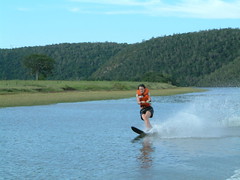
water ski skiing Eastern Cape South AfricaImage by moron noodle via Flickr
June 24-26 are awareness days; operations underway year-round
PRATT — Marine law enforcement officers from local, state, and federal boating agencies — including the Kansas Department of Wildlife and Parks (KDWP) — will be out in force June 24-26 for Operation Dry Water (ODW), an annual campaign focused on the detection and enforcement of boating under the influence (BUI). A secondary objective is to raise awareness among all boaters that it is unsafe as well as illegal to operate a boat under the influence of drugs and/or alcohol.

More than 17 percent of boating fatalities result from alcohol use, and KDWP has gotten tougher in recent years in enforcing laws against this high-risk behavior. Operating a recreational vessel with a blood alcohol concentration of .08 or higher is against Kansas state law. Boaters caught operating under the influence can find their voyage terminated and their vessel impounded. Additionally, penalties can include arrest, fines, and loss of boating privileges.

The effort is timed to give BUI enforcement high visibility before the Fourth of July, perhaps the busiest recreational boating weekend of summer. A new battery of testing standards will, for the first time, allow marine patrol officers to test boaters in a seated position and apply a percentage of probability that the subject is impaired at .08 blood alcohol concentration (BAC) or higher.

For more information on this annual event, go online tooperationdrywater.org.


Enhanced by Zemanta

Wednesday, April 6, 2011

SAFETY FIRST WHEN ON THE WATER

Lifejacket from MS Estonia.Image via Wikipedia
Boaters reminded of laws, safety rules that could save a life
PRATT — It’s springtime, and outdoor recreational users are taking to the water. Fishing, skiing, tubing, sailing, and paddle sports are common activities people enjoy while boating on Kansas waters. With the new season, the Kansas Department of Wildlife and Parks (KDWP) reminds recreational enthusiasts that safety equipment, attention to rules, and properly-maintained equipment help make a safe and enjoyable trip.
The most valuable piece of equipment for both swimmers and boaters is the personal flotation device (PFD), commonly known as a life jacket. “Of the six boating-related fatalities that occurred in 2010, all were from drowning, and none of the victims wore a life jacket,” says Dan Hesket, boating law administrator for KDWP. “These tragedies illustrate the importance of obtaining and wearing a proper life jacket. New designs of life jackets, including inflatable designs, eliminate common excuses for not wearing them. These new PFDs are comfortable, fashionable, and designed to reduce any restrictions while moving around.”
Attending or completing an approved boating safety course is also highly recommended and is required for any person between the ages of 12 and 20 who wishes to operate a vessel (PWC, power boat, sailboat) without direct, on-board supervision. In addition, no one under the age of 12 may operate a vessel without direct, on-board supervision regardless of boater education certification. Information on courses may be found at the KDWP website,www.kdwp.state.ks.us. Just click “Boating/Boating Education.” This course provides information on types of equipment required on vessels, as well as others suggested to make the outing as safe as possible.
Many people are unaware that there are operating rules for boats on the water, which include being able to recognize buoy markings and the proper use of navigation lights. Knowledge of these rules can prevent dangerous, even deadly, situations.
Safety on the water is not all that is covered in a boating education course. Before turning the key, letting down the sail, or controlling a paddle, you must first get the boat to the water. Most of this involves the use of a trailer. Proper trailer inspections cover wheel bearings, trailer lights, winch straps, structural integrity of trailers, and properly-working trailer hitches.
Motorized boats and sailboats are required to be registered and properly numbered before operated on public waters of Kansas. Original registration papers must be on board and made available for inspection. Upon sale of a boat, the registration must be properly transferred to the new owner before it can be legally operated on public waters.
For more information on boating safety and boating laws, phone KDWP at 620-672-5911 and ask for Boater Education.