Showing posts with label Safety. Show all posts

Thursday, July 26, 2012

RAISED FLAG ON BOAT ILLEGAL UNLESS SKIER IS DOWN

Misunderstood law can lead to accidents
PRATT — Boating and water sports are great ways to beat the summer heat, and Kansas waters teem with recreational boaters this time of year. Some of the most popular activities involve boating and being pulled by boats — such as skiing, boarding, or tubing — at high speeds. High-speed boating is fun but potentially dangerous without proper precautions, especially when riders fall while being towed.

A downed rider is hard to spot, and accidents can happen when other boaters fail to see them. That’s why it is Kansas law to raise red or orange “skier down” flags to caution boat traffic when a rider falls. Flags must be at least 12 inches by 12 inches. On Kansas Department of Wildlife, Parks and Tourism (KDWPT) waters and federal reservoirs, all boaters must obey a no-wake, 5-mile-per-hour speed limit when passing within 200 feet of a swimmer or person who has fallen while being pulled by another boat or is otherwise in the water as indicated by one of these raised flags.

As important as this statute is, misunderstanding of the law is widespread. It’s common to see boats towing riders with raised flags, and some boaters have apparently adopted a policy of leaving a flag up during an entire outing, according the KDWPT. This violates the letter and the intent of the law, which states that the flag is to be raised immediately when a rider loses control of a tow rope and falls into the water. The flag is to be lowered once the towing resumes.

Although correct procedure may seem trivial, failure to follow it can lead to a general complacency that raises the risk of accidents.

“KDWPT boating and law enforcement officers emphasize the importance of understanding and obeying safety laws when towing passengers,” says Dan Heskett, boating law enforcement coordinator for the agency. “Boaters who run at high speed with a raised flag will be stopped and warned or ticketed. The same goes for failure to raise the flag when stopped.”

Remember, the flag should only be raised when a person is down in the water, and the flag must be down when towing begins or is resumed. Following these simple safety regulations will help ensure that summer boating trips remain exciting but safe.

Friday, March 23, 2012

KDWPT OFFERS BOATING MAINTENANCE TIPS

Basic parts of an outboard motor
Basic parts of an outboard motor (Photo credit: Wikipedia)
Pre-season maintenance can ensure a safe, trouble-free boating season
PRATT — March of 2012 has been a mild month, and anglers and recreational boaters are eager to get on the water. This means it’s time to prepare boats and trailers for a trouble-free boating season. The Kansas Department of Wildlife, Parks and Tourism (KDWPT) recommends the following simple steps so that your boat works properly and safely before launch. Not only will you have more fun, but you and your family will be safer.
Outboard motor
Replace the lower unit grease. Grease all zerks on the motor, and make sure the steering mechanism is lubricated and working smoothly. Clean or replace spark plugs. Check fuel lines. Remove the prop and check for nicks or gouges. Remove any old fishing line or weeds from shaft. Grease the shaft and replace the cotter pin on the shaft nut. You can start the motor in your driveway if you have a pair of motor muffs, which attach to a garden hose and force water into your motor’s water intake ports. Never start your motor dry. If your engine is oil injected, fill the oil reservoir and test the temperature warning signal device.
Trailer
Grease the wheel hubs. Check the tires for weathering and proper inflation. Check wire connections and make sure all lights work. Lubricate the trailer winch and check the winch strap for wear. Make sure the hitch is sound and safety chains are in place. Check the ball and tighten if necessary.
Batteries
Batteries should have been charged every 30 days throughout the winter. Inspect and clean all battery connections. Water levels should be checked in each cell, and batteries should be fully charged before the first trip. Check the batteries several days before a trip to make sure they are holding a charge.
Electrical gear
Check all bilge pumps and electrical gauges. Tighten any loose connections and secure wire harnesses.
Safety Gear
Inspect all life jackets and throwable cushions. They must be in good working condition to be legal. Be sure a sound-making device or working horn is on board. Test the boat lights, clean connections, and replace bulbs if needed. It's also important to make sure your boating registration is up to date.
In addition to these items, boaters should make sure drain plugs work and keep a spare on board. Other items should include first aid kit, anchor, paddle, tool kit, electrical tape and wire connectors, a variety of spare fuses, extra two-cycle oil, spare trailer light bulbs, and extra life jackets.
And don't forget boater education. Any person born on or after Jan. 1, 1989, must complete an approved boater safety education course in order to operate a motorboat or sailboat on public waters in Kansas. This requirement does not apply to a person accompanied by and under the direct supervision of a person age 17 or older who either possesses a certificate of completion of an approved boater safety education course or is legally exempt from the requirement.
For more information, click "Boating" on the KDWPT website, ksoutdoors.com, phone 620-672-0770, or email erika.brooks@ksoutdoors.com.

Monday, June 20, 2011

OPERATION DRY WATER BRINGS FIELD SOBRIETY TESTS TO BOATERS

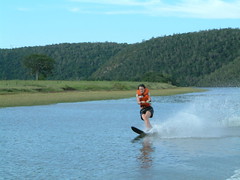
water ski skiing Eastern Cape South AfricaImage by moron noodle via Flickr
June 24-26 are awareness days; operations underway year-round
PRATT — Marine law enforcement officers from local, state, and federal boating agencies — including the Kansas Department of Wildlife and Parks (KDWP) — will be out in force June 24-26 for Operation Dry Water (ODW), an annual campaign focused on the detection and enforcement of boating under the influence (BUI). A secondary objective is to raise awareness among all boaters that it is unsafe as well as illegal to operate a boat under the influence of drugs and/or alcohol.

More than 17 percent of boating fatalities result from alcohol use, and KDWP has gotten tougher in recent years in enforcing laws against this high-risk behavior. Operating a recreational vessel with a blood alcohol concentration of .08 or higher is against Kansas state law. Boaters caught operating under the influence can find their voyage terminated and their vessel impounded. Additionally, penalties can include arrest, fines, and loss of boating privileges.

The effort is timed to give BUI enforcement high visibility before the Fourth of July, perhaps the busiest recreational boating weekend of summer. A new battery of testing standards will, for the first time, allow marine patrol officers to test boaters in a seated position and apply a percentage of probability that the subject is impaired at .08 blood alcohol concentration (BAC) or higher.

For more information on this annual event, go online tooperationdrywater.org.


Enhanced by Zemanta

Wednesday, April 6, 2011

SAFETY FIRST WHEN ON THE WATER

Lifejacket from MS Estonia.Image via Wikipedia
Boaters reminded of laws, safety rules that could save a life
PRATT — It’s springtime, and outdoor recreational users are taking to the water. Fishing, skiing, tubing, sailing, and paddle sports are common activities people enjoy while boating on Kansas waters. With the new season, the Kansas Department of Wildlife and Parks (KDWP) reminds recreational enthusiasts that safety equipment, attention to rules, and properly-maintained equipment help make a safe and enjoyable trip.
The most valuable piece of equipment for both swimmers and boaters is the personal flotation device (PFD), commonly known as a life jacket. “Of the six boating-related fatalities that occurred in 2010, all were from drowning, and none of the victims wore a life jacket,” says Dan Hesket, boating law administrator for KDWP. “These tragedies illustrate the importance of obtaining and wearing a proper life jacket. New designs of life jackets, including inflatable designs, eliminate common excuses for not wearing them. These new PFDs are comfortable, fashionable, and designed to reduce any restrictions while moving around.”
Attending or completing an approved boating safety course is also highly recommended and is required for any person between the ages of 12 and 20 who wishes to operate a vessel (PWC, power boat, sailboat) without direct, on-board supervision. In addition, no one under the age of 12 may operate a vessel without direct, on-board supervision regardless of boater education certification. Information on courses may be found at the KDWP website,www.kdwp.state.ks.us. Just click “Boating/Boating Education.” This course provides information on types of equipment required on vessels, as well as others suggested to make the outing as safe as possible.
Many people are unaware that there are operating rules for boats on the water, which include being able to recognize buoy markings and the proper use of navigation lights. Knowledge of these rules can prevent dangerous, even deadly, situations.
Safety on the water is not all that is covered in a boating education course. Before turning the key, letting down the sail, or controlling a paddle, you must first get the boat to the water. Most of this involves the use of a trailer. Proper trailer inspections cover wheel bearings, trailer lights, winch straps, structural integrity of trailers, and properly-working trailer hitches.
Motorized boats and sailboats are required to be registered and properly numbered before operated on public waters of Kansas. Original registration papers must be on board and made available for inspection. Upon sale of a boat, the registration must be properly transferred to the new owner before it can be legally operated on public waters.
For more information on boating safety and boating laws, phone KDWP at 620-672-5911 and ask for Boater Education.