Showing posts with label March. Show all posts

Monday, March 18, 2013

ANGLERS, WALLEYE BENEFIT FROM ARTIFICIAL SPAWNING

Artificial spawning practices produce abundant fish populations
Spring marks the beginning of spawning season for several fish species, but it also marks the start of artificial spawning for walleye. Kansas Department of Wildlife, Parks and Tourism (KDWPT) biologists and culturists will work tirelessly this season artificially producing walleye to stock state reservoirs and lakes.

This highly-prized sport fish naturally spawns during March and April when temperatures reach around 45-50 degrees Fahrenheit. Female walleye will typically lay their eggs in a rocky area during the night, secreting upwards of 300,000 eggs. Although females produce eggs in abundant numbers, less than 5 percent of their young will successfully hatch in the wild due to various environmental factors.

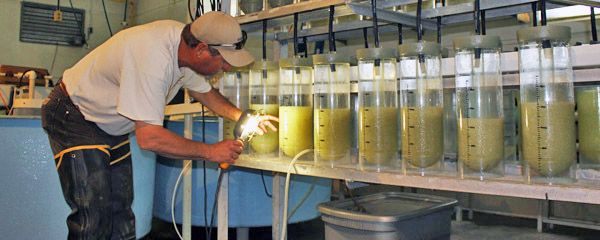
When conditions are right, fisheries biologists will work long hours at select Kansas lakes to capture spawning walleye. Eggs are taken from ripe females, fertilized, then delivered to the Pratt and Milford fish hatcheries where employees work around the clock to ensure the success of the walleye young.

A non-native species to Kansas, walleye were first introduced to Kansas waters in the 1960’s through the KDWPT walleye culture program. In addition to walleye, KDWPT also artificially produces bluegill,channel catfish, crappie, largemouth bass, redear sunfish, sauger, saugeye, smallmouth bass, striped bass, and wipers.

KDWPT also operates hatcheries located at Farlington and Meade, as well as a rearing pond at Woodson State Fishing Lake. These hatcheries produce approximately 39.5 million fry, 3.5 million fingerlings, and 385,000 intermediate fish each year.

For more information on KDWPT hatcheries, visit www.ksoutdoors.com and click “Fishing/Hatcheries.”

Sunday, April 8, 2012

PRAIRIE CHICKEN SPRING DANCE A BIRDERS DELIGHT

Tympanuchus cupido English: A male Greater Pra...
 (Photo credit: Wikipedia)

April 5, 2012
From March through May, male chickens dance, fight, and call to attract mates
PRATT — Each spring, one of the most extraordinary mating rituals in all of nature occurs right here in Kansas — the courtship of the prairie grouse, more commonly known as the prairie chicken. On specific sites in otherwise indistinguishable tracts of natural prairie landscape, groups of male chickens gather at dusk and dawn in elaborate dances designed to attract females.
These areas — called leks, or booming grounds — are actually formed in fall when the order of dominance is established among the males. At this time, mature males gather in these relatively high, flat areas and attempt to establish their own small territories as close to the center of the lek as possible, where activity will be highest in spring. Although young males visit the lek, they are kept to the edges and seldom given the opportunity to establish their own territories.

While the fall activity is important and interesting, it is the spring lekking, or “booming,” activity that most fascinates naturalists, both professional and amateur. Beginning in March and lasting through the end of May, male chickens display an incredible array of vocalizations and maneuvers to win the right to mate.

Avid bird watchers and novices alike are mesmerized by this site, and it’s not difficult to find a place to witness it. For a list of prairie chicken viewing opportunities, visit the Natural Kansas website www.naturalkansas.org/birding.htm#PCV or phone the Kansas Department of Wildlife, Parks and Tourism’s Emporia Office at 620-342-0658 or the Pratt Operations Office at 620-672-5911.

In the mating ritual, the male chicken's tail is elevated; horn-like feathers (called pinnae) on the neck are raised over the head; and the wings are lowered with the primary feathers spread. The bird stamps its feet while moving forward or in circles, and this is followed by a series of rapid tail snaps and fans. At the same time as the tail is clicked open and shut, a whoom-AH-oom sound is given as the bright orange air sacs on the neck of the greater prairie chicken (orange to plume in the lesser) are inflated for maximum exposure. The lesser prairie chicken exhibits similar behavior, but the sound is higher-pitched, and the air sacs are a reddish color.

A second major display is flutter-jumping with associated cackling calls. The male jumps several feet into the air, flies forward, and lands. In so doing, the bird advertises its presence as well as the location of the lek. Flutter-jumping is typical of the peripheral males when females are near the center of the display ground.

A female will typically fly to the edge of a lek and walk slowly toward the center. When the hen enters a male’s territory, the male's behavior changes greatly. Lekking is performed with high frequency and extreme posturing. The male will display in circles around the female, showing all aspects of its plumage. At the peak of this performance, the dancer often spreads his wings and lays his head flat to the ground, as if bowing to the hen. If suitably impressed, the hen will stoop low to the ground, signaling that she is ready to mate.

Occasionally, fights break out among competing males. This is mostly ritual, as well, involving short jumps; striking with feet, beak, and wings; and face-offs in which the competitors whine and attempt to stare each other down. Injuries do occur but are seldom serious.

With its large, colorful air sacs, horn-like pinnae, and feathers growing all the way to its feet, the prairie chicken is one of the most beautiful birds in Kansas. And its mating ritual makes it one of the most fascinating birds to watch. Kansans are lucky to have the largest population of prairie chickens in the world, so viewing opportunities are good.

Two species of prairie chicken can be found in Kansas. The greater prairie chicken, the most populous, can be found throughout portions of northcentral and eastern Kansas, especially in the Flint Hills region. The lesser prairie chicken, which is slightly smaller and has reddish-orange air-sacs, can be found in pockets of native sandsage and shortgrass prairie in western Kansas. The lesser prairie chicken male produces a higher-pitched, bubbly sound, or "gobble," leading to the term "gobbling grounds" for their leks. On a quiet spring morning, the sounds of both species can carry as far as 2 miles across the open prairie.

Friday, March 2, 2012

SPECIAL SPRING TURKEY HUNT APPLICATIONS AVAILABLE ONLINE

The Kansas River near De Soto, Kansas.
Image via Wikipedia
Special hunts application deadline March 18; regular season April 11-May 31
PRATT — To encourage youth involvement in turkey hunting, the Kansas Department of Wildlife, Parks and Tourism (KDWPT) will offer special hunts on select state wildlife areas this spring. In addition, KDWPT is joining with private landowners to offer special turkey hunts on private lands. Private land special hunts will be offered in 12 counties — Chase, Clay, Douglas, Leavenworth, Marshall, Osage, Ottawa, Pottawatomie, Reno, Riley, Sumner, and Wabaunsee — opening more than 3,700 acres for 83 special hunts.

Public lands special spring turkey hunts will be held on Benedictine Bottoms, Grand Osage, Kansas River Fitzgerald Tract, and Noe (Jackson County) wildlife areas, as well as Marais des Cygnes National Wildlife Refuge and Pottawatomie SFL No. 2.

Special hunts range from youth-only and youth-mentor hunts to open hunts. All special hunt opportunities are available by online application and a random drawing. Those applicants who are drawn for a hunt will be notified by email with additional hunt information and their special hunt permit. The online application and hunt information is on the KDWPT website, www.ksoutdoors.com under Hunting/Special Hunts Information. The application deadline is Sunday, March 18.

Access to lands enrolled in these special hunts will be limited to foot traffic only, unless posted otherwise. Each property will have special restrictions for dates allowed and type of hunt that will be listed on the application.

For more information or applications, contact Tina McFerrin, KDWPT, 512 SE 25th Ave., Pratt, KS 67124; phone 620-672-0791; or emailtina.mcferrin@ksoutdoors.com.

The 2012 spring turkey season runs April 11-May 31. Turkey permits allow hunters to use a shotgun, crossbow, or bow throughout the regular season. Archery-only and youth/disabled seasons run concurrently, April 1-10.

Turkey permits for units 1, 2, and 3 may be purchased online from the KDWPT website or over the counter at any license vendor. Detailed information on spring turkey hunting seasons, permits, and fees may be found on the website underHunting/Applications and Fees/Turkey. This page also includes results of the resident-only, limited-draw permit application for Unit 4.

Archery hunters, anyone 16 years old or younger, and those with disability permits may hunt April 1-10. (All youth must have an adult supervisor during the youth season.) Hunters younger than 16 are not required to have hunter education certification to hunt while they are supervised by a person 18 or older, but they must have a turkey permit. (During the regular season, persons age 12 through 15 may hunt without adult supervision if they have completed a certified hunter education course.) Hunter education certification may not be obtained until age 11, and all hunters younger than 12 must have adult supervision to hunt at any time.

A spring turkey atlas showing all public hunting lands and spring Walk-In Hunting Access program lands will be available at KDWPT offices and the KDWPT website in late March.