Tuesday, February 4, 2014

APPLICATIONS BEING ACCEPTED FOR OUTDOORS-WOMAN WORKSHOP

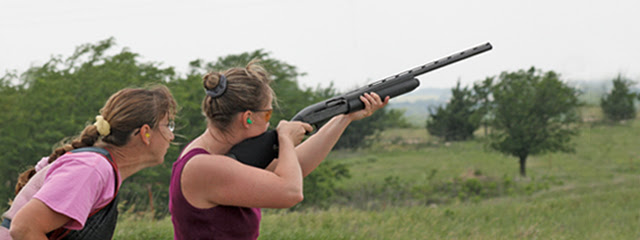
 If you’ve ever wondered what baits catch what fish, how to start a fire with your bare hands, May 16-18,the workshop will offerparticipants courses on everything from wood-carving and GPS basics, to rifle marksmanship and fly fishing.
or even have thought about coasting a creek in a canoe, youshouldsign up for the 2014 Spring Becoming An Outdoors-Woman (BOW) workshop thisMay. Held at Rock Springs 4-H Center
Offered through the Kansas Department of Wildlife, Parks and Tourism, BOW is a non-profit, non-membership program designed for teaching women outdoor skills. The workshop will offer over 25 different classes thanks to a core of volunteer instructors, including KDWPT employees, law enforcement officials, and even past participants, all of whom are considered to be experts in their field.
Cost for the three-day workshop is $250, which includes lodging, meals and class supplies. Three $100 scholarships are available to first-time participants based on financial need.
Early registration will be open to first-time participants through March 15. If spots still remain, past participants may register beginning March 16. Applicants are encouraged to apply early as the spring workshop is limited to 48 participants and the application period will close May 2. To register, visit www.ksoutdoors.com, click “Services/Education/Becoming an Outdoors Woman,” and download a registration form.
For questions, call or email Jami McCabe at (785) 845-5052 or kansasbow@sbcglobal.net. To learn more, and view pictures of past workshops, visit the BOW Facebook page found under “Becoming an Outdoors Woman KANSAS.”

Monday, February 3, 2014

CATCH FIRST GLIMPSE OF 2014 FISHING REGULATIONS SUMMARY ONLINE

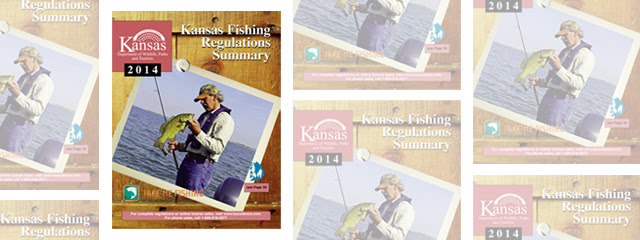
 For anglers, timely, quality information can be the difference between getting a couple tugs on a lure and a grill lined-to-the-brim with your favorite catch. Cram-packed with all the information you need to set up for a perfect day of fishing, the 2014 Kansas Fishing Regulations Summaryis the closest you can get to having a game warden, a fisheries biologist, ksoutdoors.com by clicking “Fishing / Fishing Regulations.” Print copies will be available wherever licenses are sold within one to two weeks.
and a hatchery manager at your beck and call. This free, easy to use, full-color pamphlet can be downloaded online now at

Apart from information on important fishing regulations such as special seasons, creel and length limits, license fees and legal fishing methods, anglers will also find a helpful section highlighting new regulations for the 2014 season in the summary. This publication is a must-have for anglers because creel and length limits vary from lake to lake.

Included in a special 16-page section, this pamphlet also lists all public waters, along with their location and any special regulations in effect. At the turn of a page, anglers can see which community lakes don’t charge extra fees for fishing, as well as community lakes designated as Family Friendly Facilities (FFF)thatwill include flush toilet facilities, security patrols, security lighting, easy access to the water and do not allow alcohol.

Information is also provided on aquatic nuisance species (ANS), as well as regulations governing the use of live baitfish. Five pages are devoted to fish identification, featuring color illustrations by Joe Tomelleri. Current state record fish are listed, and there is also a Master Angler Application for anglers who catch fish that qualify forthis certificate award program.

The2014 Kansas Fishing Regulations Summarypamphlet is truly an angler’s “Bible.” Grab a copy, read it, and keep it by your side. Available at more than 200 outlets statewide, and online, there’s no excuse to ever find yourself without one.

Sunday, February 2, 2014

GREAT PLAINS NATURE CENTER HONORED WITH NATIONAL AWARD

Wichita’s GPNC recognized for its unique partnerships

Secretary of the Interior Sally Jewell presented the 2013 Partners in Conservation awards at a ceremony in Washington, DC on Jan. 16. The Secretary honored 20 partnership projects that have demonstrated exemplary natural resource conservation efforts through public-private cooperation. Four
partnerships nominated by the U.S. Fish and Wildlife Service(USFWS), including The Great Plains Nature Center in Wichita,received awards.

 The Great Plains Nature Center, located at 6232 E. 29th Street N in Wichita, is a wild oasis in an urban setting. Each year the Center provides outdoor recreation and educational opportunities to hundreds of thousands of visitors. The facility is a one-of-a-kind partnership that began in 1988. It serves as an outdoor education center for the City of Wichita, a regional office for the Kansas Department of Wildlife, Parks, and Tourism, and an administrative site for theUSFWS. The Friends of the Great Plains Nature Center help visitors learn about the plants and animals of the Great Plains through live animal exhibits, dioramas depicting native flora and fauna, and nature trails leading to abundant wildlife viewing opportunities on the adjacent Chisholm Creek Park. Its education programs operate throughout the year, and a highlight of the Center is a massive 2,200-gallon aquarium offering close-up views of native fish.

Other award winners include the Edwards Aquifer Recovery Implementation Program in Texas, the Klamath Tribal Leadership Development for Integrative Science and Traditional Ecological Knowledge Program in northern California and southern Oregon, and the Center for Land-Based Learning Partnership in California.

Partnerships are vital to wildlife conservation efforts nationwide as they allow us to combine the strengths of our stakeholders with the resources and abilities of our staff, saidUSFWSDirector Dan Ashe. Almost anything is possible when you leverage the skills, talents, dedication and abilities of diverse groups of stakeholders that share a common conservation agenda.

A total of 14 partnerships were submitted nationwide by Service staff for consideration as part of this year’s awards.

Additional information on the selected programs and full listings of entities involved are available here:
http://www.fws.gov/home/feature/2014/2013-pic-awards.html.

Saturday, January 25, 2014

KANSAS WILDLIFE, PARKS AND TOURISM COMMISSION APPROVES REGULATIONS

Public hearing held for wildlife and park regulation changes
WINFIELD – The Kansas Wildlife, Parks and Tourism Commission conducted a public hearing in Winfield on Jan. 9 to consider amendments to several wildlife and park regulations. Public hearings are held to discuss and vote on regulation changes after recommendations have been proposed in two previous commission meetings.
In first action, Commissioners listened to recommendations on increases for utility and seasonal camping fees. Kansas Department of Wildlife, Parks and Tourism (KDWPT) staff recommended camping fee increases to accommodate rising utility rates. Current utility camping fees are $7.50 for one utility, $9.50 for two and $10.50 for three utilities per camping night. The commission approved raising the rates to $9 for one utility, $11 for two and $12 for three utilities per night.
Seasonal camping fees, which are charged by the month, were increased $30.50 to $270.50 for one utility, $330.50 for two utilities and $390.50 for three utilities per month at all parks except El Dorado, Milford and Tuttle creek state parks. The seasonal monthly fees at El Dorado, Milford and Tuttle Creek state parks were increased $30.50 to $310.50 for one utility, $370.50 for two utilities and $430.50 for three utilities.
Commissioners approved the recommended increases.
The second public hearing item was a house-cleaning issue on the regulation defining the scoring system used to determine restitution for big game animals taken illegally. The recommendation more clearly defined a measurable point to “a projection on the antler of a deer or elk at least 1 inch long as measured from its tip to the nearest edge of the antler beam and the length of which exceeds the width at one inch or more of length.” The commission approved this recommendation.
And in final action, the commission approved changes to the fall turkey season bag limits. Turkey populations declined in most regions from 2004-2008 because adverse weather impacted spring nesting success and brood survival.  Success rates for spring hunters dropped accordingly, triggering a change in regulations. KDWPT staff recommended reducing the fall turkey bag limit from four turkeys to one turkey in Turkey Management Units 3, 5 and 6. The fall limit remains one turkey for Unit 1 (northwest) and the season bag limit will remain four turkeys in Unit 2 (northcentral). Unit 4 (southwest) is closed to fall turkey hunting. Commissioners approved the season bag limit change, as well as proposed season dates of Oct. 1-Dec. 3, 2014 and Dec. 16, 2014-Jan. 31, 2015.

Friday, January 24, 2014

2014 COMISSION BIG GAME PERMIT WINNERS ANNOUNCED

Being awarded a Commission Big Game Permit can mean big fundraising dollars for
conservation-based nonprofits
PRATT – On Jan. 9, 2014, a total of seven conservation-based nonprofit organizations were awarded a Commission Big Game Permit at the Kansas Department of Wildlife, Parks and Tourism’s commission public meeting held at Southwestern College in Winfield. A total of 99 successful applications were received for the seven highly-sought after permits consisting of one elk, one antelope, and five deer permits. Because each organization is asked to rank each permit by first choice through last choice, a total of one elk and six deer permits were awarded this year. In order to be considered for this drawing, applicants had to be a Kansas-based nonprofit organization that works to promote wildlife conservation, as well as hunting and fishing.
2014 Commission Big Game Permit winners are as follows:
ELK PERMIT
RMEF - Traveling Committee
DEER PERMITS
Ducks Unlimited - Cloud County Chapter
Quail & Upland Wildlife Federation, Inc. - Kaw Valley
Quail & Upland Wildlife Federation, Inc.
Friends of NRA - South Central KS - Pratt #KS-18
Friends of NRA - Sunflower State #KS-30
Deer: Friends of NRA - Tri Valley #KS-36
The winning applicants received the permit in the form of a voucher. Typically these vouchers are sold to the highest bidder, who can then exchange the voucher for their designated big game permit through the Kansas Department of Wildlife, Parks and Tourism (KDWPT) licensing section. Once a voucher is sold, the price of the permit and 85 percent of the total is returned to KDWPT. The conservation group keeps 15 percent to spend at its discretion. After a conservation project is approved, the 85 percent is returned to the group to fund the project.
Past projects include Pass It On activities, Hunter Education courses, habitat development and restoration, as well as archery and shooting clinics for youth and adults.
For more information on the Commission Big Game Permit program, or instructions on how to apply for 2015, contact commission secretary Sheila Kemmis at (620) 672-0702.

Thursday, January 23, 2014

YOUTH AND WOMEN’S PHEASANT HUNT DRAWS 35 PARTICIPANTS

Female hunters made up over a third of the participants at this annual hunt
BELOIT ­– Thirty-five new hunters with limited experience came from all across the state to get a taste of what pheasant hunting can be like. Hunters ranged in age from 11 to 55, and out of those 35 hunters, an impressive number of 11 participants were female. The event is organized by Kansas Department of Wildlife, Parks and Tourism staff from the Glen Elder Wildlife Area and volunteers from the Pass It On – Outdoor Mentors, Inc. of Wichita.
This year hunters were joined by 10 celebrities and hometown heroes who served as hunting mentors. Celebrity hunters included former NFL players Mark Arneson, Jerry Holloway, Mel Gray, and Eric Williams; former professional drag racer Guy Caster; youth Crappiemasters champion John Gilotte; and national go-cart racing youth champions Brody and Nolan Pope. Hero-celebrities from the Kansas National Guard included LTC Damon Frizzell from Gardner and SSGT Casey Pennock from Manhattan.
The day began before sunrise in the basement of Hopewell Church at Glen Elder State Park with a biscuits and gravy breakfast. Following breakfast the young hunters were briefed on safety procedures and then divided into five hunting groups. Each hunting group had celebrities, a hunt captain, and at least three bird dogs. Groups hunted in either Glen Elder State Park or in one of the refuge areas on Glen Elder Wildlife Area surrounding the lake where public hunting is generally not allowed.

Every group saw a good number of pheasants within shooting range and almost all of the hunters got multiple shot opportunities at the tough birds. Only the youth and celebrities hunted in each group and each youth was “shadowed” by a parent or other adult mentor throughout the morning. While afield, participants also enjoyed seeing lots of deer, geese, ducks, bald eagles, as well as several other wildlife species.
Hunters bagged a combined total of eight roosters, with every group harvesting at least one bird. The morning of the hunt, participant Cassandra Kinzie even managed to pull off a “double” on two roosters that flushed together, making quite a present for the young lady who celebrated her birthday that day.
At lunch, groups returned to the church basement for a meal provided by the Waconda Lake Association. Hunting stories were shared and one youth hunter from each group was recognized and presented with an additional prize for demonstrating excellent safety skills while they hunted. A longest tail feather contest was also held for the successful youth hunters. After lunch, several hunters took part in a trap shoot held in Glen Elder State Park. Within a couple hours, trap shooters managed to burn up about 1,500 rounds of target ammo and blue rock that was provided as part of the event.
The day’s events concluded in the evening with a Hunter’s Banquet held at Memorial Hall in Downs where each youth hunter received a prize package, and attendees learned about the importance of quality habitat for pheasants and the importance of getting more kids involved in hunting. Meet and greets with celebrity hunters concluded the evening.
“This event would not be possible without the generous support of over 30 businesses and individuals that stepped up as sponsors from the local communities surrounding Waconda Lake,” said Glen Elder Wildlife Area Manager, Chris Lecuyer. “These sponsors allow the day-long event to be offered to participants absolutely free of charge and their donations of prizes, food, services, and financial contributions continue to make the event a bigger success every year, so thank you.”
For information, contact the Glen Elder Area Office at (785) 545-3345.

Wednesday, January 22, 2014

KANSAS BIRDING BIG YEAR COMPETITION GOING ON NOW

The Kansas Department of Wildlife, Parks and Tourism holds second annual birding competition
PRATT – If you can look through a pair of binoculars, spot a bird, and positively identify it, you just may have what it takes to win the 2014 Kansas Birding “Big Year” hosted by the Kansas Department of Wildlife, Parks and Tourism (KDWPT). “Big Years” are informal competitions that take place across the globe where birders compete to see who can observe the most bird species within a designated geographic area in one calendar year. The 2014 Kansas Birding Big Year will run Jan. 1-Dec. 31, spanning the state of Kansas. Participants can compete in one of three categories: youth (16 and under), adult (17-64), and senior (65 and up).Winners of each category will receive prizes to be awarded January 2015.
“The great thing about this competition is that you don’t have to own the latest equipment or know how to identify every bird species under the sun to participate,” said KDWPT wildlife education coordinatorand competition organizerMike Rader. “You just have to get out there and start looking, because you’ll be amazed at what you might find.” Rader recommends participants carry a pocket-sized notebook and pencil to record their findings. He suggests jotting down information such as size, color, sounds, and surrounding habitat, followed by a quick thumbnail sketch of the bird.
“A good way to learn how to identify birds is to watch them. Soak up as much information about them as you can, watch their flight pattern, their behavior, where they like to feed, whether they’re solitary or in a group,any little thing you notice,” said Rader. “After that, hit your books and start narrowing down what you think it may be, paying close attention to their geographical range and population abundance, because that can also serve as a good indicator of what species you may have spotted.”
Participants are asked to log their findings into the online service, eBird, available through the Cornell University web site, www.ebird.org. The data collected is then gathered and used to aide researchers in the study of species abundance, time spent in the field, and more.
For more information on the 2014 Kansas Birding Big Year, or to register, visit ksoutdoors.com/birding-big-year, or email Rader at mike.rader@ksoutdoors.com.