Showing posts with label Bison. Show all posts

Thursday, October 23, 2014

BUFFALO AUCTION AT MAXWELL WILDLIFE REFUGE

The Kansas Department of Wildlife, Parks and Tourism (KDWPT) will host its annual Wednesday, Nov. 12 at 11 a.m. Approximately 55 buffalo from the KDWPT herd will be available for purchase, including three cows; five yearling heifers; eight heifer calves; seven cow/calf pairs; 10 yearling bulls; eight two-year-old bulls; and seven bull calves. The corrals are located six miles north and one and a quarter miles west of Canton.
Maxwell Wildlife Refuge Buffalo Auction
Auctioneer services will be provided by Lyle Leppke and Roger Hiebert, and lunch and concessions will be served by Friends of Maxwell.
The Department reserves the right to reject any or all bids. All purchases must be paid in cash. Personal checks will be accepted if accompanied by a notarized authorization letter from the issuing bank.
Buffalo over one year old will be brucellosis and tuberculosis tested and accompanied by a health certificate. Heifer calves will be vaccinated for brucellosis and certificates will be issued. 
Buyers must pick up buffalo the day of the sale or make arrangements with the refuge manager prior to the sale. Animals become buyer’s responsibility upon settlement on sale day. Load out assistance is available until dusk. Stock racks and trailers should be covered or lined as buffalo transport is best done in darkened conditions.
For more information, call refuge manager Cliff Peterson at (620) 628-4592, KDWPT Wichita Regional Office at(316) 683-8069, or KDWPT Pratt Operations Office at (620) 672-5911.

Friday, November 1, 2013

PUBLIC BUFFALO AUCTION NOV. 20

Buffalo from Maxwell Wildlife Refuge herd are available for purchase

PRATT – The Kansas Department of Wildlife, Parks and Tourism (KDWPT) will auction off surplus buffalo at the Maxwell Wildlife Refuge onWednesday, November 20, 2013 beginning at 11 a.m. Those interested in bidding are encouraged to arrive early to receive a bidder number. The auction is open to the public, and lunch and concessions will be served.
Each fall, surplus buffalo are sold as available habitat can support only a finite number of animals. This year, a total of 60 buffalo will be auctioned, including seven cows, 13 yearling heifers, eight heifer calves, 13 yearling bulls, eight two-year-old bulls, eight bull calves, and three three-year-old bulls. Bison over 1-year-old will be brucellosis and tuberculosis tested and accompanied by a health certificate. Heifer calves will be vaccinated for brucellosis and certificates issued. Prices paid per animal range from several hundred dollars to several thousand, depending on market demand, condition, sex and age of the animal.
Cash and personal checks (if accompanied by a notarized authorization letter from the issuing bank) will be accepted. KDWPT reserves the right to reject any or all bids. Buyers must pick up the bison the day of the sale or make arrangements with the refuge manager prior to the sale. Animals become the buyer’s responsibility upon settlement on sale day. Load-out assistance is available until dusk the day of the sale. Stock racks and trailers should be covered or lined because bison transport best in dark conditions.
The sale will be outside and will take place rain or shine, so attendees are encouraged to dress accordingly. For more information, contact Maxwell Wildlife Refuge manager Cliff Peterson at (620) 628-4592, or KDWPT’s Region 4 Office in Wichita at (316) 683-8069.

Sunday, March 4, 2012

BISON BEING MOVED FROM SANDSAGE WILDLIFE AREA

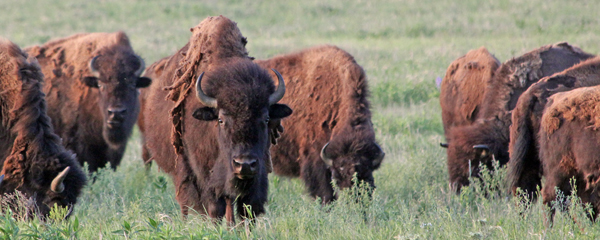
English: A small, privately owned Bison herd.
Image via Wikipedia
Drought forces temporary move of 40 animals
GARDEN CITY — A two-year drought is forcing the Kansas Department of Wildlife, Parks and Tourism (KDWPT) to move bison from the Sandsage Bison Range and Wildlife Area, near Garden City, to Maxwell Wildlife Area, in McPherson County north of Canton. The drought has depleted forage on the area, and the move is being made to protect both the sensitive range as well as the bison.

“We have been supplementing the bison with hay and range cubes since August,” said area manager Tom Norman. “However, the bison still have too great a need for grass for supplements to be a long-term solution. Also, the Sandsage Bison Range is a pretty fragile ecosystem, so maintaining the type of vegetative cover that provides food for the bison and prevents sand movement is a challenge even under normal climatic conditions. A drought makes it almost impossible to maintain vegetation to provide for either.”

Attempts to stay within the carrying capacity of the range have resulted in consistent herd reductions since 2002, and today, the herd has 50 percent fewer animals than in 2001. Even with the reductions in herd size, the pastures have been unable to keep up with the forage needs of the bison. According to Norman, the area needs long-term rest.

“We will be moving 40 head and retaining nine,” Norman explained. “We would take all of them, but there just isn't room at Maxwell for any more. The bison we retain will be kept in the corral pens at least until we get some forage growth this spring. I am hoping to get a large exhibition pasture fenced to hold them until we can allow them into the sandhill pastures. But it all depends on precipitation. We are hoping that conditions will improve enough to bring the majority of the herd home in the fall.”

The agency began transporting animals on Feb. 29 and plans to complete transportation by the end of the week. Since Feb. 8, the herd has been confined to the corral pens, where they have been vaccinated against the Mycoplasma bovisorganism.

Historically, bison herds would move great distances during drought, but today’s fences across the Great Plains require transportation by truck and trailer. The 2,500-acre Maxwell Bison Refuge was donated to KDWPT in 1943 by Henry Maxwell to create a wildlife refuge dedicated to bison and other prairie species.