Showing posts with label Biology. Show all posts

Thursday, May 30, 2013

WALK WITH WILDLIFE EVENT TO SHOWCASE KANSAS WILDLIFE

Are snakes slimy or smooth? What does a kestrel’s call sound like? You can learn this and more when you attend the 29th Annual Walk With Wildlife event, Saturday, June 8, 9:00 a.m.-3:00 p.m. The Great Plains
Participants get up-close to wildlife
species without leaving the sidewalk
Nature Center (GPNC) will be holding the event at Chisholm Creek Park, 6232 E. 29th Street North in Wichita. The cost to attend is $2 per person, and lunch concessions will be available.

Chisholm Creek Park’s 1-mile handicapped-accessible trail loop will be decorated with multiple stations, each featuring different wildlife species. Visitors can get up-close views of native mammals, birds, reptiles, amphibians, fish, insects and more.

While visiting the GPNC, participants can also enjoy fun and educational videos in the Coleman Auditorium, hands-on nature exhibits in the Koch Habitat Hall, or shop the Owl’s Nest Gift Shop.
In addition, the GPNC will also host a Kids Fishing Clinic for youth age 12 and under at no additional charge. Each participant will receive fishing equipment, as well as a free photo with their fish. Registration forms can be obtained from The Wichita Eagle newspaper, or by calling (316) 268-2640. Attendance is limited, so early registration is encouraged. Participants must be accompanied by an adult.

For more information on the Walk With Wildlife event, call (316) 683-5499.
Spirit Aerosystems is an annual sponsor of the Walk With Wildlife event.

Saturday, February 4, 2012

KANSAS TRAPPERS REACH OTTER QUOTA

Lontra canadensis English: North American Rive...
Image via Wikipedia

Trappers notified that harvest quota has been met; season closes after Feb. 5
EMPORIA — For the first time in modern history, Kansas allowed otter trapping during the 2011-2012 trapping season. Biologists had been monitoring a growing otter population for many years and had proposed a limited harvest to manage otter numbers and learn more about the species. The season was to run Nov. 16, 2011-March 31, 2012, or until the statewide trapping mortality quota of 100 otters was met.

Biologists with the Kansas Department of Wildlife, Parks and Tourism (KDWPT) have announced that that quota has been met. Trappers have been allowed a grace period for notification that the quota has been met, so all otters taken on or before Feb. 5 may be kept by the furharvester.
Otters accidentally taken while trapping for other species after Feb. 5 must be reported to KDPWT prior to removal from the trap site. They may be reported to the toll free hotline at (855) 778-6887 (RPT-OTTR) or to a local KDWPT natural resource officer or biologist. Inadvertent capture of otters shall not be deemed illegal if the capture is reported or if the animal is released unharmed.

KDWPT collected carcasses from all harvested otters this season and will be determining age, reproductive output, and other biological information, which will be used to make decisions about future seasons. For more information, phone Matt Peek at 620-342-0658.

Wednesday, September 14, 2011

KANSAS HERPETOLOGICAL SOCIETY FALL FIELD TRIP SEPT. 16-18

Prairie Rattlesnake (Crotalus viridis) at the ...Image via Wikipedia
Public welcome to join experts on scientific expedition
JEWELL COUNTY — The Kansas Herpetological Society (KHS) will conduct its annual Fall Field Trip Sept. 16-18 in Jewell County. They will use the KHS campsite at Lovewell State Park as event headquarters. (Kansas State Park vehicle and camping permits are required.) And Kansas nature lovers are being asked to participate by taking a hike across Jewell County this weekend and make a herpetologist’s day. Become the first to find and document the plodding presence of an ornate box turtle or the diminutive brown snake in this northcentral Kansas county.
On the group’s wish list of notable finds are some 28 species of reptiles, amphibians, and turtles that have yet to be officially documented in the county. Another dozen species that have not been reported in the area for more than three decades are also being sought.
The free event — one of two or three such trips coordinated by the group each year — assesses the herpetofauna (reptiles, amphibians, and turtles) of Kansas, and the public is encouraged to attend. KHS members and others will gather at Lovewell State Park campground northeast of Mankato; look for the KHS signs as early as Friday, Sept. 16, although the actual event will begin with off-site field surveys on Saturday and Sunday mornings at 9 a.m.
"Jewell County holds a great deal of potential for significant herpetological discoveries," says Travis Taggart, curator of herpetology at the Sternberg Museum of Natural History in Hays and field trip co-chair for the KHS. "It supports great habitat yet little field work has been conducted there." According to Taggart, another impetus behind the visit to Jewell County is its proximity and geographic similarity to the smooth green snake’s range in nearby Nebraska. This weekend, KHS hopes to discover and document the snake’s presence in Kansas.
Folks joining the Jewell County field trip should to prepare for field conditions and the weather. Long pants and thick boots are advised, and leather gloves, a hat, sunscreen, drinking water, snacks, two-way radios or a cell phone, field guides, a map, and a camera are also good items to bring. Old pillowcases and gallon-sized freezer bags can be used to temporarily hold captured animals. Participants are responsible for their own meals and overnight accommodations. Contact the Lovewell State Park office at 785-753-4971 or email lovewellsp@ksoutdoors.com for information on camping and cabin rental. Visit www.travelks.com for information about accommodations and places to eat or visit in nearby Mankato or other cities in the region.
Non-venomous snakes and other animals will be captured and brought to a checkpoint for identification and documentation. Unless specially trained to do so, participants are discouraged from attempting to catch venomous snakes.
Most animals will be released where they are found although researchers with Kansas scientific collecting permits may retain individual animals for further study.
Since 1975, KHS field trips have allowed people of all ages an opportunity to aid scientists, teachers, naturalists, and students to search for, discover, and document some of the world’s most misunderstood animals. The events assess the distribution and abundance of herpetological species in the state and gain other valuable data. In addition, participants are given an excellent opportunity to photograph and observe closely many different kinds of amphibians, reptiles, and turtles.
A species count from the field trip is published in the KHS Journal of Kansas Herpetology and is also made available to agencies such as the Kansas Department of Wildlife, Parks and Tourism and other conservation groups.

Wednesday, June 8, 2011

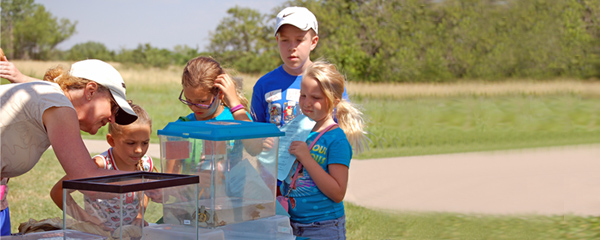
KANSAS WETLAND EDUCATION CENTER PLANS CHILDREN'S SUMMER PROGRAMS

From dragonflies to spiders and soil, kids learn about nature; preregistration required
GREAT BEND — The Kansas Wetlands Education Center, on Cheyenne Bottoms Wildlife Area northeast of Great Bend, will conduct a number of children’s programs this summer. These one-hour programs will be offered at no charge. Programs for kids age four through seven will run from 10:30 a.m. to 11:30 a.m., and programs for those age eight through 12 will run from 2 p.m. to 3 p.m. Programs include plenty of hands-on activities, with trips outside if possible. Each program will include activities, games, and/or crafts and sometimes a story.
Parents are asked to dress children in old clothes and shoes and bring sunscreen, insect repellant, and water. Children age seven and younger must be accompanied by an adult. The registration deadline is one week before the class. To register for a program, or for more information, phone 1-877-243-9268. There is a limit of 20 per class. Although there is no program charge, donations for supplies are appreciated.
The following programs will be held in July:
  • "Dancing Dragonflies," July 7 (register by July 1) — the aerial antics of dragonflies are matched by their power as predators of the air. Discover the two very different worlds dragonflies live in and search for them above and below the water. Make your very own dancing dragonfly to take home.
  • "Dog Days of Summer," July 14 (register by July 9) — from the rare black-footed ferret to the burrowing owl, many creatures depend upon the prairie dog and the habitat their "towns" create. Participants will investigate who shares prairie dog burrows and make a nesting wildlife chain.
  • "The Itsy Bitsy Spider," July 21 (register by July 15) — feared and misunderstood, spiders are fascinating creatures that create engineering marvels and complete amazing physical feats. Search for spiders and make a web.
  • "What's in the Soil?," July 28 (register by July 22) — the soil is a complex, interesting system with millions of inhabitants. Learn what is living under the ground we walk, make an edible soil profile, and get an up-close look at dirt.

Enhanced by Zemanta

Wednesday, April 27, 2011

THE 29TH PRAIRIE GROUSE TECHNICAL COUNCIL IN HAYS OCT. 4-6

Greater Prairie Chicken (Tympanuchus cupido)Image via Wikipedia Annual event to feature experts from throughout prairie grouse range
HAYS — On Oct. 4-6, the Kansas Department of Wildlife and Parks (KDWP) will host the 29th meeting of the Prairie Grouse Technical Council (PGTC) at Fort Hays State University in Hays. Prairie grouse conservationists from across the country — both professional and amateur — will gather to share knowledge, data, and appreciation of prairie grouse populations throughout their range.

The prairie grouse family includes sage grouse, lesser and greater prairie chicken, Attwater’s prairie chicken, and sharp-tailed grouse. The meeting location is near an expanding population of lesser and greater prairie chickens — the only place in the world where these two species overlap in range — and hybridization has been documented in this area.

Participants will have the opportunity to see the impact of Farm Bill programs, such as the Conservation Reserve Program (CRP), on prairie grouse populations in western Kansas.

For professional biologists attending, abstracts for the meeting are now being accepted. The deadline for receipt of abstracts is Aug. 15. Authors will be notified by Sept. 1 if their submissions have been accept or not. Presentation of abstracts should be limited to 15 minutes. Speakers will be notified of the day, time, and location of their presentations. Email abstracts to Jim Pitman (jim.pitman@ksoutdoors.com) in Microsoft Word or plain text format. Those who do not have email may fax abstracts to 620-342-6248 or mail them to Jim Pitman, c/o KDWP, 1830 Merchant, Emporia, KS 66801.

State biologists attending are asked to submit reports on the status of prairie grouse in their states. Reports will include information on hunting and harvest of prairie grouse species by state (if applicable), population trends, conservation programs, and recent or ongoing research activities.

The meeting will include presentation of the Hamerstrom Award for the 29th PGTC Conference, and nominations for this award are now being accepted. This award was established in honor of Fred and Fran Hamerstrom, pioneers of prairie grouse research and management. The award recognizes “individuals and organization who have made significant contributions in prairie grouse research, management or other support programs that have enhanced the welfare of one or more species of prairie grouse in a particular state or region.” The deadline for nominations is Sept. 4.

In addition to the various prairie grouse reports, the event will feature presentations by experts in the field, field trips, educational meetings, and a banquet and auction.

For more information or to register, phone David Dahlgren at 785-628-8614 or email dave.dahlgren@ksoutdoors.com, or phone Pitman at 620-342-0658 or email him at jim.pitman@ksoutdoors.com. Questions regarding the technical program should go to Pitman; all other logistical questions for the meeting should go to Dahlgren.
Enhanced by Zemanta