Showing posts with label Arkansas River. Show all posts

Tuesday, June 11, 2013

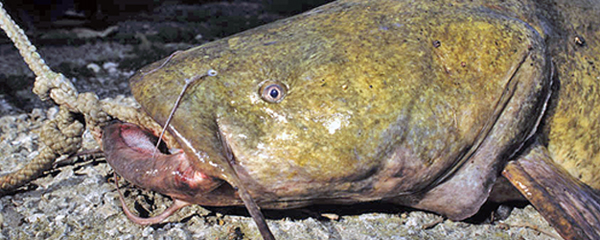
FLATHEAD CATFISH HANDFISHING SEASON RUNS JUNE 15-AUG. 31

The increased popularity of television shows like “Hillbilly Handfishin’,” “Catfishin’ Kings,” and “Mudcats,” proves that handfishing for large catfish can be an exciting and fast-paced sport. Luckily, Kansas is one of June 15-Aug. 31.
Special fishing season offers anglers a
more “hands on” way of catching flatheads
a handful of states that offer this special season. With a special permit, anglers can handfish for flathead catfish in select waters from sunrise to sunset

Commonly referred to as “noodling,” handfishing consists of finding a suspected catfish hole, barricading any possible exits the fish might escape through, using your hands as bait and sticking your arm inside the hole to catch the catfish bare-handed. Although seemingly easy, this sport can prove to be very dangerous for inexperienced anglers.

Adding to the challenge of handfishing, no man-made objects that attract fish, such as a barrel, box, or bathtub may be used. Handfishing anglers are also prohibited from using snorkel or scuba gear, as well as any hooks. A stringer may be used, but not until the catfish is caught by hand and is at or above the water’s surface.

Kansas waters open to handfishing include:
  • the entire length of the Arkansas River,
  • all federal reservoirs from beyond 150 yards of the dam to the upstream end of the federal property, and
  • the Kansas River from its origin, downstream to its confluence with the Missouri River.
Handfishing permits can be obtained for $27.50 at select license vendors or online. Anglers participating in this special season will need to have a handfishing permit in addition to a regular fishing license. New for 2013, handfishing permit-holders are no longer required to complete and submit a questionnaire following the close of the season.
To purchase a handfishing permit online, visit ksoutoors.com and click “License/Permits.”

Friday, June 1, 2012

KDHE Modifies Public Health Advisory for Arkansas River

Downtown Wichita, Kansas, skyline at night fro...
Downtown Wichita, Kansas, skyline at night from The Keeper of the Plains at the Arkansas River (Photo credit: Wikipedia)
Friday work will permanently plug leak at Wichita’s wastewater treatment plant
TOPEKA, Kan.—The Kansas Department of Health and Environment (KDHE) has modified the public health advisory first issued on May 25 for the Arkansas River. Water samples collected by KDHE and the city of Wichita indicate that bacteria concentrations above the 47th Street bridge are safe for recreation. Therefore, KDHE is modifying the current health advisory to include the portion of the Arkansas River from the 47th Street bridge to the state line.

Last week, elevated levels of bacteria were recorded during routine stream sampling by KDHE’s ambient water quality monitoring program. The city then discovered a leak at an intermediate pump station at the wastewater treatment plant. Work crews constructed a temporary fix for the leaking valve, and it has been partially successful. Therefore, the city is implementing a permanent solution that is scheduled to be completed on June 1.

KDHE advises individuals to have no contact with the Arkansas River from the 47th Street bridge in central Wichita to the Oklahoma state line. Residents are also advised to keep their pets and livestock from making contact with the water.

State and local officials will continue working to assess the situation and are committed to minimizing the impact downstream. The affected portion of the Arkansas River is south, or downstream, of Wichita's Riverfest activities, which begin June 1.

KDHE will continue to follow up with water testing to determine when this advisory can be lifted.

Saturday, May 26, 2012

Public Health Advisory Issued for Portion of Arkansas River

English: Map of the Arkansas River watershed i...
Map of the Arkansas River watershed in the south-central United States. (Photo credit: Wikipedia)
Advisory extends from Lincoln Street Bridge in Wichita to Oklahoma state line
TOPEKA — The Kansas Department of Health and Environment (KDHE) has issued a public health advisory for a portion of the Arkansas River due to elevated levels of bacteria discovered during routine stream sampling by KDHE’s ambient water quality monitoring program. KDHE has also confirmed a report of a fish kill in the Arkansas River in areas where there is black, odiferous water.

The health advisory covers a the stretch of the Arkansas River from the Lincoln Street Bridge in central Wichita to the Oklahoma state line.

KDHE advises individuals to have no contact with the Arkansas River between the locations identified above until further notice. Residents are also advised to keep their pets and livestock from making contact with the water.

The cause has not been identified. KDHE is conducting an investigation and will follow up with additional water testing to determine when this notice can be lifted.

Saturday, January 7, 2012

KDHE ISSUES REVISED FISH CONSUMPTION ADVISORIES

Map of USA with Kansas highlighted
Image via Wikipedia

Agency evaluates waters annually
TOPEKA — The Kansas Department of Health and Environment (KDHE), in conjunction with the Kansas Department of Wildlife, Parks and Tourism (KDWPT), has issued revised fish consumption advisories for 2012. The advisories identify types of fish or other aquatic animals that should be eaten in limited quantities or, in some cases, avoided altogether because of contamination.
Fish consumption advisories are formulated using Environmental Protection Agency (EPA) risk assessment methods. Cancer risk assessment is a method to determine the added increase in cancer levels in a human population if fish in the advisory areas are consumed regularly (one 8-ounce serving per week) over a 70-year period. Assessments that estimate the increased risk of cancer as greater than one in 100,000 persons are regarded as unacceptably high. Risk assessments for contaminants assessed as non-carcinogens (mercury, lead, cadmium) are based on 8-ounce serving sizes for adults and 4-ounce serving sizes for children nine to 18 years old. For further technical information, go online to water.epa.gov/scitech/swguidance/fishshellfish/techguidance/
Water body-specific advisories
KDHE provides the following guidelines:
  1. Do not eat bottom-feeding fish (carp, blue catfish, channel catfish, flathead catfish, freshwater drum, bullheads, sturgeons, buffalos, carpsuckers and other sucker species) taken from the Kansas River from Lawrence (below Bowersock Dam) downstream to Eudora at the confluence of the Wakarusa River (Douglas and Leavenworth counties) because of PCB levels;
  2. Avoid eating all forms of aquatic life, including fish, taken from Horseshoe Lake located in units 22 and 23 of the Mined Lands Wildlife Area (Cherokee County) because of perchlorate levels;
  3. Do not eat shellfish (mussels, clams, and crayfish) taken from Spring River from the confluence of Center Creek to the Kansas/Oklahoma border (Cherokee County) because of lead and cadmium levels;
  4. Do not eat shellfish taken from Shoal Creek from the Missouri/Kansas border to Empire Lake (Cherokee County) because of lead and cadmium levels;
  5. Do not eat bottom-feeding fish taken from Cow Creek in Hutchinson and downstream to the confluence with the Arkansas River (Reno County) because of PCB levels; and
  6. Do not eat bottom-feeding fish taken from the Arkansas River from the Lincoln Street dam in Wichita downstream to the confluence with Cowskin Creek near Belle Plaine (Sedgwick and Sumner counties) because of PCB levels.
The state recommends restricting consumption of any species of fish from the following locations:
  1. Little Arkansas River from the Main Street Bridge immediately west of Valley Center to the confluence with the Arkansas River in Wichita (Sedgwick County). Limit of one 8-ounce serving per month for adults or one 4-ounce serving per month for children for all types of fish because of mercury and PCBs;
  2. Blue River from U.S. 69 Highway to the Kansas/Missouri state line (Johnson County). Limit of one 8-ounce serving per week for adults or one 4-ounce serving per week for children for all types of fish because of mercury; and
  3. Kansas counties with current fish consumption advisories include Cherokee, Douglas, Johnson, Leavenworth, Reno, Sedgwick, and Sumner.
General advice for eating locally caught fish in Kansas
  1. Women who are pregnant, may become pregnant, or are nursing and parents of children under twelve years of age may wish to consult with their physician about safe levels of fish consumption and mercury exposure. This sensitive group should restrict their total mercury intake as related to both supermarket fish and locally-caught species. Kansas recommends that this sensitive group restrict consumption of locally-caught fish, from waters not specifically covered by an advisory, to one 8-ounce meal per week for adults or one 4-ounce meal per week for children.
  2. People who regularly consume locally caught fish (more than one meal/week) can reduce their mercury intake by limiting their consumption of large predatory fish such as largemouth bass, walleye, and wiper. Larger/older fish of all types are more likely to have higher concentrations of mercury.
  3. Available data comparing contaminant levels in whole fish versus fillets indicate that higher concentrations of PCBs and some other fat soluble contaminants are associated with whole fish. Kansas recommends avoiding the consumption of parts other than fillets, especially when eating bottom feeding fish.
  4. Consumers can reduce their ingestion of fat soluble contaminants such as PCBs by eating fillets only, trimming fat from fillets, and cooking in a manner in which fat drips away from the fillet.
  5. In water bodies where advisories or warnings related to harmful algae blooms have been applied, fish should be consumed in moderation and care taken to only consume skinless fillets. Avoid cutting into internal organs, and as a precaution rinse fillets with clean water prior to cooking or freezing.
It should be recognized that eating fish is considered an integral part of a healthy and balanced diet. Concerned consumers should educate themselves by seeking further information about the health benefits and risks of eating fish.
Details of monitoring efforts and protocols may be found in the Fish Tissue Contaminant Monitoring Program Quality Assurance Monitoring Plan on the KDHE website at www.kdheks.gov/environment/qmp/download/FTCMP_QAMP.pdf .
Information on the Kansas Fish Tissue Contaminant Monitoring Program can be found at www.kdheks.gov/befs/fish_tissue_monitoring.htm . Advisories are also posted on the KDWPT website at kdwpt.state.ks.us/news/Fishing/Are-My-Fish-Safe-To-Eat .
For further information about mercury in fish, national advisories, and advisories in other states, go to the EPA website at www.epa.gov/fishadvisories/advice .

Wednesday, January 5, 2011

KDHE, KDWP ISSUE REVISED FISH CONSUMPTION ADVISORIES

While most fish is safe, caution urged for certain species, waters
TOPEKA — The Kansas Department of Health and Environment (KDHE) and the Kansas Department of Wildlife and Parks (KDWP) have issued revised fish consumption advisories for 2011. The advisories identify types of fish that should be eaten in limited quantities or, in some cases, avoided altogether because of contamination found in tested fish. It should be recognized that eating fish is considered an integral part of a healthy and balanced diet. Concerned consumers should educate themselves by seeking further information about the health benefits and risks of eating fish.
The water body-specific advisories listed below are based on mercury and polychlorinated biphenyls (PCBs) in fish, lead and cadmium in shellfish, and perchlorate in all forms of aquatic life. Data from most long-term monitoring sites show an overall gradual decline in PCB levels. Although PCBs have not been produced in the U.S. since the 1970s, these compounds degrade very slowly and take decades to be completely removed from the environment. Kansas data show no clear increasing or declining trends in mercury concentrations in fish.
Kansas counties with current fish consumption advisories include Cherokee, Douglas, Johnson, Leavenworth, Reno, Sedgwick and Sumner counties.
Fish consumption advisories are formulated using EPA risk assessment methods. Cancer risk assessment is a method to determine the added increase in cancer levels in a human population if fish in the advisory areas are consumed regularly (one 8-ounce serving per week) over a 70-year period. Assessments that estimate the increased risk of cancer as greater than one in 100,000 persons are regarded as unacceptably high. Risk assessments for contaminants assessed as non-carcinogens (mercury, lead, cadmium) are based on 8-ounce serving size for adults and 4-ounce serving size for children nine to 18 years of age. For further technical information, go online to water.epa.gov/scitech/swguidance/fishshellfish/techguidance/technical_index.cfm.
Waterbody specific advisories
The Kansas agencies recommend not eating specified fish or aquatic life from the following locations:
  • the Kansas River from Lawrence (below Bowersock Dam) downstream to Eudora at the confluence of the Wakarusa River (Douglas and Leavenworth counties) because of PCB levels in bottom-feeding fish (carp, blue catfish, channel catfish, flathead catfish, freshwater drum, bullheads, sturgeons, buffalos, carpsuckers and other sucker species);
  • Horseshoe Lake located in units 22 and 23 of the Mined Lands Wildlife Area (Cherokee County) for all forms of aquatic life including fish because of perchlorate levels;
  • Spring River from the confluence of Center Creek to the Kansas/Oklahoma border (Cherokee County) for shellfish (mussels, clams, and crayfish) because of lead and cadmium levels;
  • Shoal Creek from the Missouri/Kansas border to Empire Lake (Cherokee County) for shellfish because of lead and cadmium levels;
  • Cow Creek in Hutchinson and downstream to the confluence with the Arkansas River (Reno County) because of PCB levels in bottom-feeding fish; and
  • Arkansas River from the Lincoln Street dam in Wichita downstream to the confluence with Cowskin Creek near Belle Plaine (Sedgwick and Sumner counties) because of PCB levels in bottom-feeding fish.
The agencies recommend restricting consumption of any species of fish from the following locations:
  • Little Arkansas River from the Main Street Bridge immediately west of Valley Center to the confluence with the Arkansas River in Wichita (Sedgwick County) — limit of one 8-ounce serving per month for adults or one 4-ounce serving per month for children for all types of fish because of mercury and PCBs; and
  • Blue River from U.S. 69 Highway to the Kansas/Missouri state line (Johnson County) — limit of one 8-ounce serving per week for adults or one 4-ounce serving per week for children for all types of fish because of mercury.
General advice for eating locally-caught fish
  • women who are pregnant, may become pregnant, or are nursing and parents of children under twelve years of age may wish to consult with their physician about safe levels of fish consumption and mercury exposure. This sensitive group should restrict their total mercury intake as related to both supermarket fish and locally caught species. Kansas recommends that this sensitive group restrict consumption of locally caught fish, from waters not specifically covered by an advisory, to one 8 oz. meal per week for adults or one 4 oz. meal per week for children;
  • people who regularly consume locally caught fish (more than one meal/week) can reduce their mercury intake by limiting their consumption of large predatory fish such as largemouth bass, walleye, and wiper. Larger/older fish of all types are more likely to have higher concentrations of mercury;
  • available data comparing contaminant levels in whole fish versus fillets indicate that higher concentrations of PCBs and some other fat soluble contaminants are associated with whole fish. Kansas recommends avoiding the consumption of parts other than fillets, especially when eating bottom feeding fish; and
  • consumers can reduce their ingestion of fat soluble contaminants such as PCBs by eating fillets only, trimming fat from fillets, and cooking in a manner in which fat drips away from the fillet.
Mercury in Kansas, monitoring efforts and results
Since 2004, KDHE and KDWP have been collecting additional fish tissue samples from both lakes and streams to evaluate mercury levels in Kansas fish. KDHE monitors the listed advisory sites, a number of large river sites, and randomly selected stream and river sites throughout the state each year. KDWP collects samples from the 17 largest and most heavily fished/harvested reservoirs every other year and from a number of randomly selected smaller public fishing lakes each year.
Kansas has decided to include new precautionary statements this year regarding mercury because monitoring results from some randomly selected streams and lakes exceed KDHE’s one-meal-per-week threshold. Advisories are normally based on three-year (six-sample) averages and examination of longer term trends. However, randomly-selected stream and lake sites are sampled only once unless randomly selected again and are used to interpret mercury levels geographically instead of on a site-by-site basis. Kansas lacks the resources to conduct follow-up investigations of all randomly-selected sites that exceed the above mentioned consumption thresholds. Follow-up studies are being conducted and will be conducted at locations where preliminary data indicates the occurrence of unusually high concentrations of mercury in fish.
Details of monitoring efforts and protocols may be found in the Fish Tissue Contaminant Monitoring Program Quality Assurance Monitoring Plan on the KDHE website at www.kdheks.gov/environment/qmp_2000/download/2007/FTCMP_QAMP.pdf .
Information on the Kansas Fish Tissue Contaminant Monitoring Program can be found at www.kdheks.gov/befs/fish_tissue_monitoring.htm . Advisories are also posted on the KDWP website, kdwp.state.ks.us/news/Fishing/Are-My-Fish-Safe-To-Eat .
For further information about mercury in fish, national advisories, and advisories in other states, visit the EPA website, www.epa.gov/fishadvisories/advice .
Enhanced by Zemanta