Showing posts with label Smallmouth bass. Show all posts

Wednesday, May 25, 2016

Biologists Take Tissue Samples To Evaluate Bass Stocking Program

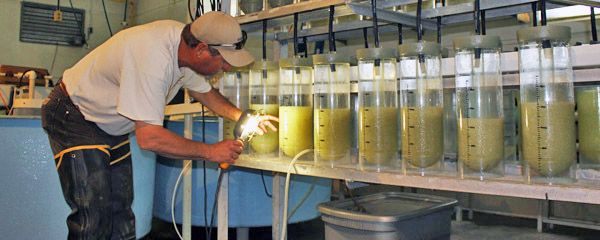
EMPORIA – Fisheries biologists at the Meade Fish Hatchery have been fooling Mother Nature to get largemouth bass to spawn earlier than normal. By controlling water temperature and photo-period (day length), along with other biological factors, hatchery staff are able to create an environment where largemouth bass spawn up to two months earlier than they would in the wild. The fry produced have a huge advantage over naturally-spawned bass because they are large enough to feed on small fish through the spring and summer. By fall, these larger bass are more likely to survive their first winter in a Kansas lake.
So far, early-spawn bass have been stocked into select Kansas reservoirs where bass are popular with anglers but natural reproduction and normal stocking practices aren’t maintaining good bass populations. To evaluate the success of the early-spawn program, fisheries staff have conducted creel surveys to determine if catch rates have improved. In addition, DNA testing of adult bass caught in these lakes will tell biologists what percentage of the bass population is made up of early-spawn fish.
A unique quality of the early-spawn program is that genetic records kept on the brood fish allow each bass produced to be traced back to the hatchery. KDWPT biologists are working with bass tournament organizers to obtain samples from bass brought to tournament weigh-ins at select lakes. Recently, staff worked with the East Kansas Bassmasters club during a tournament on Hillsdale Reservoir where early-spawn bass have been stocked since 2012. Fingernail-sized clippings from the upper caudal fin were collected from fish at the weigh-in before the bass were released. The tissue samples will be tested to determine if they came from fish produced at the Meade Fish Hatchery.  
In the past five years, more than 10 million largemouth bass have been produced and stocked through the early-spawn procedure. The evaluation efforts will help biologists determine the program’s effectiveness in bolstering bass populations, as well as what changes should be made to improve stocking success.

Sunday, May 22, 2016

Master Angler Awards Go To Lucky Anglers

PRATT ­– So, you caught a big fish; was it luck or was it skill? There’s no doubt a little luck never hurts, but good anglers make their own luck by refining their skills, paying attention to environmental conditions and being persistent. And for that, the Kansas Department of Wildlife, Parks and Tourism (KDWPT) wants to recognize them when they catch trophy-class fish.
KDWPT’s Master Angler Award program provides anglers with a certificate when they catch a fish that is at or above the minimum length set for that species. All an angler needs is a tape measure and a camera. Measure the fish, snap a color photo and fill out the application, available in the 2016 Kansas Fishing Regulations Summary or at www.ksoutdoors.com; click on “Fishing” then click on “Special Fishing Programs.”
Minimum lengths are listed for 33 different species of fish in the regulations summary and online. For example, to receive a Master Angler Award for a largemouth bass, the fish must measure at least 23 inches. The color photo allows species identification.
Even if you are luckier than you are good, and you catch that monster bass, send us an application and we’ll mail you a custom certificate suitable for framing. May is one of the best months of the year to catch big fish, so what are you waiting for?

Monday, March 18, 2013

ANGLERS, WALLEYE BENEFIT FROM ARTIFICIAL SPAWNING

Artificial spawning practices produce abundant fish populations
Spring marks the beginning of spawning season for several fish species, but it also marks the start of artificial spawning for walleye. Kansas Department of Wildlife, Parks and Tourism (KDWPT) biologists and culturists will work tirelessly this season artificially producing walleye to stock state reservoirs and lakes.

This highly-prized sport fish naturally spawns during March and April when temperatures reach around 45-50 degrees Fahrenheit. Female walleye will typically lay their eggs in a rocky area during the night, secreting upwards of 300,000 eggs. Although females produce eggs in abundant numbers, less than 5 percent of their young will successfully hatch in the wild due to various environmental factors.

When conditions are right, fisheries biologists will work long hours at select Kansas lakes to capture spawning walleye. Eggs are taken from ripe females, fertilized, then delivered to the Pratt and Milford fish hatcheries where employees work around the clock to ensure the success of the walleye young.

A non-native species to Kansas, walleye were first introduced to Kansas waters in the 1960’s through the KDWPT walleye culture program. In addition to walleye, KDWPT also artificially produces bluegill,channel catfish, crappie, largemouth bass, redear sunfish, sauger, saugeye, smallmouth bass, striped bass, and wipers.

KDWPT also operates hatcheries located at Farlington and Meade, as well as a rearing pond at Woodson State Fishing Lake. These hatcheries produce approximately 39.5 million fry, 3.5 million fingerlings, and 385,000 intermediate fish each year.

For more information on KDWPT hatcheries, visit www.ksoutdoors.com and click “Fishing/Hatcheries.”

Sunday, May 6, 2012

3 Percent of Lakes in Basmmaster Top 100 in Kansas

Transparent PNG of Smallmouth bass (Micropteru...
(Photo credit: Wikipedia)
Perry, Wilson, Keith Sebelius reservoirs listed among best in country; others may be as good or better
PRATT — Bassmaster.com has recently listed three Kansas reservoirs in its list of top 100 bass fishing lakes in the U.S. Perry, Wilson, and Keith Sebelius reservoirs received honors, ranking 60th, 77th, and 87th, respectively. The rankings were determined using information from the Kansas Department of Wildlife, Parks and Tourism’s (KDWPT) annual electro-shocking and angler surveys; B.A.S.S. Federation Nation state presidents’ opinions based on state tournament results; B.A.S.S. Federation Nation conservation directors rankings based on access, stocking practices, and current health of fisheries; and opinions from a blue ribbon panel of experts, including outdoor writers, Elite Series anglers, and fishing industry leaders from across the country.

While this is bodes well for Kansas anglers, there may be even better news. 2012 is stacking up as a great year for Kansas bass anglers statewide.
“We have a tremendous smallmouth bass fishery at Coffey County Lake, too” says Doug Nygren, KDWPT Fisheries Section chief. “LaCygne Lake will rival any lake in the state for big largemouths. But Sebelius may be our best because it has smallmouth, spotted, and largemouth bass. And many of our small- to medium-sized lakes always have great bass fishing.”
“Anglers know that great bass fisheries are not created in one year,” adds Kyle Austin, KDWPT’s hatchery system supervisor. “The past three or four years have been very good for bass fisheries in Kansas lakes. We’re in really good shape.”
Nygren agrees. “This is going to be an above-average year for bass in our reservoirs.”
So whether you’re fishing one of the Bassmaster.com Top 100 or one of the state’s many other great bass lakes, this should be a an outstanding year for Kansas bass anglers. For a sneak peek at the top lakes in the state this year, go online to the KDWPT website, ksoutdoors.com, and click “Fishing/Fishing Forecast.” Now go fish.