Showing posts with label Crappie. Show all posts

Thursday, April 30, 2015

Crappie Days Are Here Again

Pomoxis nigromaculatus
\
 If someone wishes you a “crappie day” this time of year and you’re an angler, you accept that wish with a smile. It’s a good thing. Crappie anglers wait all year for late April and early May when water temperatures in Kansas lakes warm to the high 50s and low 60s. That brings one of our most popular sport fish to shallow water to spawn, making them available to anglers of all ages and skill levels. And crappie are popular because they may be the tastiest fish in our waters.

Spring is the only time of year when anglers fishing from shore or wading might have an advantage over boat anglers. When the spawn gets going, crappie can be caught in water as shallow as 2 feet, depending on the clarity. And since the fish will be concentrated in shallow areas with specific habitat, anglers often catch good numbers of fish on a single outing.
What’s good crappie habitat? Crappie like cover such as brush, cattails, flooded weeds or rocky areas. Rip-rap dams and jetties are perfect places to start fishing. 

Crappie anglers prefer light tackle – spinning or spincast outfits rigged with 6- or 8-pound test line. A long, light-action rod is perfect for detecting soft strikes and working hooked crappie out of cover. Often called “paper mouths,” crappie have thin skin along their top jaw and can’t be “horsed” out of the cover without the hook pulling out.
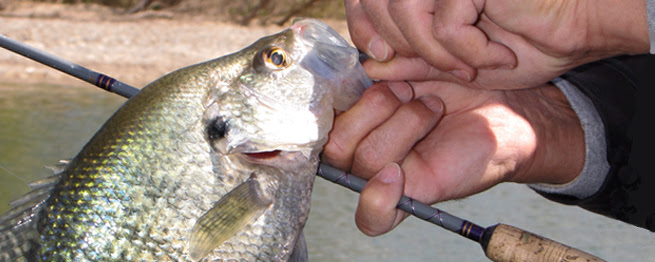
Small white or chartreuse jigs or minnows are effective baits. The trick is getting your lure or bait in or close to the cover without spooking the fish or snagging up. One tried and true method is referred to as “doodlesocking,” which is simply dipping your bait vertically into the cover. The jig or minnow is worked slowly or held suspended 6 inches or a foot off the bottom before it is lifted straight up and repositioned. An 8-foot fly rod rigged with a spinning reel allows added reach and can be perfect for doodlesocking. Strikes are usually a “tap,” felt as the jig is held suspended. The angler must set the hook quickly and lift the fish straight up out of the cover.

Another popular method is to rig a small float 2 feet above the jig or minnow. The float can be cast along the brush or rocks and allowed to bob and drift with the breeze. Strikes can be subtle, often just moving the float or pulling it just below the surface.

The crappie spawn usually starts in the upper ends of reservoirs, with fish congregating in small coves and inlet creeks. The spawn will continue down the lake as water warms in the lower reaches. This can extend the spawn through the end of May.

According to the2015 Fishing Forecast, the top three reservoirs for crappie fishing this spring are John Redmond, Perry and Hillsdale. But don’t avoid your favorite fishing spot if it’s not high on the forecast’s list. Remember that the spawn season concentrates crappie in specific areas, so good fishing can still be found in lakes with only fair crappie populations.
You’ll find great fishing information on the Kansas Department of Wildlife, Parks and Tourism’s (KDWPT) website,www.ksoutdoors.com, including a full-length how-to video “Kansas Crappie Bonanza.” You can also keep track of lake temperatures and conditions, as well as angler success through the Weekly Fishing Reports.

The statewide creel limit for crappie is 50 fish per day. However, local creel and length regulations may vary, so be sure to consult of the2015 Kansas Fishing Regulations Summarywhere you’ll find a complete listing of Kansas lakes with special regulations. The regulation pamphlet is available at all KDWPT offices, license vendors and online.

Monday, May 28, 2012

HORTON MISSION LAKE EAST RENOVATION COMPLETE

Micropterus salmoides
 (Photo credit: Wikipedia)
Revitalized fishery, improved water quality, new facilities enhance lake
HORTON — Renovation of Horton Mission Lake East (½ mile north of Highway 20 on the east edge of Horton) is complete, and it is time to get out and enjoy this revitalized fishery. Mission Lake was opened to fishing on May 23.
Since the fishery was cleaned out last August, several thousand fish have been stocked, including fathead minnows, bluegill, black crappie, and largemouth bass. Some of these were smaller hatchery fish; however, a good portion were adults that were relocated from surrounding waters.
Is there a keeper fish behind every clump of vegetation or in every new brush pile? Probably not, but when Kansas Department of Wildlife, Parks and Tourism (KDWPT) biologists sampled the lake in mid-May, they saw a healthy young fishery. And since the renovation, water clarity has improved to more than 4 feet, much better than the 4-7 inches the lake used to have.
In addition to improving the fishery, staff have made several new additions to lake facilities, including a concrete boat ramp, courtesy dock, several fishing piers, two fish feeders, and several new campsites with electrical hookups.

Monday, May 7, 2012

Crappie in the Shallows

Pomoxis nigromaculatus
(Photo credit: Wikipedia)
Warming water lures fish to shallows; online video details best angling techniques
PRATT — The Kansas crappie spawn is one of the most exciting times of the year for many Kansas anglers. In response to warming April weather, breeding fish are moving into lake shallows, and anglers are already catching them as they move to spawning waters close to shore. This concentrates the fish and makes great fishing for boaters and shore anglers. Reservoirs from Glen Elder in the northwest, Perry and Tuttle Creek in the northeast, Cheney in the southcentral, and LaCygne and Melvern in the southeast are reporting crappie caught in shallow water, according to the Kansas Department of Wildlife, Parks and Tourism’s (KDWPT) Fishing Reports web page, the most currently-recorded biologists' fishing reports

Crappie move to shallow areas when water temperatures reach the mid-50s and wait to spawn at water temperatures of 60-65 degrees. They may spawn as shallow as 2 feet deep and are most active at dawn and dusk, when light levels are low. Look for spawning fish near vegetation, brush, and rocky gravel shorelines.
Live minnows are good crappie bait, especially during cool spells when fish are less active. Hook the minnow just under the dorsal fin to keep it lively. Use a bobber to set depth, and keep a minnow near structure where the fish are hiding.
When crappie are most active, small, colorful jigs can produce even better catches. Small spoons, spinners, or crankbaits can be effective, as well. For the avid fly fisherman, crappie present a welcome challenge and bite well on a variety of flies. Those that imitate minnows and nymphs are best.
Most crappie anglers use ultralight spinning gear because the fish generally weigh less than a pound. Monofilament line of 4- to 6-pound test allows an angler to cast tiny jigs and provides better feel for light bites. A slip bobber or float can help keep a small jig at just the right depth and might help avoid snags.
Spawning crappie are easily frightened by noise, so approach shallow fishing spots quietly. Some anglers use 8- to 10-foot rods, wading and dipping a jig in a technique known as "doodlesocking." Dipping the jig in partially-submerged timber and brush, the doodlesocker can fish from spot to spot without spooking the fish. This is an effective method when crappie are in water about 3 feet deep or shallower.
For visual tips on crappie fishing year-round, the 25-minute video, Kansas Crappie Bonanza, will help crappie anglers be more successful. Available to view free of charge on the KDWPT website, ksoutdoors.com/crappie-video, the video shows basic fishing strategies for any season and provides ample advice and tips from crappie guides and fishing experts on how to catch crappie anytime. Although weather is incorporated into the different strategies, the video focuses on the fun of crappie fishing no matter what the weather.
For anglers fishing for food, it doesn't get any better than spring crappie fishing. This year, the top crappie reservoirs include Lovewell, Hillsdale, Melvern, Big Hill, and Perry. The best small lakes include Cedar Lake in Olathe, Hargis Creek Lake in Wellington, Scott State Fishing Lake, Carbondale City Lake East, and Polk Daniels Lake in Howard.
For more information on crappie fishing prospects, go to the KDWPT website, www.ksoutdoors.com, and click “Fishing.” Reservoir ratings for both black and white crappie may be found under Fishing Forecast. Anglers can report their own experiences and read those of others on the department's Public Fishing Reports page. Water temperatures typically vary from north to south in Kansas, so movement may begin later in some of the state's northernmost lakes.
Because they are prolific in most Kansas waters, crappie creel limits are liberal — in most places, 50 fish per day. Some lakes have more restrictive length and creel limits. Check the 2012 Kansas Fishing Regulations Summary, available wherever licenses are sold, or the KDWPT website for details. Fishing conditions may vary depending on weather, particularly storms and heavy run-off. For up-to-date information on lake conditions, go to "Where To Fish In Kansas" on the KDWPT website, simply type fishks.org in your browser.

Tuesday, February 21, 2012

KDWPT TO RELEASE FREE CRAPPIE FISHING VIDEO

Pomoxis nigromaculatus
Image via Wikipedia

Online video reveals all the secrets of catching the state’s favorite panfish
PRATT — A new video, Kansas Crappie Bonanza, will be released by the Kansas Department of Wildlife, Parks and Tourism (KDWPT) on Feb. 17 to show anglers how to catch crappie throughout the year in the Sunflower State. Although this popular panfish is pursued most actively in springtime, crappie provide a great angling opportunity year-round, even through winter ice.
Both entertaining and educational, the 25-minute video shows basic fishing strategies for each season and provides ample advice and tips from crappie guides and fishing experts on how to catch crappie anytime. Although weather is incorporated into the different strategies, the video focuses on the fun of crappie fishing no matter what the weather.
Produced by outdoor videographer and photographer Gene Brehm, with assistance from the KDWPT Fisheries Division video committee, Kansas Crappie Bonanza will help all crappie anglers be more successful in pursuit of this abundant sport fish. On Feb. 17, the video will be available to view free of charge on the KDWPT website,ksoutdoors.com/crappie-video. A limited number of DVD copies of the video are available free on a first-come, first-served basis from district fisheries biologists and KDWPT offices.
Crappie can be found in most waters in Kansas, from large reservoirs to small farm ponds and streams, in both urban and rural settings. As table fare, many rank crappie among the best freshwater fish, and with a 50-fish per day creel limit at most lakes, honing crappie fishing skills is a great way to provide the family with a banquet fit for a king.

Sunday, October 23, 2011

ANGLERS TACKLE FALL FISHING

P. annularisImage via Wikipedia

Lull between hunting seasons a great time to be on the water
PRATT — Before long, the Kansas hunting seasons will be in full swing, but there’s still time to enjoy some excellent fishing. There’s a lull after the fast action of the opening dove, early teal, and youth deer and duck seasons, but avid outdoorsman are still itching to get out. This is a time of year when many take advantage of hungry fish, feeding continually in preparation for a long winter. Fall is a great time to be outdoors.

In the state’s larger lakes and reservoirs, gizzard shad are the preferred prey of most sport fish. In the fall, young-of-the-year shad are about 2-3 inches long, and a white or chrome, fat-bodied crankbait is the perfect imitation of a gizzard shad. Cast a deep- or medium-diving crankbait along rocky points and rip-rapped shorelines, and retrieve it quickly, so it gets near the bottom and bounces off the rocks. A deep-diving crankbait may be the best choice even when fishing relatively shallow water. The lure’s long lip deflects off rocks and other snags, and this action can trigger strikes. If the lure does hang up, give it some slack, and it will often float free. Using light monofilament or a small-diameter braided line will allow a crankbait to dive deeper.

Later in fall, when water temperatures cool to the low 50s or high 40s, it’s time to catch Kansas crappie. Reservoir crappie congregate in large schools over deep brushpiles and creek channel dropoffs at this time. Jigs or jigging spoons fished vertically in 12-25 feet of water are most effective. If too many small crappie are biting, try a larger jig with a 2- or 2 1/2-inch shad-type plastic body. The larger bait will more closely resemble shad and may discourage smaller fish. When concentrations of crappie and white bass are found, use landmarks or GPS to mark their location. If the state experiences a frigid winter and safe ice forms, you can return to the spots that held fish before freeze-up and catch them through the ice.

Even though autumn weather may be mild, always wear more layers of clothing than you think necessary when fall fishing. No matter how warm it feels on land, it will be much cooler on the water, especially if the wind blows. And don’t forget to wear a life jacket; it will keep you warm and may save your life.

Sunday, September 11, 2011

KDWPT BRINGS OUTDOORS TO STATE FAIR SEPT. 9-18

Channel catfish (Ictalurus punctatus) may be f...Image via Wikipedia
Aquaria, taxidermy, cabin, tourism information highlight exhibits this year
PRATT — The 2011 Kansas State Fair — Sept. 9-18 — offers a wide variety of sights, sounds, food, music, and other entertainment, but the Kansas Department of Wildlife, Parks and Tourism (KDWPT) brings a different kind of wild outdoor and travel experience to the fair. The KDWPT exhibit, located in the Eisenhower Building (north of the administration building and train station), gives fairgoers a chance to see replicas of state record fish and deer mounts, an aquatic nuisance species (ANS) display, aquaria teeming with dozens of fish species, and live snakes. Natural resource officers and staff from KDWPT education centers will be on hand to answer questions.
KDWPT’s mobile aquarium will set up next to Gate 9, on the southeast corner of the fairgrounds. The 40-foot long aquarium holds 3,200 gallons and displays many Kansas sportfish and nongame fish, including largemouth bass, smallmouth bass, spotted bass, white bass, striped bass, hybrid striped bass (wiper), bluegill, green sunfish, longear sunfish, channel catfish, blue catfish, flathead catfish, buffalo, common carp, walleye, sauger, saugeye, redear sunfish, black crappie, white crappie, longnose gar, spotted gar, and freshwater drum.
Viewers have a special chance to see native live fish up close, and fisheries biologists are on hand to answer questions and demonstrate fishing techniques from the aquarium’s casting platform.
KDWPT also has a cabin on the fairgrounds, near Lake Talbot. This cabin is much like those available for rent at Kansas state parks and wildlife areas, and visitors may enter a drawing for free cabin weekends. Governor Sam Brownback will be on hand to draw the lucky winners for free weekend cabin stays on Thursday morning, Sept. 15. More than 90 cabins are now available at 20 state parks and five wildlife areas, offering visitors comfortable, convenient accommodations.
Kansas Tourism and KANSAS! magazine will share a booth in the Pride of Kansas Building (located west of the administration building). Visitors to the booth will have the chance to pick up a free copy of the 2011-12 Official Kansas Visitors Guide, sign up to win a basket of Kansas goodies, subscribe to KANSAS! and more. Most days a representative from a “Spotlight Community” will be present in the booth with information on what there is to see and do in their Kansas community. Fair attendees can learn more about products, places and things covered in KANSAS! from special guests who will be featured in the booth.
For more information on the KDWPT State Fair exhibit, phone 620-672-5911. For information about the Kansas Tourism exhibit, phone 785-296-2281.