Saturday, April 18, 2015

Free Entrance At Kansas State Parks April 25


 In today’s world when we hear the word “free,” we sometimes associate it with something that is low quality or that comes with a catch. However, the Kansas Department of Wildlife, Parks and Tourism is offering something free that bucks both of these notions. If you’re looking for a quality family activity that doesn’t cost money and doesn’t come with strings attached, take advantage of the Kansas State Parks Free Park Entrance events April 25. 
On this day, families can visit any Kansas State Park without the purchase of a daily vehicle permit, and a variety of parks will be hosting open houses, allowing visitors to also tour cabins and other facilities. If that’s not incentive enough, select parks will be providing additional family-friendly activities on-site such as guided hikes, animal displays, prize drawings, fishing and archery tournaments, 5k races, and more.

To plan your state park visit, visit ksoutdoors.com and click on the “Event Calendar” for a list of state park locations, contact information, and details on activities offered. All park offices will be open but schedules are subject to change without notice. 

Visitors can purchase annual camping permits and make cabin or campsite reservations during the open houses, as well. For pricing information and to purchase permits online at ksoutdoors.com. For online permit purchases, click “License/Permits.” For campsite and cabin reservations, click “Reservations.”

Friday, April 17, 2015

Young Wildlife Rarely Need “Saving”


 You’re mowing your lawn when you notice something moving in the grass. You stop the mower and peer over to find it’s a nest of young rabbits, and the mother is nowhere in sight. Fear sets in that they may not make it through the night and you begin to devise a plan to “rescue” them. It’s a mistake that many well-intentioned people make, and unfortunately, it usually results in the premature death of the wildlife being “saved.”

The notion that a young animal found in the wild will die if not given care is wrong. In most cases, the mother is typically feeding nearby, keeping a distant eye on her offspring. Not only are most young found in the wild not abandoned, picking them up is against the law. The Kansas Department of Wildlife, Parks and Tourism and the Kansas Department of Health and Environment have regulations against such activity that can result in a fine up to $1,000 or more. In addition to legal repercussions, wild animals can pose a number of health risks, including diseases such as distemper, rabies, Lyme disease, roundworms, tapeworms, mites, and tularemia.

Additionally, if a “rescued” animal were to bite someone, it must be put to death and tested for diseases. Even if they don't bite, the young usually fail to survive in captivity because most people are not equipped to handle wild animals, especially as they mature. On the off chance the animal does survive in captivity, it typically loses instincts that allow it to survive in the wild.

It is important to remember that although young wildlife may be cute, they belong in the wild. Wild animals cannot legally be inoculated by veterinarians, and few people really know how to care for them.

If you should see a young animal in the wild this spring or summer, observe at a distance and consider yourself lucky. But remember, just because they appear alone, that doesn’t mean they are abandoned.

If you really want to help, leave young in the wild where they were born and belong. 
If you find an injured animal, a list of licensed rehabilitators can be found at ksoutdoors.com, by clicking "Services/Rehabilitation.”

Thursday, April 16, 2015

KDWPT’s Jennifer Rader Receives Rising Star Award


Jennifer Rader, director of Kansas Department of Wildlife, Parks and Tourism’s Southeast Kansas Nature Center, was presented with the Kansas Association for Conservation and Environment Education (KACEE) Rising Star Award. The award, presented on April 10 at KACEE’s Environmental Education Awards Celebration in Manhattan, recognizes individuals who are new to the Kansas conservation and environmental education field but are already making an impact. Rader was hired by KDWPT to direct the nature center in Galena in 2013.

Rader’s parents, Mike and Ellen Rader, instilled in her a love for nature very early in life. As a young girl, she volunteered in outdoor events at Wilson State Park such as Eco-Meets and OK Kids Days. After graduating from Fort Hays State University in 2008, Rader worked in environmental education and took a leading role in developing innovative and engaging programs, including Kansas Wildscape’s Wildlifers program. The Wildlifers program encourages kids to earn “badges” by completing certain outdoor and wildlife-related tasks.
As director of the Southeast Kansas Nature Center, Rader uses her passion for wildlife and her creativity to reach people of all ages. She hosts preschoolers for story time, local school classes, and community groups.

Linda Phipps, the founder of the nature center notes about Jennifer, "I have seen seasoned nature lovers listen to every word she has to share. Every time I am around Jenn, I learn something new. She has a genuine love for and curiosity about nature and conservation and she shares that with everyone she meets.”

KACEE is a statewide nonprofit association of many public and private agencies, organizations, businesses and individuals that promotes and provides effective, non-biased and science-based environmental education for all Kansans. 

Wednesday, April 15, 2015

Volunteers Sought For Kansas State Parks Clean-up Days


 If you’re looking to gain volunteer service hours, are wanting to give back to your community, or are just needing a good excuse to spend productive time outside, consider volunteering for one of the “Keep It Clean Kansas” events. Hosted by the Kansas Department of Health and Environment (KDHE), Kansas Department of Wildlife, Parks and Tourism (KDWPT), and Westar Energy, the one-day events will consist of volunteers collecting trash and recyclable materials at one of five Kansas state parks from 8 a.m. to 11 a.m. in recognition of Earth Day.
The five state parks chosen for 2015 include: Cedar Bluff, El Dorado, Elk City, Lovewell, and Perry.
Volunteers are asked to preregister at www.kdheks.gov/waste/earthday.html. Trash sacks and gloves will be provided on location. Apart from the satisfaction of doing a good deed, volunteers can also enjoy a complimentary lunch and take home a commemorative event t-shirt.
For more information, or to register, visit www.kdheks.gov/waste/earthday.html.

Friday, February 20, 2015

THREE MUST-HAVE TOOLS FOR ANGLERS THIS SEASON

Fishing is one part luck, two parts preparation
PRATT – Fishing is an art, and although it requires a little bit of luck, most great fishing experiences are a result of prior planning and research. The Kansas Department of Wildlife, Parks and Tourism (KDWPT) has three must-have angling tools this season that will help you determine what fish are out there, where to catch them, and how to do so lawfully.
Enhance your fishing experiences this season by investing your time with these publications:
2015 Fishing Forecast
If you want to know what fish are out there for catching, consult the 2015 Fishing Forecast. Compiled with data gathered through fisheries biologists’ sampling efforts, the free forecast provides anglers with up-to-date information on what lies beneath the water’s surface. Brochures are available at KDWPT offices, as well as online atksoutdoors.com/fishing. In addition to what species of fish can be caught at any given body of water, the forecast also includes tables with Density Ratings, Preferred Ratings, and Lunker Ratings, as well as information on the Biggest Fish sampled, Biologist’s Ratings, and a Three-Year Average of popular species. Anglers can use the forecast to find lakes that provide the fishing opportunities they desire. For example, if you enjoy catching and eating channel catfish, you can select a lake with a high Density Rating, which is the number of channel catfish at least 16 inches long caught per sampling effort. If you’re only after trophy-sized catfish, you can select a lake with a high Preferred Rating, which is fish longer than 24 inches or a high Lunker Rating, which is fish longer than 28 inches.
A copy of the 2015 Fishing Forecast can also be seen in the March/April issue of Kansas Wildlife & Parks magazine. To become a subscriber, call toll-free (866) 672-2145, or visit ksoutdoors.com/Services/Publications/Magazine.
2015 Kansas Fishing Atlas
Knowing where to drop a line can be tricky, but the 2015 Kansas Fishing Atlas removes the guesswork. The free, 84-page atlas provides anglers with maps pinpointing public fishing areas, as well as public lands across Kansas. These maps also include Fishing Impoundment and Stream Habitats (F.I.S.H.) areas, or privately-owned ponds or streams KDWPT has leased and opened to public fishing. F.I.S.H. sites are labeled by an abbreviated access period, size, and boating restriction for each location, so refer to the atlas prior to fishing. Each map also shows all federal reservoirs, state fishing lakes, river access areas, and community lakes, making the question of “where to fish” just that much easier to answer.
The atlas is currently available online at ksoutdoors.com. Printed copies will be available shortly wherever licenses are sold.
2015 Kansas Fishing Regulations Summary
After you’ve decided what species to fish for and where to find them, refer to 2015 Kansas Fishing Regulations Summary for information on regulations changes for the new season, creel and length limits, permit requirements, and more. Copies can be obtained at no cost online at ksoutdoors.com/fishing, and at any license vendor.
For more on Kansas fishing, visit ksoutdoors.com/fishing.

Thursday, February 19, 2015

ONE IN THREE DEER HUNTERS TO RECEIVE E-MAIL SURVEY

Effective deer management requires hunter participation in surveys
PRATT – One third of the hunters who pursued deer during the 2014-2015 season will be randomly-selected to receive an e-mail survey from the Kansas Department of Wildlife, Parks and Tourism (KDWPT) this month. Because biologists depend on the data gathered to make deer management recommendations, hunter participation in completing the survey in its entirety is crucial to ensure data is statistically-valid.
“Some people reply back and tell us they killed a doe or got a 10-point buck and think that is all we really need. That is not the case,” said KDWPT big game biologist, Lloyd Fox. Fox explained that KDWPT wants to know about multiple aspects of the hunt in order to gain a clearer picture of the men and women who hunt deer and the impact of hunting on the resource.
The survey, which is conducted every year, gathers a variety of information from deer hunters including: harvest success, dates and seasons hunted, days spent in the field, locations hunted, choice of equipment during the 2014-2015 seasons, opinions on current deer populations, and more.
Even if a hunter did not harvest a deer, they are still encouraged to complete the survey.
For more information on Kansas deer hunting, visit ksoutdoors.com and click “Hunting / Big Game Information / Deer.”

Saturday, February 7, 2015

Legislative News

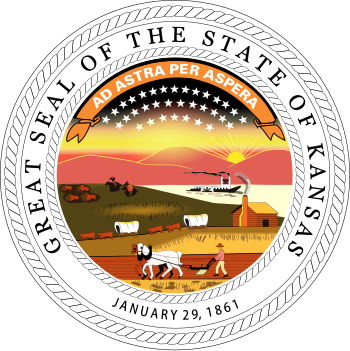
The Great Seal of the State of Kansas
The Great Seal of the State of Kansas (Photo credit: Wikipedia)
2015 Bills

SB46 -- This bill would require domesticated deer that enter a premises alive or leave a premises alive or dead for any purpose, other than for direct movement to a licensed or registered slaughter facility in Kansas, have official identification, as prescribed by rules and regulations of the animal health commissioner. The bill passed out of the Senate Committee on Agriculture.

SB50 -- This bill would amend K.S.A. 79-1439, which deals with property tax valuation classification of bed and breakfast properties. The proposed amendment would allow outbuildings or adjacent properties to be included as long as the total number of bedrooms does not exceed five. This bill was referred to the Senate Committee on Assessment and Taxation.

SB97 -- This bill would amend K.S.A. 32-1301 which regulates contact with dangerous animals. The amendment would allow clouded leopards and certain dangerous animals weighing 25 pounds or less full physical contact with members of the public and incidental contact with the public for animals weighing 40 pounds or less.This bill was referred to the Senate Committee on Natural Resources and has a hearing scheduled on Wednesday, Feb. 4, 8:30 a.m., RM 159-S.

SB112 -- This bill amends K.S.A 32-1049, relating to violations of wildlife, parks and tourism laws to clarify that county attorneys can file charges without a written citation. The bill was referred to the Senate Committee on Judiciary.

SB113 -- This bill amends K.S.A. 32-1001, relating to  KDWPT licenses, permits, stamps, specifying that only physical licenses, permits or stamps shall be surrendered under judges' orders of forfeiture or suspension. This amendment is proposed to prepare for the advent of electronic licensing. The bill was referred to the Senate Committee on Judiciary.

SB120 -- This bill would amend K.S.A. 32-833, relating to land purchases by KDWPT, to exempt lands purchased with Natural Resource Damage Restoration Funds from required legislative approval. The bill was referred to the Senate Committee on Natural Resources.

HB2029 -- This is the companion bill of SB46 regarding identification of domesticated deer. The bill was referred to the House Committee on Agriculture and Natural Resources and had a hearing on Jan. 27.

HB2116 -- This bill would designate the channel catfish as the official fish of the state of Kansas. The department supports this bill. The bill was referred to the House Committee on Agriculture and Natural Resources.

HB2117 -- This will would require anyone born on or after January 1, 1995 to complete an approved boater safety education course before operating a motorboat or sailboat on Kansas waters. The current law only requires boater safety education of boaters younger than 21. The department supports this bill. The bill was referred to the House Committee on Agriculture and Natural Resources.

HB2168 -- This is the House companion bill for SB50, which would allow outbuildings or adjacent properties to be classified as a bed and breakfast for tax valuation purposes. This bill was referred to the House Committee on Taxation.

House Concurrent Resolution No. 5008 -- This resolution would amend the state constitution to guarantee Kansas residents the right to hunt, fish and trap wildlife. If approved by two-thirds of the Senate and House, the proposed amendment would be voted on in a November general election.